Why Home Exercise Works - Even Without Equipment
The assumption that meaningful exercise requires a gym membership, machines, or specialized gear is one of the most persistent barriers to getting started. In reality, your own bodyweight is a legitimate and well-studied tool for building strength, improving cardiovascular fitness, and supporting overall physical health.
Bodyweight training works because it uses gravity and body position to create resistance. A push-up recruits the same chest and tricep muscles as a bench press. A squat loads the same quads and glutes as a leg press. The absence of added weight simply means you're working with what you already have - which, for most beginners, is enough challenge to prompt real adaptation.
If your daily life involves long hours sitting, weaving in structured home movement can help offset some of that sedentary time. For more on integrating movement into a desk-heavy schedule, see our guide on building an active routine when you sit at a desk all day.
Bodyweight training
Exercise that uses your own body mass as resistance, rather than external weights or machines. Push-ups, squats, and planks are common examples.
Progressive overload
Gradually increasing the challenge of exercise over time so your body continues to adapt. At home, this might mean doing more repetitions, slowing down the movement, or trying a harder variation.
DOMS
Delayed onset muscle soreness - the muscle ache that typically peaks 24-48 hours after unfamiliar exercise. It's a normal response to new physical stress, not a sign of injury.
Movement pattern
A category of physical motion - like pushing, squatting, or hinging - that groups exercises by how the body moves rather than by muscle name.
Core stabilization
Exercises that train the muscles of the trunk to hold a stable position, rather than moving through a range of motion. Planks are a well-known example.
Setting Realistic Expectations From the Start
One of the most common reasons people abandon new exercise habits within the first few weeks is misaligned expectations. It's worth being honest: beginners typically don't feel significantly fitter after one or two sessions. Physical adaptation - improved strength, endurance, coordination - takes weeks of consistent effort to become noticeable.
What you can expect early on is a sense of accomplishment from showing up, some muscle soreness after novel movements (a normal response called delayed onset muscle soreness, or DOMS), and gradually improving ease with the same exercises over time.
It's also worth understanding that home exercise and formal gym training aren't competitors - they're different tools. If your goal is general health and consistent movement rather than competitive performance, home-based bodyweight training is a fully capable approach. And if you're someone who genuinely struggles with the idea of structured workouts, there are other valid entry points - our article on fitness for people who dislike exercise covers practical alternatives.
Core Movement Patterns You Can Practice at Home
Rather than memorizing a long list of exercises, it helps to think in terms of fundamental movement patterns. Most human movement - and most effective exercise - fits into a handful of categories:
- Push: Moving weight or your body away from a surface. Push-ups (and their many variations - incline, knee-supported, wide-grip) are the primary home example.
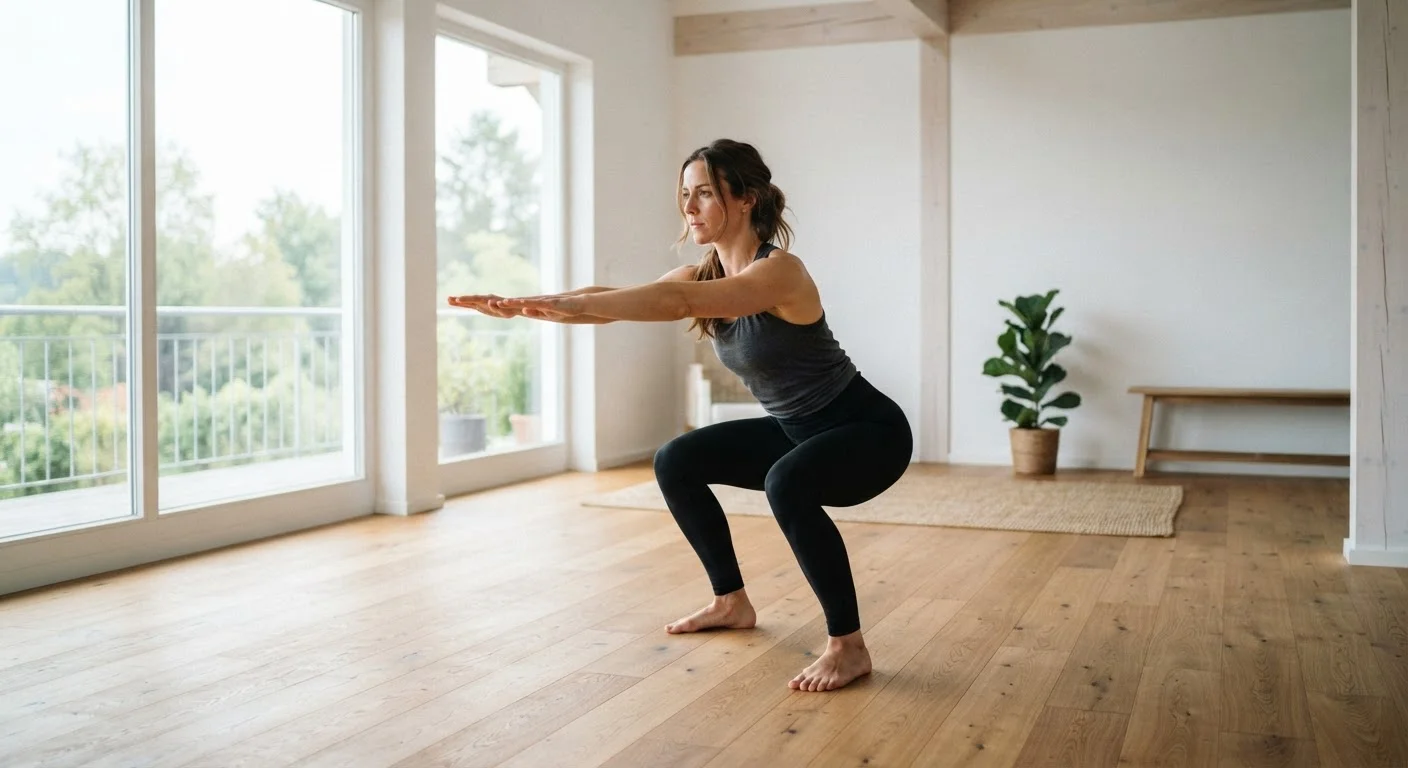
- Squat: Bending at the knees and hips to lower and raise your body. Bodyweight squats, sumo squats, and wall sits all qualify.
- Hinge: Folding at the hips with a relatively straight back. Glute bridges and single-leg deadlift mimics fall here.
- Lunge: Stepping movements that train each leg independently. Forward, reverse, and lateral lunges each emphasize slightly different muscles.
- Core stabilization: Exercises that resist movement rather than create it. Planks, dead bugs, and bird dogs are classic examples.
You don't need to master every variation immediately. A beginner can build a complete, balanced routine from just one or two exercises per category.
Start With What You Can Already Do
If a standard push-up is currently too difficult, an incline push-up against a countertop or wall is a legitimate starting point - not a modification to be ashamed of. Meeting yourself where you are and progressing from there is exactly how effective training works. There's no minimum fitness level required to begin.
How to Structure a Simple Routine
Structure is what turns isolated exercise moments into a routine. For beginners, simplicity is a feature - not a shortcut. A straightforward session might look like this:
- Warm-up (5 minutes): Light movement to raise your heart rate and loosen your joints. Marching in place, arm circles, or hip rotations work well.
- Main work (15-20 minutes): Choose three to five exercises covering different movement patterns. Perform each for a set number of repetitions or a timed interval, rest briefly, and move on.
- Cool-down (5 minutes): Gentle stretching focused on the muscles you worked. Hold each stretch for 20-30 seconds without bouncing.
Two to three sessions per week with rest days in between is a manageable starting point for most adults. Movement doesn't have to be an all-or-nothing endeavor - even brief, consistent sessions add up. If you're curious about how everyday, non-workout movement contributes to health, our article on NEAT and everyday movement is a useful companion read.
Common Pitfalls and How to Avoid Them
A few patterns reliably derail new home exercisers. Knowing them in advance can help you sidestep them:
- Doing too much too soon: Starting with ambitious sessions often leads to excessive soreness or fatigue that makes the next session feel daunting. Beginning conservatively and progressing gradually is more effective long-term.
- Skipping recovery: Rest days aren't laziness - they're when your body adapts to the stress of exercise. Exercising every day without adequate recovery can increase injury risk and reduce motivation.
- Treating missed sessions as failure: Missing a workout is normal. The relevant metric is the pattern over weeks and months, not any single day. Returning after a break is always the right move.
- Ignoring discomfort signals: General muscle fatigue during exercise is expected. Sharp, joint-specific, or persistent pain is not - stop the activity if something feels wrong, and consult a healthcare professional if symptoms continue.
Home exercise is accessible precisely because it removes many external barriers. Keeping the routine simple enough to maintain on your lowest-energy days is one of the most underrated strategies for long-term consistency.
This article is for general informational purposes only and is not a substitute for professional medical advice. If you have any health concerns or conditions, consult a qualified healthcare professional before beginning a new exercise program.