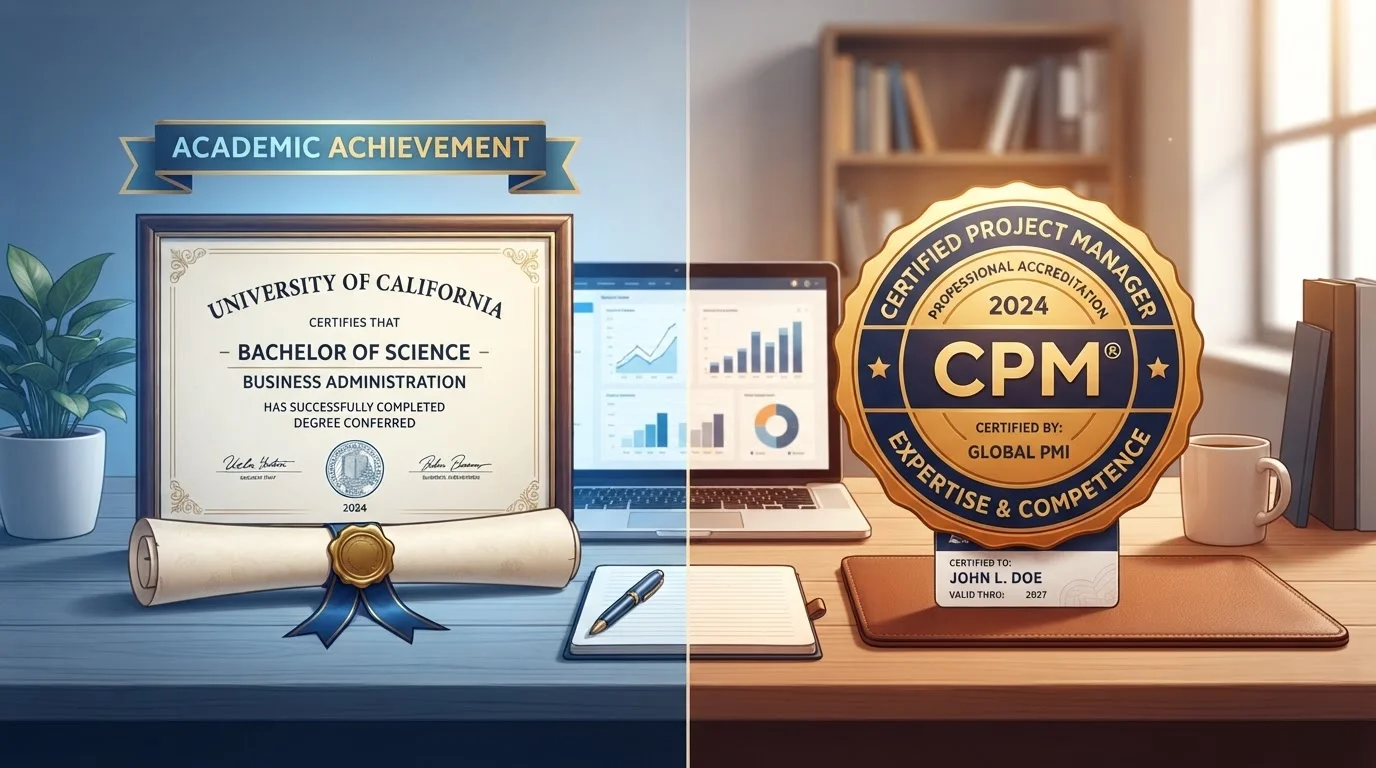
Understanding the Core Difference
An online degree is an academic credential awarded by an accredited college or university after completing a prescribed curriculum - typically an associate's, bachelor's, or master's program. It signals broad, theory-grounded preparation in a discipline and is issued by an institution whose accreditation status is recognized by employers, licensing boards, and graduate programs.
A professional certification, by contrast, is a credential issued by an industry body, professional association, or vendor that validates competency in a specific skill or role. Examples include the Project Management Professional (PMP), CompTIA Security+, or AWS Certified Solutions Architect. Rather than demonstrating breadth, certifications confirm that a credential-holder meets a defined performance standard in one domain.
The distinction matters because employers, licensing bodies, and graduate schools treat them very differently. Understanding what professional certifications are and when they matter is a useful starting point before weighing either path.
| Criterion | Online Degree | Professional Certification |
|---|---|---|
| Typical duration | 2-4+ years | Weeks to several months |
| General cost range | $10,000-$60,000+ | Hundreds to low thousands |
| Issuing body | Accredited college or university | Industry body, association, or vendor |
| Breadth of learning | Broad, interdisciplinary | Narrow, role- or skill-specific |
| Meets degree requirements | Yes | No |
| Renewal required | Rarely | Often (every 1-3 years) |
| Best fit for | Career pivots, regulated roles | Skill validation, technical fields |
Cost, Time, and Commitment
Cost is often the first factor adult learners confront. Online degree programs at accredited public universities can range from roughly $10,000 to well over $60,000 in total tuition depending on the institution and degree level. Private institutions typically cost more. Financial aid, employer tuition assistance, and income-share arrangements can offset some of this, but the debt risk is real and worth careful consideration. Consult a qualified financial adviser before taking on education debt.
Professional certifications are comparatively lean. Exam fees and study materials for widely recognized credentials often range from a few hundred to a few thousand dollars. Preparation time can span weeks to several months rather than years.
2-4 years
Typical online degree completion time
Most accredited bachelor's programs require 120 credit hours, commonly spanning two to four years for full- or part-time online students.
Weeks-months
Typical certification preparation time
Many widely recognized industry certifications can be prepared for and earned within a few weeks to a few months, depending on prior experience.
73%
Employers valuing relevant certifications
According to CompTIA's 2023 IT Industry Outlook, a large majority of hiring managers report that IT certifications are valuable when evaluating candidates.
Time also shapes the opportunity cost equation. A four-year online degree means years of tuition payments and divided attention. A certification pursued part-time may fit around an existing job. That said, depth has value: a degree's longer arc builds analytical reasoning, communication skills, and subject-matter breadth that a targeted exam rarely replicates.
How Employers View Each Credential
Employer perceptions vary considerably by industry, role level, and company culture. In many technical fields - IT, project management, cybersecurity, cloud infrastructure - industry certifications are actively screened for in job postings and carry significant weight in hiring decisions. Certifications carry real hiring weight in some sectors more than others, and understanding your target field is essential before committing to either path.
For management roles, graduate school admission, and regulated professions, the degree requirement is often non-negotiable. Hiring managers in these contexts may view certifications as complementary but not substitutional.
The format - online or on-campus - matters less than accreditation and institutional reputation for degrees. What employers actually think of online learning credentials provides a grounded look at how recruiters weigh digital-first education signals generally.
Accreditation Is Non-Negotiable for Degrees
Not all online degree programs carry equal weight. Regional accreditation from a recognized body is the standard most employers, licensing boards, and graduate schools expect. Before enrolling in any online degree program, verify its accreditation status through the U.S. Department of Education's database or the Council for Higher Education Accreditation (CHEA). A credential from an unaccredited institution may not be recognized by employers or transfer to other programs.
Making the Decision for Your Situation
A practical decision framework starts with three questions. First, do any roles you're targeting list a degree as a minimum requirement? Check current job postings, not assumptions. Second, what is your current credential baseline? Someone without any post-secondary credential may find a degree opens more doors long-term, even if a certification is faster. Third, what resources - time, money, employer support - do you realistically have?
Many professionals find a sequenced approach works well: earn a foundational degree early, then layer certifications as careers evolve. If you're evaluating a specific certificate program, use a structured checklist before enrolling in any certificate program to vet accreditation, outcomes data, and cost carefully.
Once you hold a certification, presenting it effectively matters too. Turning an online certificate into a tangible career move covers how to position credentials on a résumé and convert learning into actual professional progress.
Finally, salary research should inform - not drive - your decision. What the research actually says about certifications and salary growth offers a clear-eyed view of what labor market data does and doesn't demonstrate about pay outcomes.
This article is for general informational and educational purposes only and does not constitute financial, career, or legal advice. Consult a qualified adviser before making significant education or financial decisions.