What Stackable Credentials Actually Mean in Practice
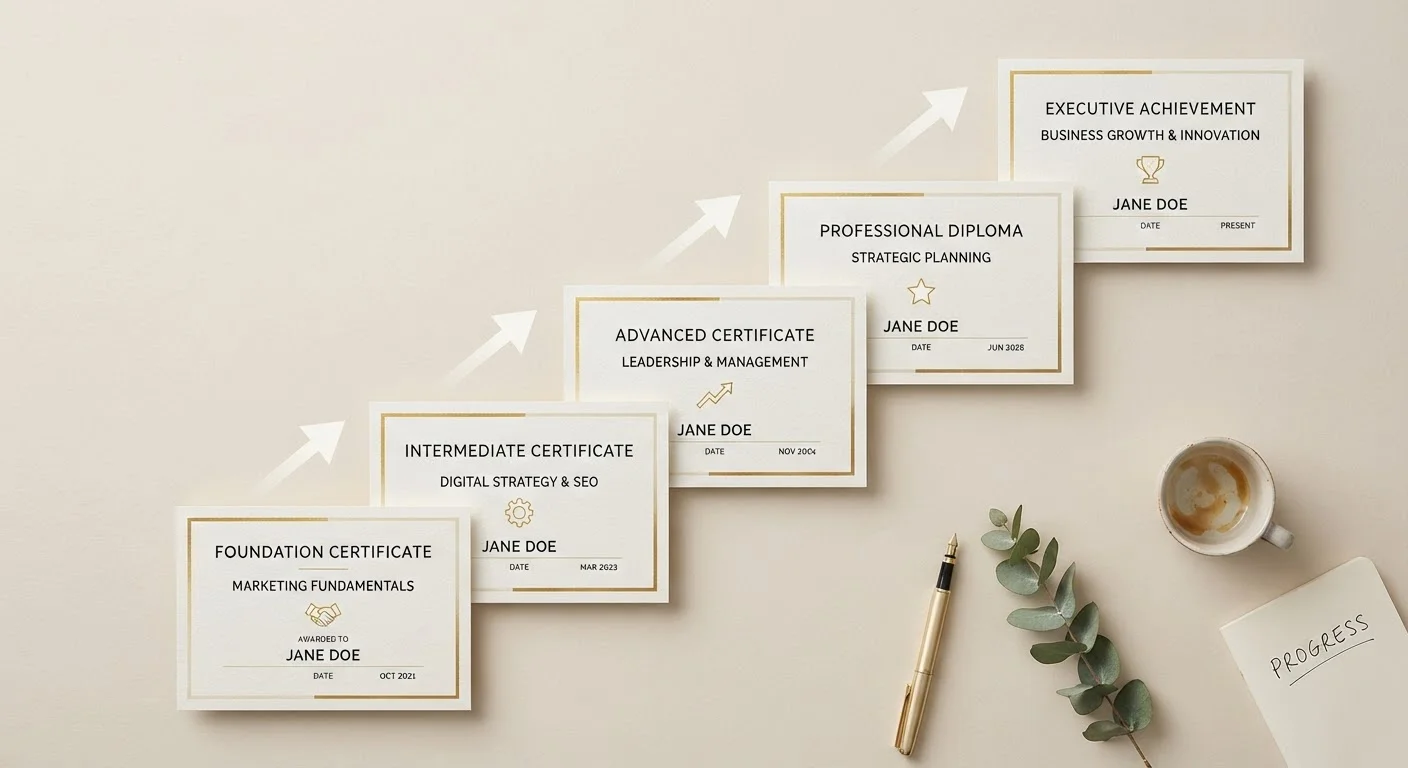
The phrase "stackable credentials" describes an education strategy, not a single product or platform. The core idea is straightforward: rather than committing to a multi-year degree before seeing any return, you earn smaller, recognized qualifications in a planned sequence. Each credential acknowledges a real competency. Over time, those credentials accumulate into a portfolio - or formally count toward a higher-level qualification.
This structure was developed in part to address a persistent challenge for adult learners: the difficulty of pursuing long programs while managing work and family obligations. If life interrupts your studies, you leave with something tangible rather than nothing. When circumstances allow, you pick up where you left off.
Community colleges, workforce boards, and some four-year institutions have built formal stackable pathways, particularly in healthcare, manufacturing, information technology, and business. Professional associations in many fields have also created tiered certification programs that work on the same principle.
Stackable Credentials vs. Traditional Degrees
Stackable credentials and traditional degrees serve different purposes and are recognized differently across industries. In fields with strong credentialing cultures - technology, healthcare, skilled trades - a stack of recognized certifications can be highly competitive. In fields where a bachelor's or advanced degree remains the default hiring standard, certificates typically supplement rather than replace degree requirements. Neither path is universally superior; the right choice depends on your specific field, employer landscape, and career goals. For more on how these paths compare, see our article on self-taught vs. formally credentialed.
How a Stackable Path Typically Works
A stackable credential sequence usually moves from foundational to specialized. Consider a pathway in healthcare administration: a learner might earn a medical billing certificate, then a health information management certificate, then a certified coding credential, with each step building directly on the last. At any point in that sequence, the individual holds a marketable credential - but completing the full stack may qualify them for more senior roles or meet the prerequisite for a degree program.
In technology fields, a similar logic applies. Foundational credentials in networking or cybersecurity concepts may stack toward more advanced vendor-neutral certifications or even credit toward an associate degree in information systems. The fields where online credentials carry genuine weight tend to overlap heavily with industries that have developed these structured pathways.
Not every credential labeled "stackable" is formally connected to a degree pathway. Some stacks exist only within a single provider's ecosystem. Before investing time and money, confirm whether the credentials are recognized beyond that one program - and whether they connect to the outcomes you actually want.
1 in 3
U.S. adults hold a sub-baccalaureate credential
According to the National Center for Education Statistics, a substantial share of U.S. adults report holding a certificate or other sub-baccalaureate credential as their highest level of educational attainment.
~40%
Community college programs with stackable pathways
Research from Jobs for the Future and related workforce policy organizations has found that a significant portion of community college career and technical programs have been restructured around stackable credential models.
10-30%
Typical wage premium for industry certifications
Wage premium estimates for industry-recognized certifications vary by field and credential type; the Georgetown Center on Education and the Workforce has documented earnings differences in credential-heavy occupations, though outcomes are not guaranteed.
Who Benefits Most From This Approach
Stackable credentials are particularly well-suited to adult learners who are already working and cannot step away for a full degree program. They also serve people re-entering the workforce, career changers looking to demonstrate competency in a new field quickly, and learners who are managing financial constraints that make a four-year commitment impractical right now.
For anyone returning to the workforce after a career gap, a well-chosen credential - even a single certificate - can signal current, relevant knowledge to hiring managers, which is often the core challenge after time away.
This approach is also useful for professionals in credential-heavy fields who need to demonstrate continuing competency. In industries like project management, finance, or clinical healthcare, incremental certifications are often an expected part of career progression rather than an alternative to it.
That said, stackable credentials are not a universal solution. For fields where a four-year degree remains the standard hiring requirement - many roles in law, engineering, or academia - a stack of certificates is unlikely to substitute. Understanding your specific field's expectations is essential before committing to this path. Certifications carry real hiring weight in some sectors far more than others.
Planning a Stack That Actually Pays Off
The most common mistake with stackable credentials is choosing them based on availability or cost rather than labor market demand. Earning three certificates in a sequence only matters if employers in your target field recognize and value that sequence. Start by reviewing current job postings for roles you want - note which credentials appear consistently in requirements or preferences.
Next, look at who issues the credential. Credentials from nationally recognized professional bodies or accredited institutions generally carry more weight than those from less-established providers. Our overview of what employers actually think of online learning credentials provides useful context for evaluating different types of certification sources.
Also consider the total cost of your planned stack before you begin. Career development on a tight budget is achievable, but only when each investment is deliberate. Once you hold a credential, the work of translating it into career momentum is its own step - one that turning an online certificate into a tangible career move explores in practical terms.
Verify Articulation Before You Enroll
If your goal is for a certificate to eventually count toward a college degree, get the articulation agreement confirmed in writing by both the issuing institution and the receiving college before you pay tuition. Verbal assurances are not binding. Policies can change, and assumptions about credit transfer are a common source of unexpected setbacks for learners in stackable pathways.
This article is for general educational and informational purposes only. It does not constitute financial, legal, or career advice. Readers should evaluate their individual circumstances and consult qualified professionals when making significant education or career investments.