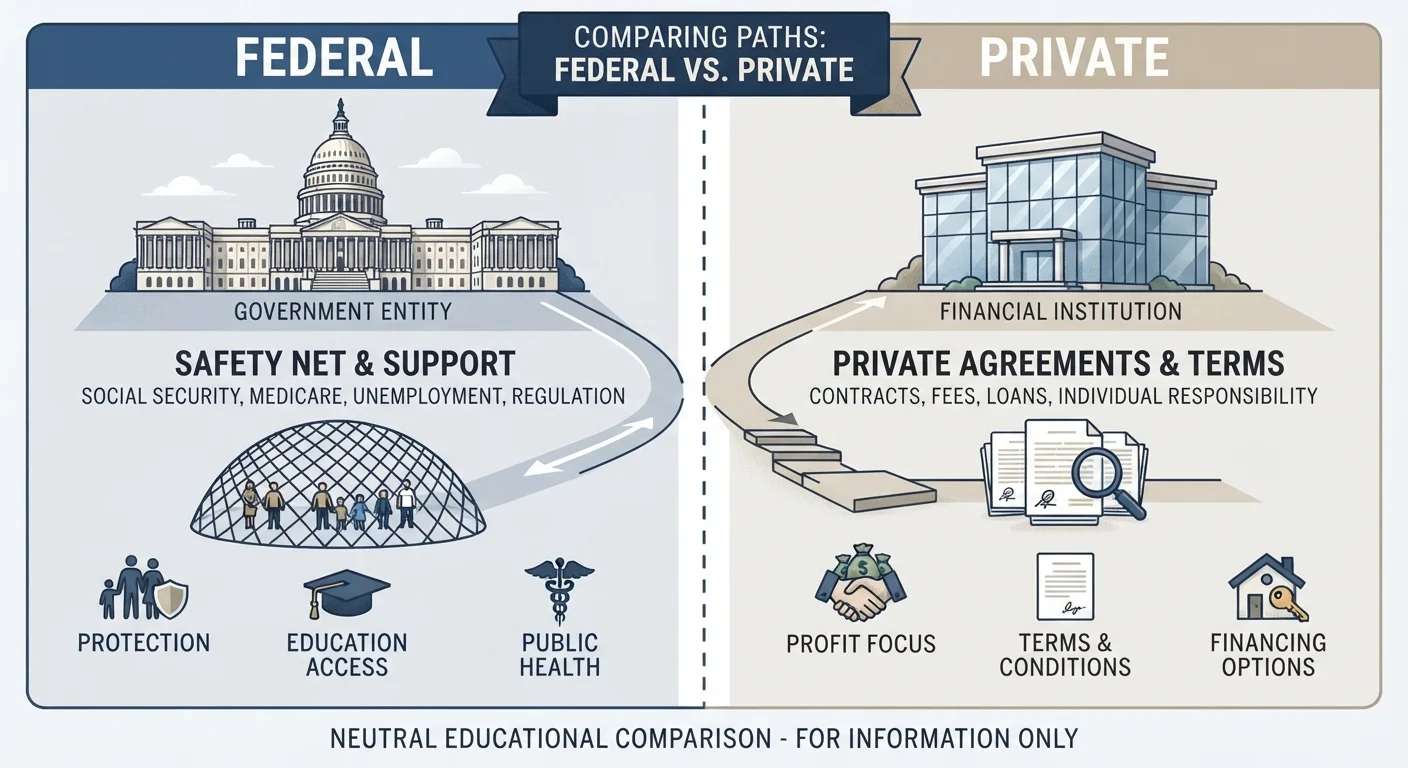
How Each Loan Type Works
Federal student loans are funded by the U.S. Department of Education and governed by federal law. Because they are standardized, every borrower who qualifies for the same loan type receives the same interest rate, regardless of credit history. Eligibility for most federal undergraduate loans does not depend on your credit score at all - it is determined by enrollment status and financial need, assessed through the FAFSA.
Private student loans are issued by banks, credit unions, and online lenders. Their terms - including the interest rate, repayment options, and borrower protections - are set by the lender and will vary based on your (or your cosigner's) credit profile. That variability is central to understanding the risk involved. For a fuller picture of how federal aid is structured overall, see The Full Picture of College Financial Aid.
Consumer Protections: Where the Gap Is Widest
The most significant difference between these two loan types is not the rate - it is what happens when repayment becomes difficult.
Federal borrowers have access to income-driven repayment (IDR) plans, which cap monthly payments as a percentage of discretionary income. Borrowers experiencing financial hardship can apply for deferment or forbearance under standardized federal rules. Programs like Public Service Loan Forgiveness (PSLF) can eliminate remaining balances for eligible borrowers who work in qualifying public-sector or nonprofit roles for ten years.
Private lenders are not required to offer any of these options. Some do provide short-term hardship programs, but these are contractual - not federally guaranteed - and vary widely. If a private lender is acquired, merges, or changes its policies, borrowers have limited recourse.
| Federal Student Loans | Private Student Loans | |
|---|---|---|
| Interest rate type | Fixed, set annually by Congress | Fixed or variable, set by lender |
| Credit check required | Generally not for undergraduates | Yes - rate depends on credit score |
| Income-driven repayment | Multiple plans available | Rarely available |
| Loan forgiveness programs | Yes (e.g., Public Service Loan Forgiveness) | Generally not available |
| Deferment / forbearance | Broad federal protections apply | Limited; varies by lender |
| Cosigner required | No (most programs) | Often required for younger borrowers |
| Borrowing limit | Annual and aggregate caps apply | Up to full cost of attendance |
Understanding these distinctions matters before you borrow. The article Subsidized vs. Unsubsidized Student Loans goes deeper into differences within the federal loan category itself.
Rates, Cosigners, and the Credit Factor
Federal loan rates are fixed and reset annually based on the 10-year Treasury note yield, plus a statutory add-on set by Congress. All borrowers in a given loan category pay the same rate for loans disbursed in the same academic year - there is no negotiation.
Private loan rates are credit-based. Borrowers with strong credit histories may qualify for rates that are competitive with or lower than federal rates in certain market conditions. However, most traditional-age college students have limited credit histories and will need a creditworthy cosigner to access reasonable private loan rates. That cosigner shares full legal responsibility for the debt - meaning missed payments affect their credit score and financial standing, not just the student's. This dynamic is worth understanding the same way you would evaluate any collateral-based lending agreement; for context on how liability works in other secured lending contexts, see Secured vs. Unsecured Auto Loans.
Always File Your FAFSA First
Completing the Free Application for Federal Student Aid (FAFSA) is the required first step to accessing any federal loans, grants, or work-study. Filing early maximizes the aid types available to you. Private loans should only be considered after you know exactly what federal aid you've been offered and have accepted what you need.
~92%
Share of student debt that is federal
According to Federal Reserve data, federal loans account for the large majority of outstanding student debt in the United States.
4-8%
Typical federal loan rate range
Federal student loan rates are set by Congress each year and tied to 10-year Treasury note yields, providing predictability for borrowers.
When Private Loans Might Make Sense - and When They Add Risk
There are legitimate scenarios where private loans serve a purpose: when a borrower has exhausted annual federal limits, attends a program ineligible for federal aid, or - less commonly - when a borrower with excellent credit can secure a lower rate than current federal offerings.
The risks, however, are real. Variable rates can rise over a multi-year repayment period. Fewer hardship protections mean a job loss or income disruption is harder to manage. And unlike federal loans, private loans generally cannot be consolidated into a federal repayment program after the fact.
Variable Rates Can Rise Significantly
Some private loans offer low introductory variable rates that can increase substantially if benchmark interest rates rise over your repayment period. Before accepting a variable-rate private loan, consider what your monthly payment would look like if the rate climbed several percentage points - and whether your expected income could absorb that increase.
Whatever loan type you use, the underlying principle remains the same: borrow only what you expect to need, not the maximum available. For strategies that apply regardless of which type you hold, Keeping Student Debt Manageable offers practical principles worth reviewing before you finalize any borrowing decision.
This article is for general informational and educational purposes only and does not constitute personalized financial or legal advice. Loan terms, rates, and federal program rules can change. Consult a qualified financial aid professional or licensed financial adviser regarding your specific circumstances.