The Tradeoff Every Buyer Should Understand
When a lender presents financing options, the most visible number is the monthly payment. That figure is real and important - it has to fit your budget. But it captures only one dimension of the loan's cost. The term length determines how many times you make that payment, and how much of each payment goes toward interest rather than the vehicle itself.
Here is the core mechanic: a longer term spreads the loan balance over more months, which lowers each individual payment. But it also means the lender earns interest on your outstanding balance for more months. The result is a higher total amount paid, even if the payment felt manageable at signing.
This is why focusing only on the monthly payment is considered one of the most costly mistakes buyers make. Dealers and lenders sometimes structure conversations around payment amount precisely because it obscures total loan cost.
72 months
Most common new-car loan term in recent years
According to Experian's State of the Automotive Finance Market reports, six-year loans have become one of the most frequently originated terms for new vehicle financing in the U.S.
~23%
Share of new-car buyers with loan terms over 72 months
Experian automotive finance data has shown that a notable portion of new-vehicle borrowers are choosing terms of 73 to 84 months, reflecting the pressure of rising vehicle prices on monthly affordability.
$1,000s
Typical additional interest on 72-month vs. 48-month loan
Standard amortization calculations on a $30,000 loan at a 7% APR show a difference of roughly $1,500-$2,000 in total interest between a 48- and 72-month term.
How Amortization Amplifies the Difference
Auto loans use a structure called amortization - each payment covers both interest and principal, but the proportion shifts over time. Early in the loan, a larger share goes to interest. As the balance falls, more of each payment reduces principal.
What this means in practice: on a long-term loan, you spend more months in the interest-heavy early period before meaningful principal reduction begins. By month 12 of a 72-month loan, you may have paid over a thousand dollars in interest while reducing the principal by a much smaller amount.
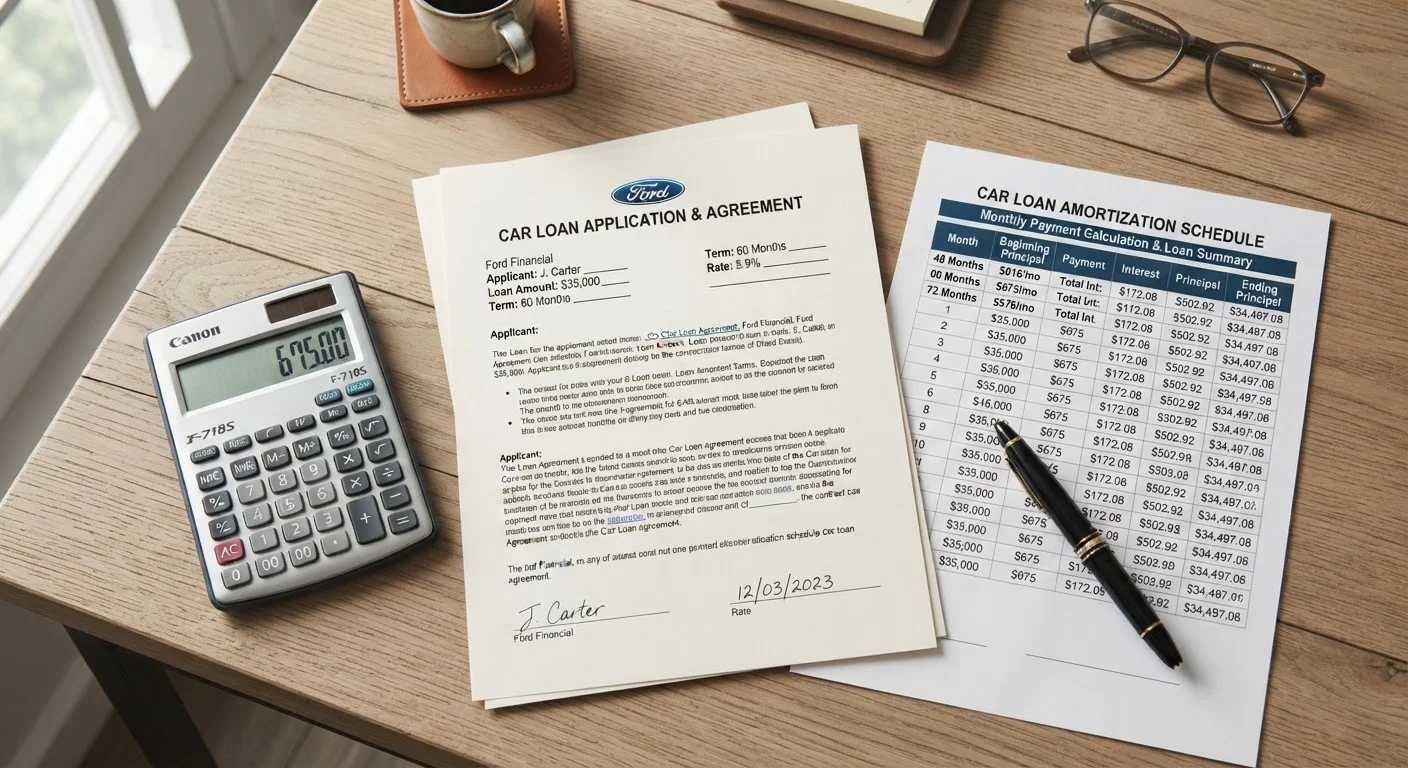
You can verify this for yourself using any standard amortization calculator - enter your loan amount, APR (annual percentage rate), and term, then compare the total interest lines across different scenarios. The gap between a 48-month and a 72-month term on the same loan amount is often several thousand dollars.
For a full breakdown of the terms involved - principal, APR, amortization - see our auto loan terms glossary.
The Depreciation Problem With Long Terms
Vehicles lose value quickly, particularly in the first two to three years of ownership. A new car may depreciate 20% or more in year one. Long loan terms introduce a specific risk: your loan balance may fall more slowly than the vehicle's market value, leaving you in a situation where you owe more than the car is worth.
This is commonly called being underwater or upside-down on a loan. It is not just an accounting abstraction. If you need to sell the vehicle, trade it in, or if it is totaled in an accident, you may owe money after the transaction closes - money that does not come with a car attached.
Gap insurance (Guaranteed Asset Protection) is a product designed to cover this shortfall in total-loss scenarios, but it adds cost and does not help in trade-in situations. Understanding the depreciation curve of any vehicle you are considering - alongside your loan structure - is part of a complete cost analysis.
Run the Total Cost Comparison Before You Sign
Before agreeing to any loan term, multiply the monthly payment by the number of months to get the total amount you will pay. Subtract the vehicle's negotiated price to see the exact interest cost of that term. Do this for every term option offered - the comparison often makes the tradeoff immediately clear.
Choosing a Term That Reflects Total Cost, Not Just Payment
The question to ask when comparing loan offers is not "which payment can I afford?" but "what is the total amount I will pay for this vehicle, including all interest?" Those two questions often lead to different decisions.
A practical approach: calculate the total loan cost (monthly payment × number of months) for each term option and compare that figure against the negotiated vehicle price. The difference is the total interest you are agreeing to pay. That number - not the monthly figure - is what changes most significantly across term lengths.
If a longer term is genuinely necessary to keep your budget stable, consider whether making occasional extra payments toward principal is feasible. Paying down principal faster reduces the balance on which interest accrues. Most standard auto loans do not carry prepayment penalties, but confirm this in your contract before proceeding.
For context on the full financing agreement you are entering, our guide on auto loan basics walks through every element of a standard loan contract. And if circumstances change after you sign, refinancing may offer a path to a better rate or shorter remaining term - though timing and fees matter.
This article is for general informational purposes only and does not constitute personalized financial or legal advice. Consult a licensed financial professional for guidance specific to your situation.