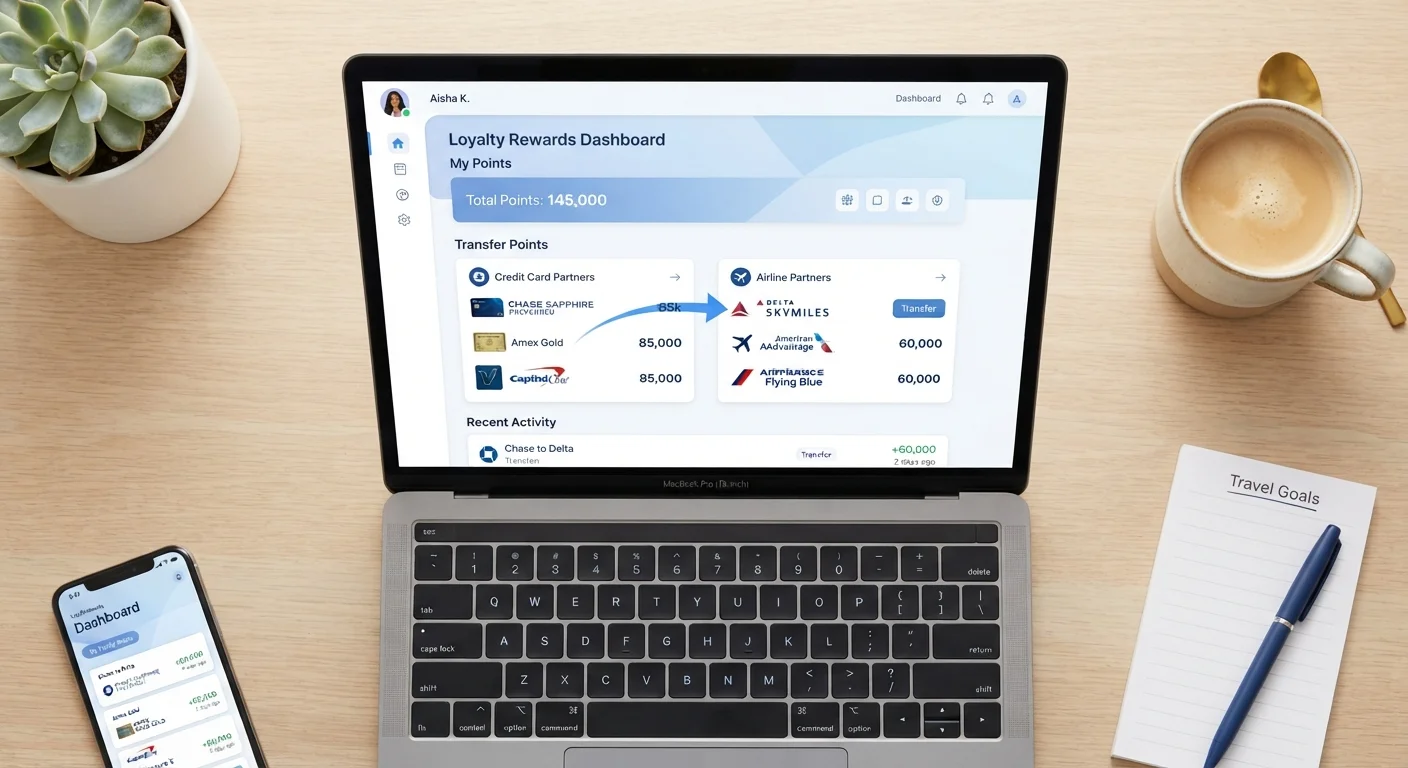
How a Transfer Actually Works
When you accumulate points through a credit card, those points sit in the card issuer's own rewards currency — not inside any airline or hotel program. A transfer is the act of moving that currency across into a partner program, where it converts into the partner's own unit (miles, points, nights).
The process typically takes three steps: you log into your card account, select a transfer partner, specify how many points to send, and confirm. Most programs require your loyalty account number for the receiving program. The points are then debited from your card account and credited to the partner — usually within 24 to 72 hours, though some partnerships are near-instant.
One detail worth internalizing early: transfers are permanent. There is no recall, no undo. If you send 50,000 points to an airline program and then decide you wanted to use a different partner, those points are gone from your card account for good. See how loyalty program currencies work for a broader breakdown of the ecosystem before committing to a transfer strategy.
Transfer Ratios: Where Value Is Made or Lost
Every transfer partnership has a ratio — the exchange rate between your card currency and the partner currency. A 1:1 ratio means one card point becomes one airline mile. A 2:1.5 ratio means every two card points become 1.5 partner miles, which is less favorable. Ratios are set by the card issuer and can change with little notice.
The ratio is only half the equation. What matters equally is what the partner program charges for the award you want. A 1:1 transfer ratio into a program that prices a domestic flight at 30,000 miles may be worse than a 1:0.75 ratio into a program that prices the same route at 12,500 miles. You have to model the full chain: card points → transfer ratio → partner miles → award cost → flight value.
1:1
Most common card-to-airline transfer ratio
Many major bank rewards programs offer at least some 1:1 transfer partnerships, though ratios vary widely across the full list of partners.
24–72 hrs
Typical transfer processing window
Transfer timing depends on the specific partnership; some complete instantly while others can take up to three business days, which matters when award space is limited.
~1–1.5¢
Fixed portal value per point (approximate)
Card travel portals typically offer a predictable fixed redemption rate, which transfers need to beat in order to justify the added complexity and irreversibility.
This math is why point valuations (often expressed in cents per point) exist. If a round-trip economy flight would cost $600 cash and the award requires 60,000 miles, each mile is worth roughly 1 cent. Whether that's good depends on how many card points it took to generate those 60,000 miles. Understanding real point value is essential before any transfer decision.
When Transfers Deliver Clear Upside
Transfers tend to produce the most value in specific circumstances. The first is premium cabin bookings — business and first-class awards often represent a disproportionately high cash equivalent because the retail price of those seats is steep. Spending 70,000 miles on a business class seat priced at $4,000 yields far better cents-per-point than spending 15,000 miles on a $200 economy ticket.
The second is partner airline routing. Many loyalty programs let you book seats on airline partners — meaning you can use Program A's miles to fly on Airline B. This opens access to routes and pricing structures you couldn't reach by booking directly with one airline's own program.
The third is sweet spots — fixed award charts where specific routes are priced below their market value. Not all programs use fixed charts anymore, but where they exist, they reward travelers who know the pricing structure. Comparing airline miles and hotel points can help clarify which currency type tends to offer better upside for your typical travel patterns.
When Transfers Are the Wrong Move
Transfers don't automatically improve value. Several scenarios should give you pause before moving points.
- No award availability: If the partner airline has no open award seats on your target route and date, transferred miles are effectively stranded. Always confirm seat availability before transferring.
- Poor redemption rates: Some programs offer low value per mile on the specific redemptions you need. If the cash price of a flight is low, the award cost in miles may not justify the transfer.
- Imminent program devaluation: Programs periodically increase award costs (devalue their currency). If a devaluation is announced, transferred points could be worth less than anticipated.
- Card portal rates are competitive: Some card issuers offer meaningful fixed-value redemptions through their own travel portals. For straightforward domestic economy bookings, the portal rate may match or beat the transfer math.
If you're weighing whether a points card makes sense for your habits at all, the cashback vs. points card comparison lays out the tradeoffs in practical terms.
This article provides general educational information about loyalty program mechanics and is not personalized financial or travel advice. Program terms, transfer ratios, and award availability change frequently — always verify current conditions directly with your card issuer and loyalty program before transferring points.