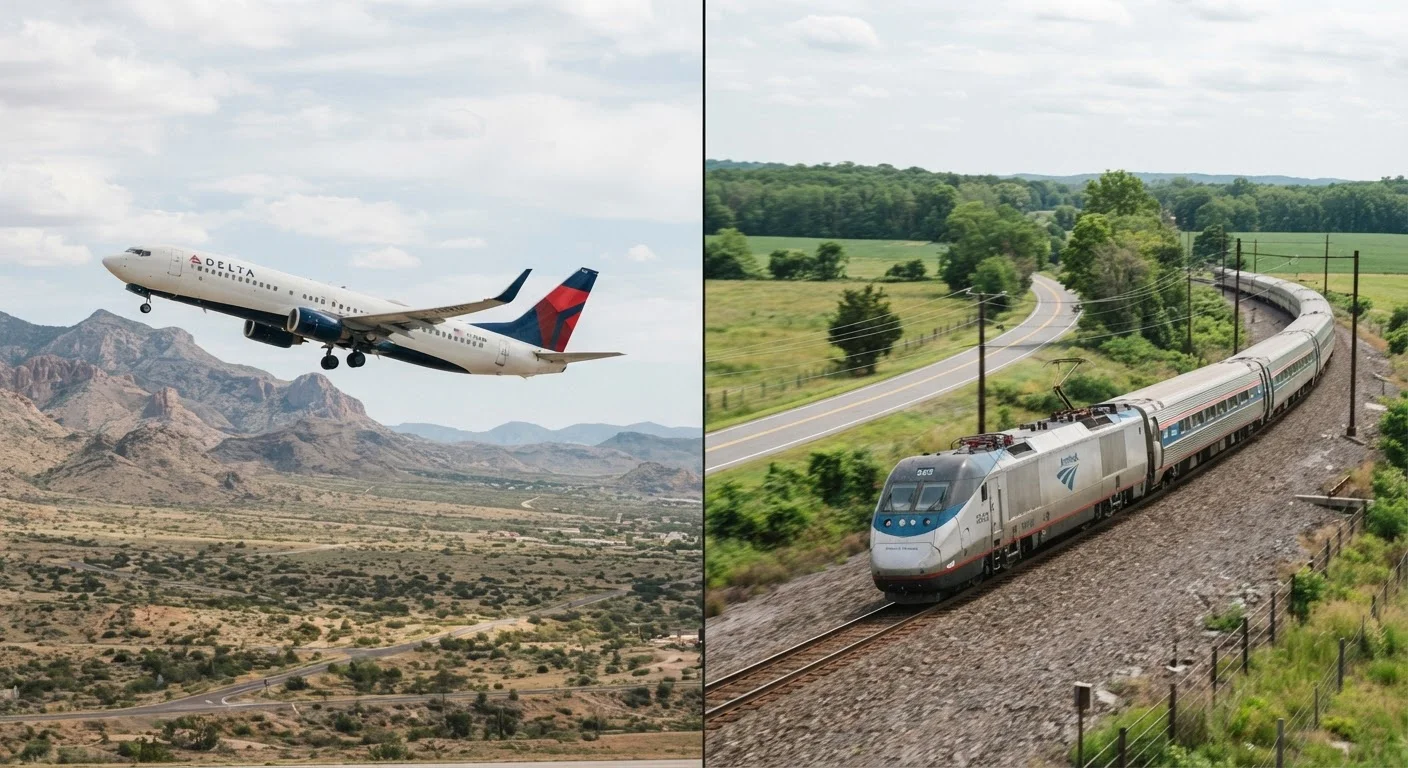
The Real Cost Comparison: Ticket Price Is Just the Start
A base airfare can look attractive until you add checked baggage fees, seat selection charges, and the cost of getting to and from an airport that's typically 30–60 minutes outside the city. Those additions routinely push the real cost of a short-haul flight well above its advertised price.
Train fares on Amtrak's core corridors — the Northeast Regional, the Pacific Surfliner, and others — are often all-in prices with no fuel surcharges and more straightforward baggage policies. On a route like New York to Washington, D.C., the fare gap between a train ticket and a no-frills flight can narrow considerably once airport fees, transit costs, and baggage are counted.
That said, flights do frequently offer lower base fares on longer routes, and airline reward programs can reduce out-of-pocket costs for frequent travelers. The key is to compare total trip cost, not just the headline ticket price. This is a point worth keeping in mind — it's one of the travel planning myths that cost people money to assume the cheapest ticket means the cheapest trip.
| Criterion | Domestic Flight | Domestic Train |
|---|---|---|
| Base ticket cost (short routes) | Variable; often lower before fees | Competitive; typically all-in |
| Baggage fees | Common; $30–$40+ per bag | Generally included up to limits |
| Airport/station access | Airport often 30–60 min from center | Station typically downtown |
| Recommended arrival window | 90 minutes before departure | 30 minutes before departure |
| Onboard comfort (economy) | Limited legroom, restricted movement | More space, café car, walk-around |
| Route availability | Nationwide coverage | Limited to established corridors |
| Carbon emissions per passenger mile | Substantially higher | Substantially lower |
| Delay/disruption frequency | Moderate to high | Moderate (varies by corridor) |
Door-to-Door Time: Where Trains Close the Gap
Flights are faster in the air. That's not in dispute. But total travel time — from leaving your front door to arriving at your final destination — tells a different story on many routes.
A domestic flight requires arriving at the airport typically 90 minutes before departure. Add security screening, gate time, a potential tarmac delay, baggage claim, and the transit ride from the airport to the city center, and a one-hour flight can consume four to five hours of your day.
A train, by contrast, departs from a downtown station, has a 30-minute recommended arrival window, and drops you at another downtown station. On routes under 300 miles, total door-to-door time is frequently comparable. The trade-offs between fast and slow travel are relevant here — the train's longer in-vehicle time can be productive time, with space to work, read, or move around in a way a cramped aircraft seat rarely allows.
~2–3x
Higher emissions: flying vs. rail per passenger mile
The International Energy Agency estimates domestic aviation produces significantly more CO₂ per passenger kilometer than intercity rail, though exact ratios vary by load factor and route.
~30 min
Amtrak's recommended pre-departure arrival window
Compared to the standard 90-minute airline recommendation, this difference adds up meaningfully on short and medium-distance routes.
$30–$40+
Typical checked bag fee on domestic US airlines
Most major US carriers charge per-bag fees for checked luggage, which can substantially increase the total trip cost relative to advertised fares.
Comfort, Flexibility, and the Hidden Costs of Flying
Economy class on a domestic flight offers limited legroom and restricted movement. Overhead bin space fills quickly, and onboard amenities beyond a beverage are typically paid extras. Delays and cancellations, while affecting both modes, tend to cascade more severely in the airline system due to network dependencies.
Train travel, particularly in business class on Amtrak, offers wider seats, café car access, and the ability to move freely. Schedules are simpler to rebook, and the overall boarding process is lower-friction. For families traveling with young children or passengers with mobility considerations, the train environment tends to be easier to navigate.
On the environmental side, domestic aviation is a significant source of carbon emissions. Rail travel produces a fraction of the greenhouse gas output per passenger mile. For travelers who factor environmental impact into their decisions, this is a meaningful distinction — though it's one consideration among several, not a directive.
For a broader view of how transport choices fit into value-conscious travel planning, this guide to traveling affordably without sacrificing comfort covers the full picture.
Rail Coverage Has Real Limitations
Amtrak's network is extensive on the coasts but significantly thinner in the South, Mountain West, and rural Midwest. Frequency is another consideration: some intercity routes operate only once daily, making rebooking after a missed train a much bigger problem than with airlines. Before assuming train travel is viable for your route, check schedules and city-pair availability directly — the network map matters as much as the ticket price.