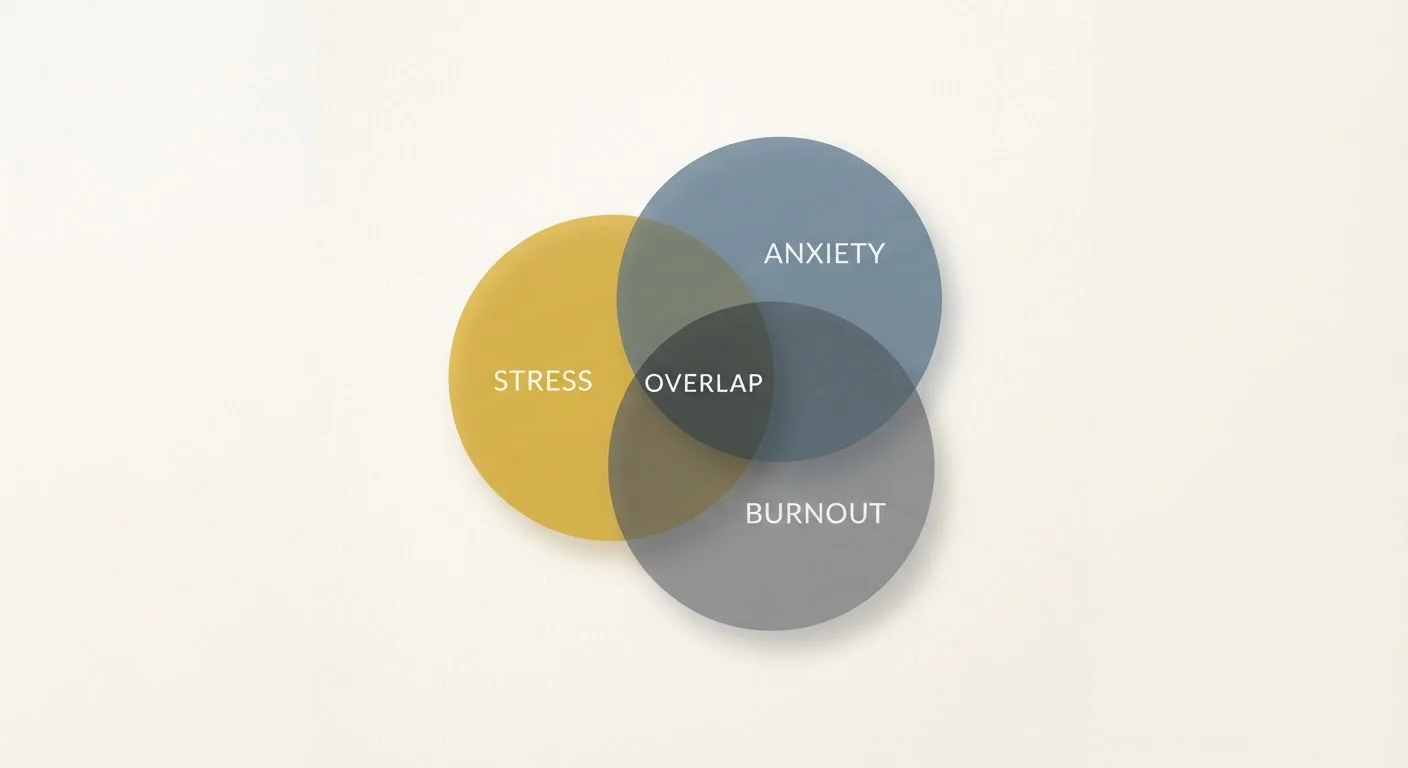
Why the Distinction Matters
Most people use the words stress, anxiety, and burnout interchangeably. That's understandable - all three involve discomfort, all three can interfere with sleep and concentration, and all three tend to arrive together. But treating them as the same thing means reaching for responses that may not fit.
Someone experiencing situational stress might benefit from setting firmer boundaries around work hours. Someone with anxiety may need a different approach - one that addresses persistent worry rather than an external workload. Someone in burnout needs genuine rest and structural change, not just a long weekend. Understanding what mental wellbeing actually means is a useful first step before sorting out which of these states applies to you.
This article is general health information and education, not medical or psychological advice. If your symptoms are significantly affecting your daily life, please consult a qualified healthcare professional.
Stress, Anxiety, and Burnout Side by Side
The table below outlines how each state tends to present across several key dimensions. Keep in mind that real experience rarely fits neatly into categories - this is a framework for thinking, not a diagnostic tool.
| Stress | Anxiety | Burnout | |
|---|---|---|---|
| Primary trigger | Identifiable external pressure | Often unclear or future-focused | Prolonged overextension without recovery |
| Duration | Typically short-term | Persistent, ongoing | Develops gradually over months |
| Core feeling | Pressure, overwhelm, urgency | Worry, dread, apprehension | Exhaustion, numbness, detachment |
| Energy level | Often high (uncomfortable) | Variable, often tense | Significantly depleted |
| Resolves when... | The stressor is removed | Requires targeted support | Structural rest and change occur |
| Common physical signs | Tension, headaches, poor sleep | Racing heart, shallow breathing | Fatigue, frequent illness, brain fog |
One important pattern to notice: stress is primarily backward-looking or present-focused (something is happening now). Anxiety is forward-focused (something might happen). Burnout is less about a specific event and more about a gradual depletion of resources over time. For a deeper look at what stress does inside the body, see why chronic stress feels so physical.
How Each State Feels From the Inside
Stress
Stress typically has a cause you can point to: a deadline, a conflict, a financial pressure. The nervous system activates, preparing the body to respond. Once the pressure lifts - the deadline passes, the conflict resolves - the stress usually fades. Common signs include irritability, tension headaches, difficulty switching off, and a sense of being pulled in multiple directions.
Anxiety
Anxiety shares many of those physical symptoms but tends to persist beyond the triggering situation, or to arise without any clear trigger at all. The worry often feels disproportionate and hard to control. You may find yourself mentally rehearsing worst-case scenarios or feeling dread without knowing why. Common thinking traps like catastrophising can feed anxiety significantly.
Burnout
Burnout is less an acute state and more a state of profound exhaustion - emotional, physical, and cognitive - that develops from chronic overextension without adequate recovery. People in burnout often describe feeling numb, detached, or cynical rather than acutely distressed. Motivation drops sharply, and even simple tasks can feel overwhelming. Unlike stress, which often comes with energy (if uncomfortable energy), burnout is characterized by its absence.
Journaling Can Help You Identify Patterns
If you're unsure which state resonates most, try briefly writing down what you're feeling and what (if anything) seems to trigger it. Over several days, patterns often emerge - does the discomfort fade when a task is done, or does it linger? Is there a specific worry you keep returning to, or do you mostly feel empty and flat? This kind of self-observation is low-barrier and can clarify what kind of support might help most.
Choosing a Response That Fits
Once you have a rough sense of which state resonates most, you can begin to match your response more deliberately.
- For stress: Focus on managing the source where possible - clarifying priorities, delegating, communicating limits. Short-term relaxation techniques (slow breathing, brief walks) can help regulate the nervous system in the moment. See building a personal stress response toolkit for evidence-informed options.
- For anxiety: Relaxation alone often isn't enough. Approaches that address thought patterns - such as cognitive behavioral techniques - tend to be more effective for persistent worry. A mental health professional can help tailor these. Mindfulness and meditation practices also have a growing evidence base for anxiety support.
- For burnout: Recovery requires more than a brief break. It typically involves addressing the structural conditions that created the depletion - workload, lack of autonomy, poor social support - alongside genuine rest. If you feel overwhelmed even starting this process, this grounded starting point for anyone feeling overwhelmed may help.
All three states can overlap, and professional support is appropriate for any of them when they persist or worsen. There is no threshold of severity you need to meet before reaching out to a qualified mental health professional.