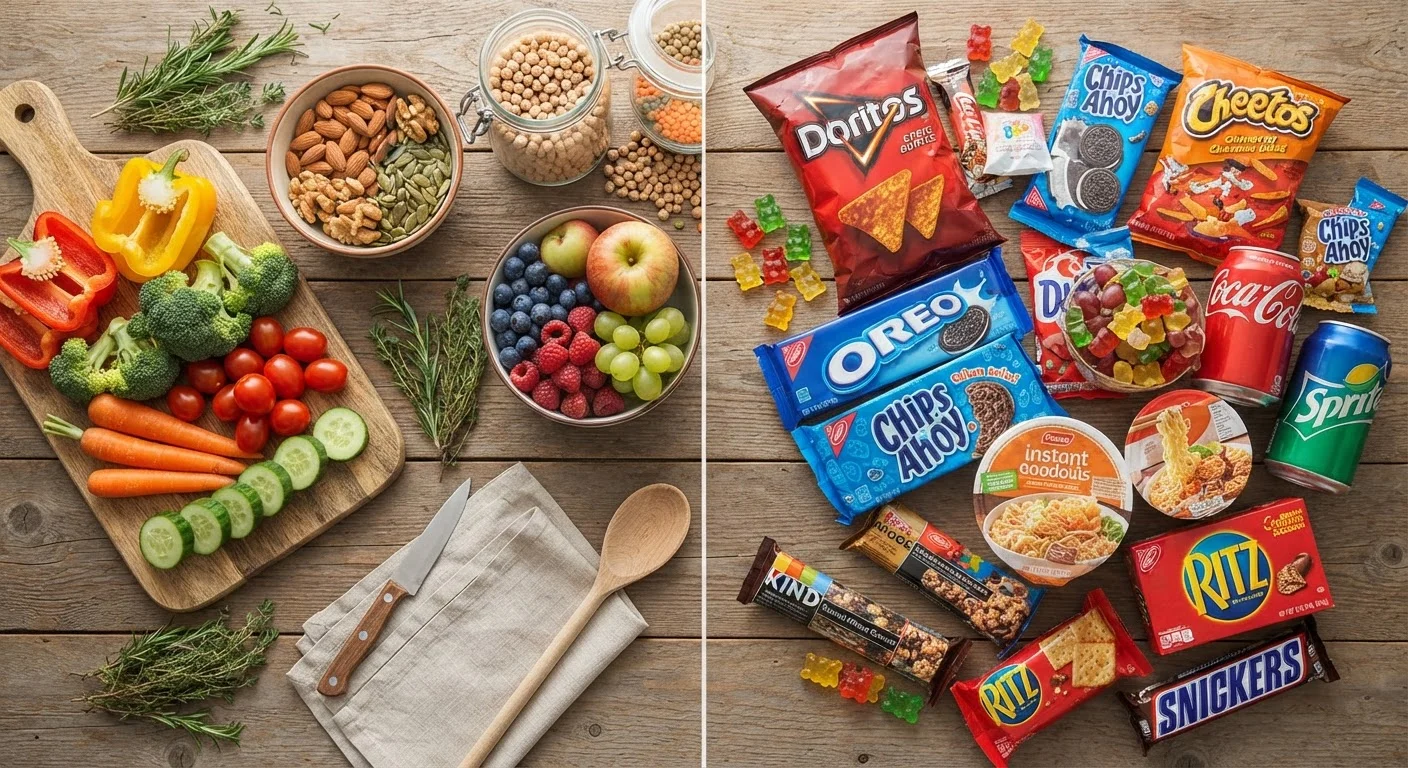
Defining the Terms: What Counts as Whole or Processed?
The phrase "processed food" is often used as shorthand for junk food, but that framing is too blunt to be useful. Processing simply means any alteration to a food from its natural state - which technically includes washing, freezing, cooking, or milling. A bag of frozen peas and a tube of cheese-flavored snack crackers are both "processed," but they sit at very different ends of a nutritional spectrum.
A widely used framework for thinking about this is the NOVA classification system, developed by researchers at the University of São Paulo. NOVA organizes foods into four groups based on the extent and purpose of processing:
- Group 1 - Unprocessed or minimally processed foods: Whole fruits, vegetables, plain meat, eggs, plain legumes, nuts, and milk. Little or no industrial alteration.
- Group 2 - Processed culinary ingredients: Oils, flour, sugar, salt - substances extracted from foods and used in cooking, rarely eaten alone.
- Group 3 - Processed foods: Foods made by combining Groups 1 and 2, such as canned vegetables in brine, cheese, or bread. Simple ingredient lists, recognizable components.
- Group 4 - Ultra-processed foods (UPFs): Industrial formulations containing substances rarely used in home cooking - emulsifiers, flavor enhancers, hydrogenated oils, colorings, and high-fructose corn syrup. Examples include many packaged snacks, flavored instant noodles, and sweetened cereals.
Understanding this spectrum matters because the nutritional implications differ dramatically across groups.
| Criterion | Whole Foods | Processed Foods |
|---|---|---|
| Definition | Unaltered or minimally altered from natural state | Altered industrially; ranges from simple to ultra-processed |
| Fiber content | Naturally high; intact | Often reduced or removed during refining |
| Added sugars | None (naturally occurring sugars only) | Frequently added; highest in ultra-processed |
| Sodium | Naturally low | Often elevated, especially in packaged/canned items |
| Micronutrients | Naturally present in complex food matrix | May be reduced; sometimes partially restored artificially |
| Shelf life | Shorter; requires refrigeration or timely use | Longer; additives and processing extend stability |
| Convenience | Often requires preparation | Ready-to-eat or quick to prepare |
| Cost | Varies; seasonal produce can be affordable | Varies; ultra-processed items often cheap per calorie |
How Processing Affects Nutritional Quality
When food moves along the processing spectrum toward ultra-processed, several things tend to happen to its nutritional profile. Fiber is often removed during refining - white flour, for example, has had the bran and germ stripped away, taking much of the fiber and micronutrient content with them. Vitamins and minerals are sometimes added back artificially ("enriched" flour), but this does not fully replicate the complexity of the original whole grain.
Ultra-processed foods are also frequently engineered to deliver concentrated levels of added sugars, sodium, and saturated or trans fats. These additions extend shelf life, enhance palatability, and improve texture - but they can push daily intake of these components well above evidence-based guidelines when eaten regularly and in large portions.
On the other side, whole foods arrive with their nutritional matrix intact. An apple, for instance, provides fiber, vitamin C, potassium, and various phytonutrients (plant compounds with potential health-supporting properties) in a package the body has co-evolved to digest. The fiber slows sugar absorption; the phytonutrients may support cellular health. Pulling those components apart or replacing them with isolated nutrients does not always produce the same effect - a concept researchers sometimes call the "food matrix" effect.
~57%
Share of US calories from ultra-processed foods
Research published in BMJ Open estimated that ultra-processed foods account for approximately 57% of energy intake in the US diet.
28%
More fiber in whole-grain vs. refined-grain diets
Studies comparing whole-grain to refined-grain diets consistently find significantly higher fiber intake, which is associated with improved digestive and cardiovascular health markers.
4 groups
NOVA food processing classification levels
The NOVA framework, developed at the University of São Paulo, categorizes all foods into four groups based on extent and purpose of industrial processing.
Importantly, not all processed foods are nutritionally poor. Plain canned tomatoes, unsweetened yogurt, and pasteurized milk are processed - and they are legitimate sources of valuable nutrients. The concern is primarily with Group 4 ultra-processed foods, which now account for a substantial share of calories in the average American diet. For a deeper look at how specific nutrients interact, see our guide to dietary fats.
Building a Practical Eating Pattern Around This Framework
The goal of understanding whole versus processed foods is not to pursue a rigid elimination diet but to make more intentional choices. A few evidence-informed principles can help:
- Read ingredient lists, not just front-of-package claims. A product labeled "natural" or "made with real fruit" can still be ultra-processed. Ingredient lists that include multiple additives - stabilizers, artificial flavors, multiple forms of sugar - are a signal that a food sits in the ultra-processed category.
- Lean on minimally processed convenience foods. Frozen plain vegetables, canned legumes (rinsed to reduce sodium), plain oats, and unsweetened dairy products offer real nutritional value with practical shelf life.
- Use whole foods as anchors. Structuring meals around vegetables, whole grains, legumes, and lean proteins naturally crowds out ultra-processed items without requiring perfection.
- Context always matters. A single food does not define a diet. Someone who eats mostly whole foods and occasionally has a packaged snack is in a very different nutritional position than someone relying on ultra-processed items for the majority of their calories.
If you are also thinking about protein sources within your diet, our comparison of plant vs. animal proteins explores how source and processing interact in that specific context.
Processing Is Not the Only Factor
While the level of processing is a useful lens, it does not capture everything. Portion size, overall dietary pattern, individual health conditions, and activity level all influence how any food affects your health. Use the whole-vs-processed framework as one tool among many, not an absolute rule. A registered dietitian can help you apply these concepts to your specific situation.
This article is for general informational purposes only and does not constitute medical or dietary advice. For guidance tailored to your individual health needs, consult a registered dietitian or qualified healthcare professional.