What Free Courses Actually Deliver
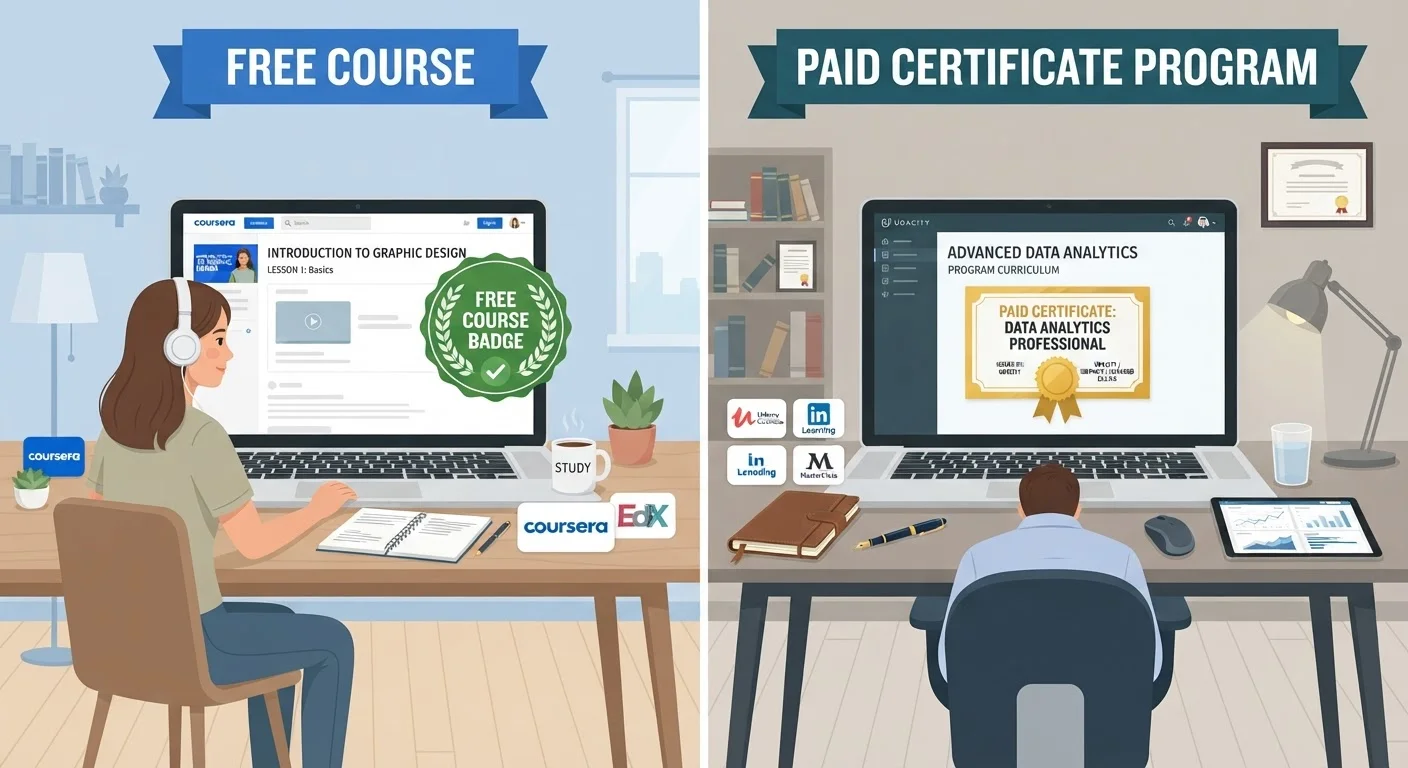
Free online courses range from informal YouTube playlists to structured, university-level content offered through major learning platforms. Many reputable institutions make lecture videos, reading lists, and discussion forums available at no charge - often under what's called an audit option, where you access course materials without earning a certificate.
The genuine strengths of free learning are real. You can explore a topic before committing money to it, build foundational literacy in a new field, or fill specific knowledge gaps without financial risk. For self-directed learners with the discipline to work through unstructured material, free courses can be remarkably effective.
However, the tradeoffs are equally real. Free access typically means no graded assignments, no instructor feedback, and no verifiable credential at the end. Peer interaction is often limited or absent. Completion rates for free courses are consistently lower than for paid equivalents, which suggests that the absence of financial commitment can reduce accountability. If your goal involves demonstrating new skills to an employer, a free course without a certificate may carry little weight.
See our guide to evaluating course quality for practical ways to assess any course before enrolling, free or paid.
What You're Paying For in a Paid Course
Paid courses cover a wide spectrum - from a $15 video series to multi-thousand-dollar certificate programs from accredited universities. Understanding what you are actually purchasing matters more than the dollar amount alone.
In most cases, payment unlocks: graded assessments with feedback, a shareable certificate, instructor or teaching-assistant access, structured pacing, and sometimes career services. These elements can meaningfully accelerate skill development because accountability tends to improve follow-through.
| Free Courses | Paid Courses | |
|---|---|---|
| Upfront cost | None | Varies widely ($10-$5,000+) |
| Certificate or credential | Rarely included | Typically included |
| Instructor feedback | Usually absent | Often included |
| Structured pacing | Self-directed only | Usually structured |
| Employer recognition | Limited to none | Depends on issuer |
| Completion accountability | Low (no financial stake) | Higher (financial investment) |
| Best use case | Exploration and curiosity | Skill-building and credentialing |
That said, price is not a reliable quality signal on its own. A costly course on a popular platform can be outdated, poorly structured, or misaligned with what employers actually value. Before paying, it is worth researching whether the issuing institution or platform is recognized in your target industry, and whether past learners have reported tangible outcomes. For a broader view of what drives educational value beyond tuition, see the real cost of online education.
Matching Course Type to Your Actual Goal
The most common mistake value-focused learners make is choosing a course based on price alone rather than purpose. The right question is not "Is this free or cheap?" but "Does this course deliver what I specifically need?"
Audit Before You Buy
Many platforms allow you to audit paid courses for free, giving access to video lectures and reading materials without assignments or a certificate. If you are unsure whether a paid course's content matches your needs, auditing first lets you evaluate quality at no cost. If the material proves useful and you decide a credential matters, you can upgrade later.
If your goal is exploration - testing whether you enjoy data analysis, for example - a free course is almost always sufficient. If your goal is skill development for an existing job role, a mid-priced structured course with projects and feedback is often worth the cost. If your goal is career transition and you need a credential an employer will recognize, the credential's market value should be weighed against the program's price.
It also helps to research whether free alternatives exist for the exact same content. Many paid courses can be audited for free; some employers offer learning stipends or tuition reimbursement that bring paid costs to zero out of pocket. Our field guide to online learning on a tight budget maps out these options in detail.
Finally, consider opportunity cost on both sides. A free course that takes three months to complete - without the structure to keep you progressing - may cost more in time than a paid course you finish efficiently. As explored in Where Frugality Ends and False Economy Begins, spending less does not always mean getting more value.
This article is for general informational and educational purposes only and does not constitute financial or career advice. Readers should assess their individual circumstances and consult relevant professionals before making significant education or financial decisions.