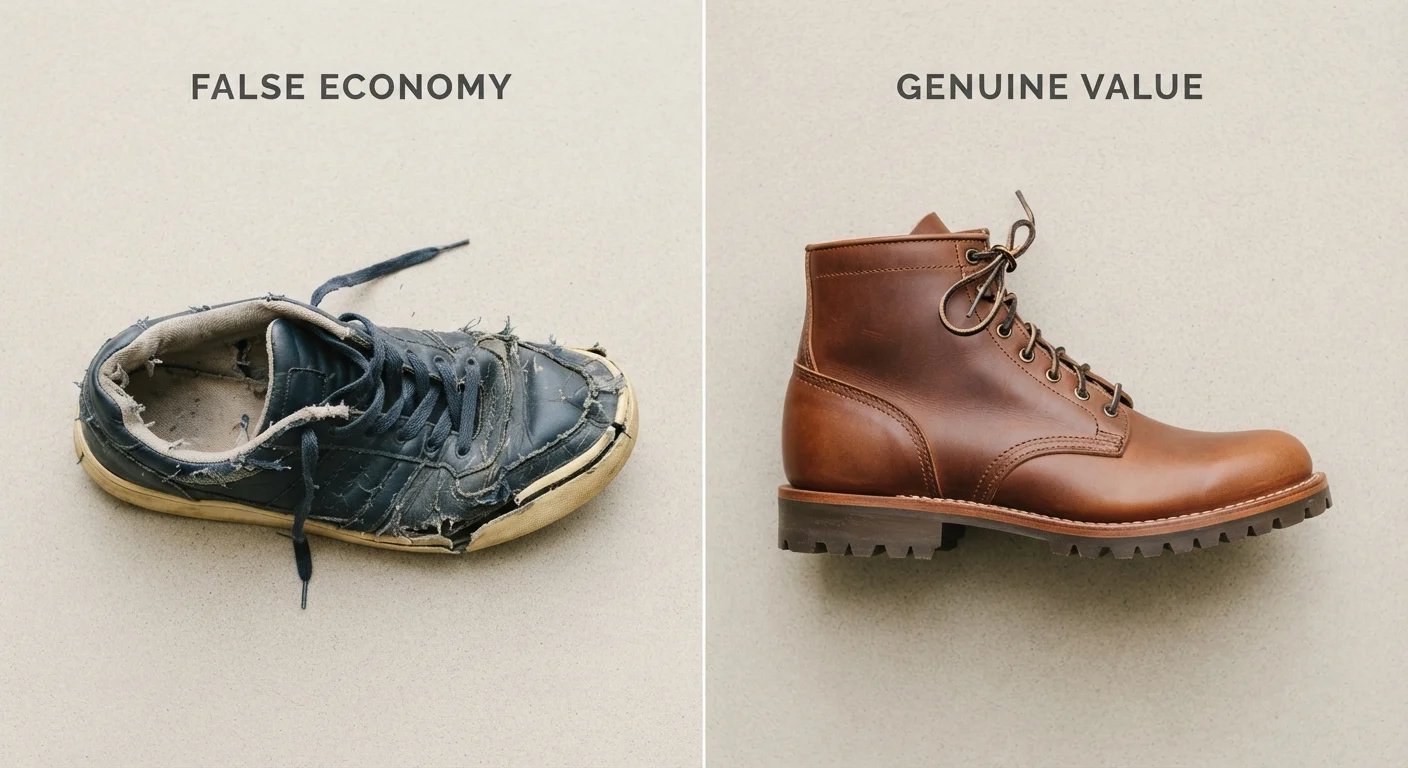
The Line Between Smart Saving and a Costly Mistake
Most cost-conscious shoppers understand frugality as a virtue - and it is, when practiced with clear eyes. The problem is that the brain often equates "less spent now" with "money saved," which isn't always true. False economy is what happens when a decision that looks financially sound in the moment turns out to cost more over time.
The distinction matters because both the genuinely frugal choice and the false economy can look identical at the point of purchase. Both involve choosing the lower-priced option. The difference only becomes visible later, when the cheap item fails early, the skipped service call turns into an emergency repair, or the bargain purchase sits unused. Understanding the difference between price and value is the foundation of avoiding this trap.
2-3×
Typical replacement multiplier for low-durability goods
Consumer research consistently finds that products at the lowest price tier in many categories require replacement two to three times more often than mid-range alternatives, erasing the apparent savings.
$1,200+
Average cost of a neglected car repair vs. preventive service
According to the American Automobile Association (AAA), neglected vehicle maintenance is a leading cause of costly breakdowns, with average roadside repair bills frequently exceeding routine service costs by a wide margin.
30%
U.S. household food waste by value
The USDA estimates that American households waste roughly 30% of the food they purchase by value - much of it driven by over-buying, often in pursuit of per-unit savings on bulk or sale items.
How False Economy Shows Up in Real Life
False economy surfaces across almost every spending category, but a few patterns are especially common:
- Deferred maintenance: Skipping an oil change, a dental cleaning, or a roof inspection to save a few hundred dollars can result in engine damage, a root canal, or structural water damage - each costing many times more.
- Low-durability purchases: A household appliance or piece of clothing priced well below comparable options may work adequately for a short time, but if it requires replacement twice as often, the economics rarely add up.
- Bulk buying the wrong items: Stocking up because something is on sale sounds prudent, but perishables that go to waste or products you never finish represent money spent, not saved. See when bulk buying actually pays off for a clear framework.
- Underinsuring to save on premiums: Choosing minimal coverage to reduce monthly costs can leave you exposed to out-of-pocket expenses that dwarf the premiums saved.
These aren't obscure edge cases - they're everyday spending patterns that quietly erode financial stability.
A Better Metric: Cost Per Use
One practical way to avoid false economy is to shift your thinking from purchase price to cost per use. Divide the total expected cost of ownership - including likely repairs and eventual replacement - by how many times you'll realistically use the item. This single reframe often makes the right choice obvious.
A sturdy tool used regularly for a decade at a higher upfront cost frequently outperforms three consecutive cheap versions on this metric. Conversely, a premium item used only once or twice may represent its own form of poor value. Context is everything: frequency of use, consequences of failure, and your actual needs all factor in.
Use Cost Per Use to Evaluate Any Purchase
Before buying, estimate the realistic lifespan of the item and divide the total expected cost - including maintenance and eventual replacement - by how many times you'll use it. A $120 item used 200 times costs $0.60 per use; a $40 item replaced every 40 uses costs $1.00 per use. The math often reveals which option is actually cheaper.
This same logic applies to services and experiences. Budget travel destinations sometimes carry hidden costs - in fees, safety considerations, or poor infrastructure - that make them pricier in total than they appear. And when it comes to pet care, managing costs without cutting corners on welfare requires the same kind of lifecycle thinking.
Applying the Framework to Your Own Spending
Avoiding false economy doesn't mean spending more across the board. It means applying scrutiny proportional to the stakes. For low-use, low-consequence items, buying cheap is often genuinely rational. For purchases central to your health, safety, home, or daily productivity, the calculus usually shifts toward quality.
A useful habit: before any significant purchase, ask two questions. First, what realistically happens if this fails or underperforms? Second, what does ownership - not just purchase - actually cost? These questions won't always point toward spending more, but they will consistently point toward spending smarter. That's the foundation of smart spending from the ground up, and it's what separates genuine frugality from the kind that costs you in the end.
If you're working to build this kind of disciplined approach into your broader financial habits, the principles connect directly to budgeting basics and building savings over time.
This article is for general informational and educational purposes only. It does not constitute personalized financial advice. Readers should consult a qualified financial professional before making decisions specific to their circumstances.