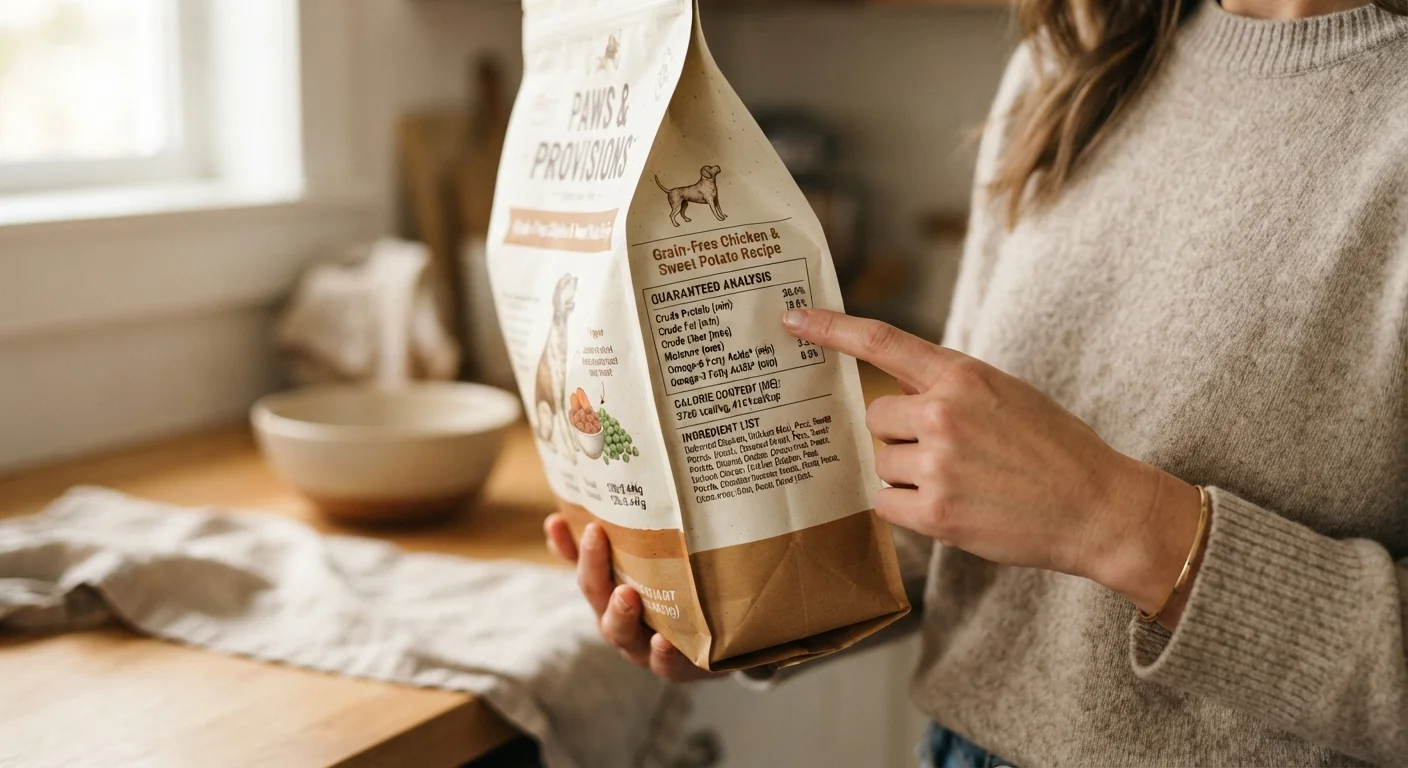
Why Pet Food Labels Are Worth Decoding
Pet food packaging is designed with marketing in mind - bold claims about "premium protein" or "wholesome ingredients" are crafted to catch your eye, not necessarily to inform your decision. The real information is on the back or side panel, in the ingredient list, guaranteed analysis, and nutritional adequacy statement. Learning to read these three sections gives you a factual basis for evaluating any food, regardless of how the front of the bag is designed.
This skill also saves money. Once you understand what labels actually communicate, you're less likely to pay a premium for a product based solely on attractive packaging. For a broader look at managing pet ownership costs without sacrificing quality, see our practical guide to pet care on a budget.
Label Reading Applies to Treats Too
Treats and toppers are also subject to ingredient and guaranteed analysis labeling. Many are not nutritionally complete, and some are high in sodium or fat. Apply the same label-reading habits to anything you feed regularly, not just the main meal. Treats should generally make up no more than 10% of your pet's daily caloric intake, though your vet can advise on what's appropriate for your individual animal.
The Three Sections That Matter Most
Before walking through the steps, it helps to know what you're looking for. Every regulated pet food sold in the US should carry these key panels:
- Ingredient list: All ingredients in descending order by pre-cooking weight.
- Guaranteed analysis: Minimum or maximum percentages for key nutrients - typically crude protein, crude fat, crude fiber, and moisture.
- Nutritional adequacy statement: A phrase indicating whether the food meets established nutrient profiles and for which life stage.
The Association of American Feed Control Officials (AAFCO) sets the nutrient profiles and label standards that most US states adopt into law. Understanding how AAFCO language works is central to reading any label accurately. This parallels the challenge of reading human nutrition labels - a topic explored in reading a nutrition label without getting lost in the numbers.
Find and Read the AAFCO Nutritional Adequacy Statement
Locate the sentence that typically begins: "[Product name] is formulated to meet the nutritional levels established by the AAFCO Dog (or Cat) Food Nutrient Profiles for [life stage]." This statement tells you two things: whether the food is complete and balanced, and which life stage it's designed for (growth/reproduction, adult maintenance, or all life stages).
If the label says "intermittent or supplemental feeding only," the food is not nutritionally complete on its own and should not be used as a primary diet without veterinary guidance.
Interpret the Ingredient List Correctly
Ingredients are listed in descending order by pre-cooking weight, which includes moisture. A raw meat ingredient like "chicken" may weigh more than a dry grain before processing, but after cooking its contribution can be smaller relative to dried or concentrated ingredients. This doesn't automatically make a food inferior - it's simply context you need when interpreting ingredient order.
Look at the first five to seven ingredients as a group. They represent the bulk of the formula. Identify the primary protein source, any named grain or vegetable carbohydrates, and fat sources. Be cautious of vague terms like "meat by-products" or "animal digest" if you prefer more transparency, though by-products are not inherently low quality - they include nutrient-rich organ meats.
Understand the Guaranteed Analysis Panel
The guaranteed analysis lists minimum percentages for crude protein and crude fat, and maximum percentages for crude fiber and moisture. These are not exact values - actual nutrient content may be higher or lower within a regulatory range. "Crude" refers to the chemical method of measurement, not the quality or digestibility of the nutrient.
When comparing a wet food to a dry food, the moisture difference makes direct comparison misleading. To compare on an equal basis, calculate the dry matter basis: divide the nutrient percentage by (100 minus the moisture percentage), then multiply by 100. This strips out water and lets you compare nutrient density fairly.
Check the Feeding Guidelines - Then Adjust
Feeding guidelines on the label are starting points based on average animals of a given weight. They are not personalized recommendations. A less active, older, or neutered pet may need considerably less than the label suggests, while a growing puppy or highly active dog may need more.
Use the guidelines to establish an initial portion, then monitor your pet's body condition over two to four weeks and adjust accordingly. For a structured way to assess appropriate serving sizes, see portion control for pets.
Look Beyond Marketing Claims on the Front Panel
Terms like "natural," "holistic," "human-grade," and "superfood" are largely unregulated in pet food marketing and carry no standardized legal definition for labeling purposes (with some exceptions for "natural" under AAFCO guidelines). They are not reliable quality indicators. Instead, focus on whether the product carries a valid AAFCO statement, lists identifiable ingredients, and fits your pet's life stage and nutritional needs.
If a food is marketed around a particular health claim - grain-free, raw-inspired, limited ingredient - look for the evidence behind it rather than accepting the claim at face value. Our article on grain-free pet diets and the research is a useful reference for one common example.
Common Label Terms That Can Mislead
Certain words on pet food labels carry specific regulatory definitions under AAFCO guidelines. Misreading them is easy if you don't know what to look for:
- "Beef" or "Chicken" (the 95% rule): If a single named ingredient leads the product name (e.g., "Beef for Dogs"), that ingredient must make up at least 95% of the total product weight, excluding water.
- "Dinner," "Entrée," or "Formula" (the 25% rule): These qualifier words mean the named ingredient needs to comprise only 25-95% of the product.
- "With" (the 3% rule): "Dog Food with Salmon" requires only 3% salmon - a much smaller amount than most consumers expect.
- "Flavor": No minimum percentage is required; the ingredient just needs to be detectable.
These distinctions matter when comparing products that appear similar on the front label. If you're considering making your own food to sidestep label confusion, our article on homemade pet food vs. commercial food walks through the real trade-offs involved.
Don't Rely on Front-Panel Claims Alone
Pet food front panels are advertising, not nutrition education. A bag prominently featuring salmon imagery may contain only 3% salmon under the "with" naming rule. Always flip to the ingredient list and guaranteed analysis before drawing conclusions about a food's nutritional profile. The back panel is where the regulated, factual information lives.
Putting It Together: Making a Confident Decision
Reading a label fluently takes a few passes. On your first read, check the AAFCO statement and confirm the food is appropriate for your pet's life stage. On the second, scan the ingredient list for the protein sources and any ingredients you want to avoid. On the third, use the guaranteed analysis to compare moisture-adjusted nutrient levels across products if you're evaluating more than one option.
Keep in mind that even a well-labeled food may not be right for every individual animal. Pets with health conditions, allergies, or specific weight management needs may require guidance beyond what any label can provide. Once you've identified a food that looks suitable, our diet change checklist can help you transition safely. And if you do decide to switch, transitioning your pet to a new food without digestive upset outlines a gradual approach that reduces stomach upset.
This article provides general educational information about pet food labeling and is not a substitute for personalized veterinary advice. Consult your veterinarian before making significant changes to your pet's diet, especially if your pet has a health condition.