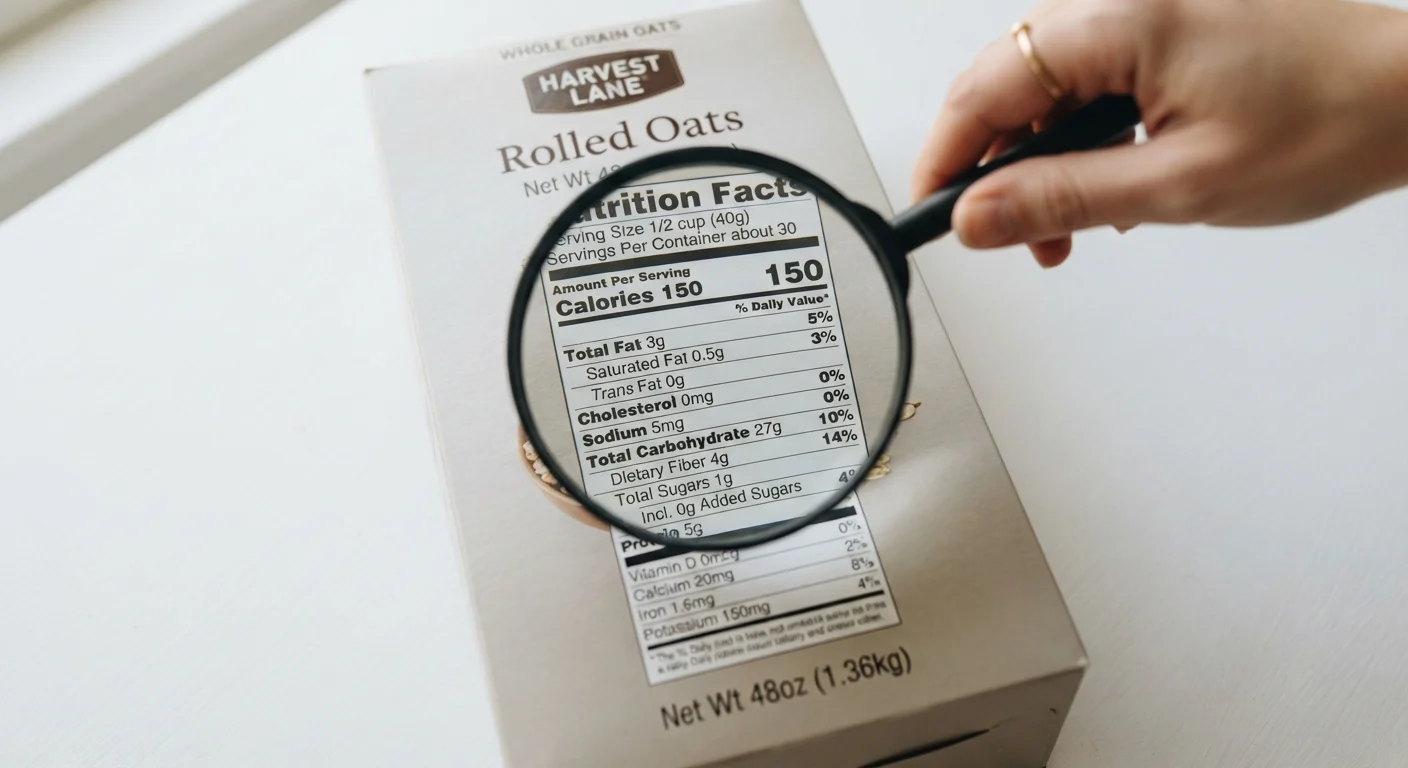
Why Nutrition Labels Feel Overwhelming
A standard Nutrition Facts panel packs dozens of numbers into a few square inches. Calories, grams, percentages, and a column of nutrients most people can't immediately place - it's no wonder many shoppers glance and move on. But the label follows a predictable structure, and once you understand that structure, reading it takes under a minute.
If you're newer to thinking about food and health, our foundational nutrition guide is a good place to start before diving into label details. For everyone else, the steps below walk through the panel from top to bottom - the same order the FDA intended.
What you will need
How to Read a Nutrition Label Step by Step
Work through the label in the sequence below. Each step builds on the one before it, so resisting the urge to jump straight to calories will pay off.
Check the serving size first
Every number on the label - calories, fat, sodium, everything - applies to one serving as defined by the manufacturer. If the package says a serving is 2/3 cup but you typically eat a full cup, every number you read needs to be scaled accordingly. The label also shows servings per container, which helps you understand the full picture at a glance.
Look at the calorie count in context
Calories measure the energy a food provides per serving. They matter, but they don't tell the whole story - 200 calories from nuts and 200 calories from a sweetened snack carry very different nutritional profiles. Note the calorie count, then keep reading before drawing conclusions.
Identify nutrients to limit
The label highlights nutrients most Americans tend to consume in excess: saturated fat, trans fat, sodium, and added sugars. These are listed because higher intake is associated - at population level - with increased risk of certain chronic conditions. You don't need to eliminate them, but keeping an eye on them across the day is worthwhile.
Identify nutrients to get enough of
Below the nutrients to limit, the label lists nutrients many people fall short on: dietary fiber, vitamin D, calcium, iron, and potassium. These support functions ranging from digestive health to bone density to blood pressure regulation. Foods with meaningful amounts of these are generally worth noting.
Use the % Daily Value column as a quick gauge
The % Daily Value (%DV) column on the right tells you how much of each nutrient one serving contributes toward general daily targets - based on a 2,000-calorie reference diet. A quick rule of thumb used by the FDA: 5% DV or less is considered low; 20% DV or more is considered high. Use this to quickly flag foods that are very high or very low in any given nutrient, for better or worse.
Compare Products Using %DV
When choosing between two similar products, the %DV column makes comparison straightforward - you don't need to interpret raw grams. Look for higher %DV on fiber and key vitamins, and lower %DV on sodium and saturated fat. This works even if the serving sizes differ slightly between products.
What the Ingredient List Adds
The Nutrition Facts panel and the ingredient list are two separate tools. The panel tells you how much of key nutrients a food contains; the ingredient list tells you what the food is made of and in roughly what proportions - ingredients are listed in descending order by weight.
A few things to watch for: added sugars appear under many names beyond "sugar." Our guide on identifying added sugars on ingredient lists covers the most common aliases. Also, a short ingredient list isn't automatically better - some minimally processed foods have few ingredients, but so do some highly refined ones. Use the ingredient list alongside the Nutrition Facts panel, not instead of it.
For a broader look at how nutrition information can be misread or oversimplified, see common pitfalls in popular diet advice.
"Low Fat" Doesn't Mean Low Everything
Front-of-package claims like "low fat," "reduced sodium," or "light" are regulated terms, but they describe only one nutrient. A product labeled low fat may still be high in added sugars or sodium. Always check the full Nutrition Facts panel rather than relying on front-label claims alone.
Putting It into Practice
Reading labels is most useful when it informs patterns rather than individual choices. A single food with high sodium isn't a problem if the rest of your day is low in sodium. A food with more saturated fat might still fit into a diet rich in vegetables, fiber, and whole foods. Context matters.
If you want to apply these skills to your overall eating habits, our nutrition check-in guide offers a reflective set of questions about daily eating patterns - no calorie counting required. And if you're curious how dietary guidelines translate to an actual plate, that article breaks down proportions in practical terms.
This article is for general informational and educational purposes only and is not a substitute for personalized nutrition or medical advice. Consult a registered dietitian or qualified healthcare professional for guidance specific to your health needs.