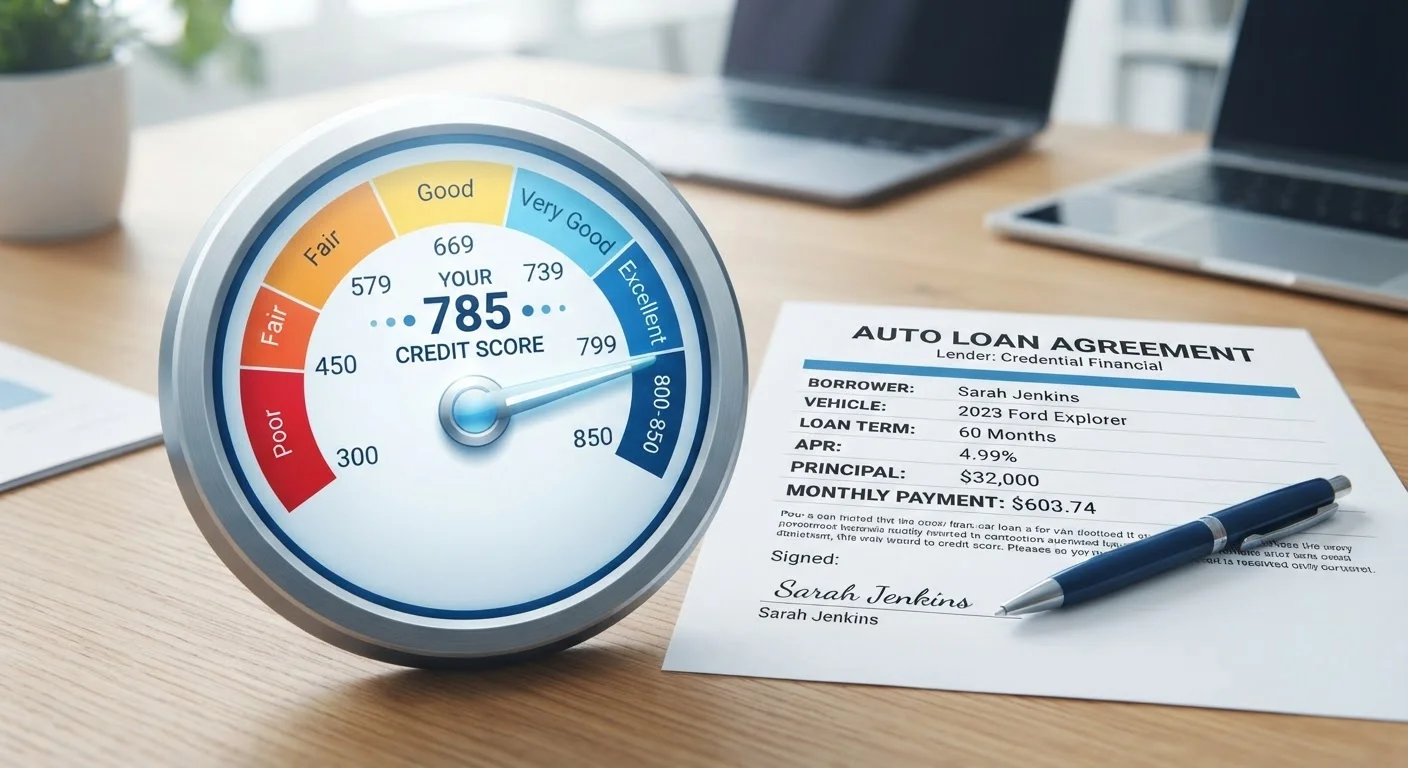
How Lenders Translate Your Score Into a Rate
Auto lenders do not set interest rates individually - they operate with structured pricing grids that map credit score ranges to predetermined rate tiers. When you apply for financing, the lender pulls your credit score, places you in the corresponding tier, and assigns the rate attached to that bracket. It is largely a formulaic process.
While exact tier definitions differ by lender, a common structure looks something like this:
- Super-prime (720+): Lowest available rates, highest approval odds
- Prime (660-719): Competitive rates, standard terms
- Near-prime (620-659): Moderate rates, more scrutiny on loan-to-value ratio
- Subprime (580-619): Elevated rates, shorter terms or larger down payments often required
- Deep subprime (below 580): Highest rates, fewest lender options
Understanding where you sit before you shop is the foundation of realistic budgeting. See our overview of auto loan fundamentals for context on how rates interact with the full structure of a loan contract.
~5-9%
Typical APR spread between prime and subprime auto loans
Industry data consistently shows a wide gap in auto loan rates between credit tiers, with subprime borrowers often paying 5 to 9 percentage points more than prime borrowers on comparable loan amounts.
$9,000+
Potential extra interest paid by subprime vs. prime borrower
On a $28,000 auto loan over 60 months, the gap in total interest paid between a prime-rate borrower and a subprime borrower can exceed $9,000 depending on the specific rates offered.
720
Score threshold most lenders use for prime-tier pricing
While cutoffs vary by lender, a FICO score of 720 or above is widely cited in the auto lending industry as the threshold for accessing a lender's most competitive rates.
The Real Cost Difference Between Tiers
Rate differences between tiers look modest on paper but compound significantly over a 60- or 72-month loan. To make this concrete, consider a $28,000 loan over 60 months:
- At 6% APR (prime): roughly $540/month, about $4,400 in total interest
- At 11% APR (near-prime): roughly $609/month, about $8,500 in total interest
- At 17% APR (subprime): roughly $694/month, about $13,600 in total interest
That is a difference of more than $9,000 in total interest between a prime borrower and a subprime borrower financing the same vehicle at the same term. The car is identical - the cost of borrowing is not.
It is also worth noting that used car loans carry higher base rates than new car loans at every tier, which compounds the cost further for buyers financing a pre-owned vehicle with a lower credit score.
“The interest rate you receive on an auto loan is not arbitrary - it is a direct reflection of the statistical likelihood of repayment as predicted by your credit history. Borrowers who understand this system can work within it rather than being surprised by it.”
— Consumer Financial Protection Bureau, U.S. federal consumer finance regulatory agency
APR Is the Number That Actually Matters
When evaluating loan offers across tiers, focus on the APR rather than the nominal interest rate alone. APR captures fees folded into the cost of borrowing and gives you a more accurate basis for comparison. Two loans with the same stated rate can have different APRs if one includes origination fees or dealer reserve markups.
For a detailed breakdown of why these two numbers differ, see APR vs. interest rate on a car loan.
When you receive multiple offers, the APR is the apples-to-apples comparison point. A slightly lower interest rate with higher fees can cost more overall than a slightly higher rate with no fees.
Using Your Credit Tier as a Negotiating Baseline
Knowing your approximate tier before you set foot in a dealership changes your negotiating position. If you already know you are a prime borrower, a dealer quoting a near-prime rate is adding margin - and you have grounds to push back or present a competing offer.
The most practical way to establish a baseline is to get pre-approved through a bank, credit union, or direct lender before shopping. This locks in a rate offer you can compare against whatever the dealer's financing department presents. Our article on getting pre-approved for an auto loan walks through that process in detail.
If your score currently sits near a tier boundary - say, 657 when prime begins at 660 - it may be worth a short delay to pay down revolving balances or address any errors on your credit report before applying. Even a modest score improvement at a boundary can shift you into a materially better rate tier.
This article provides general financial education and is not personalized financial or lending advice. Consult a qualified financial professional for guidance specific to your circumstances.