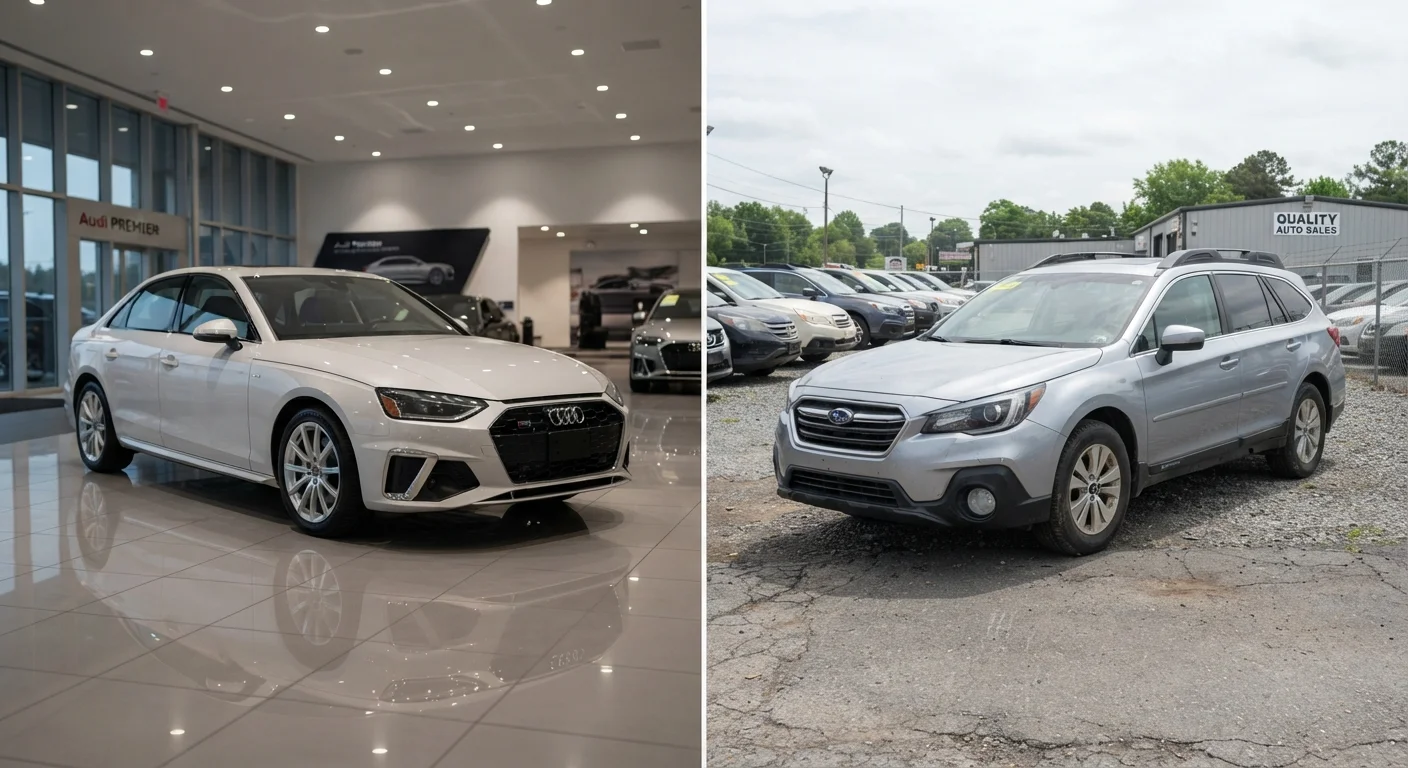
Why Lenders Price New and Used Loans Differently
Auto lenders treat new and used vehicles as distinct collateral categories. A new car has a known, verifiable value — the manufacturer's suggested retail price — and depreciates on a relatively predictable curve. A used vehicle introduces uncertainty: actual condition, mileage history, and remaining service life are harder to underwrite. That uncertainty is priced into the interest rate.
As a result, used car loan rates have historically run higher than new car rates. According to Federal Reserve consumer credit data, the spread between average new and used auto loan rates at commercial banks has frequently ranged from roughly 2 to 4 percentage points, though this gap shifts with broader credit market conditions. This matters because even a 3-point rate difference on a $20,000 loan over 48 months adds up to several hundred dollars in additional interest paid.
Lenders also consider loan-to-value (LTV) ratio — the relationship between what you borrow and what the vehicle is worth. On a used car, especially one over five or six years old, lenders may cap LTV more aggressively or require a larger down payment to limit their exposure if the vehicle loses value faster than expected. For a full breakdown of how your credit score shapes the rate you're offered, see how credit tiers map to auto loan rates.
Loan Terms: Length, Limits, and What They Cost You
New car loans are routinely available in 60-, 72-, and even 84-month terms. Used car loans are more constrained — many lenders cap terms at 48 or 60 months for vehicles over a certain age or mileage, and some won't finance cars older than seven to ten years at all. The reasoning is straightforward: lenders don't want to hold a loan longer than the vehicle is likely to remain reliable and retain meaningful resale value.
Shorter loan terms on used cars create a real monthly payment squeeze. A buyer financing $18,000 at 8% over 48 months pays roughly $439 per month; stretched to 60 months at the same rate, that drops to about $365. But fewer lenders offer that longer term on an older vehicle. Meanwhile, a new car buyer financing $28,000 at 5% over 72 months pays around $450 monthly — a similar payment on a much larger balance.
| New Car Loan | Used Car Loan | |
|---|---|---|
| Typical interest rate range | Lower (often 4–7% for good credit) | Higher (often 7–12% for good credit) |
| Maximum loan term | Up to 84 months common | Often capped at 48–60 months |
| Manufacturer subsidized rates | Available (0%–2.9% promotions) | Not available |
| Lender LTV requirements | More flexible, up to 100–110% LTV | Stricter, especially for older vehicles |
| Vehicle age restrictions | None — vehicle is new | Many lenders cap at 7–10 years old |
| Total interest on typical loan | Higher in dollar terms (larger balance) | Lower dollars, higher as % of price |
This is why monthly payment comparisons between new and used loans can be misleading. Total interest paid over the life of the loan is the more meaningful metric. Understanding APR versus the stated interest rate is equally important — APR captures fees the interest rate alone does not.
Manufacturer Incentive Rates and Why They Don't Apply to Used Cars
One financing advantage exclusive to new vehicles is the manufacturer-subsidized rate — sometimes advertised as 0% or 1.9% APR for qualified buyers. These rates are funded by the automaker's captive finance arm, not the open credit market, and they serve as a sales tool to move inventory. They are real and can represent genuine savings, but they come with conditions: typically a short loan term (often 36 or 48 months), a strong credit score requirement (usually 700+), and no combination with other incentives like cash-back rebates.
If you don't qualify for the promotional tier, the rate reverts to a standard market rate — sometimes higher than what a bank or credit union would offer. Used car buyers have no equivalent subsidy available. Their options are limited to banks, credit unions, and online lenders, all pricing the loan based on the vehicle's age, mileage, and the borrower's credit profile.
Get Pre-Approved Before You Shop
Securing a pre-approval from a bank or credit union before visiting a dealership gives you a rate benchmark regardless of whether you're buying new or used. Dealers can sometimes beat that rate, but you'll only know if you have a number to compare against. Pre-approval also clarifies your actual budget before negotiation begins, which prevents payment-focused selling tactics from inflating your total cost.
For buyers comparing new versus certified pre-owned (CPO), it's worth noting that some manufacturers offer special financing on CPO vehicles, though rates are rarely as low as new-vehicle promotions. See how new and CPO pricing compares for a closer look at that middle ground.
Running the Numbers: Which Loan Costs More Overall?
The answer depends on three inputs: purchase price, interest rate, and loan term. A used car purchased for $15,000 at 9% over 48 months generates roughly $2,900 in total interest. A new car purchased for $32,000 at 5% over 60 months generates approximately $4,200 in total interest — more in dollar terms, though on a far larger purchase. When evaluated as a percentage of the purchase price, the used loan costs more relative to the vehicle's value.
Where buyers sometimes go wrong is comparing monthly payments without accounting for the full loan period, or choosing a longer new-car loan to get a lower monthly figure without realizing they'll pay meaningfully more in interest over time. The real total cost of new versus used ownership goes beyond financing alone — depreciation, insurance, and maintenance all factor in. For insurance specifically, what drives the premium gap between new and used vehicles is worth reading before finalizing a budget.
If you later want to revisit your loan terms after purchase, refinancing an auto loan is an option — though timing and fees determine whether it actually saves money. And before visiting any dealership, understanding dealer financing versus arranging your own loan gives you a stronger negotiating position regardless of which vehicle type you choose.
This article provides general financial education about auto loan structures and is not personalized financial or lending advice. Loan rates, terms, and lender requirements vary by institution, borrower profile, and market conditions. Consult a qualified financial professional for guidance specific to your situation.