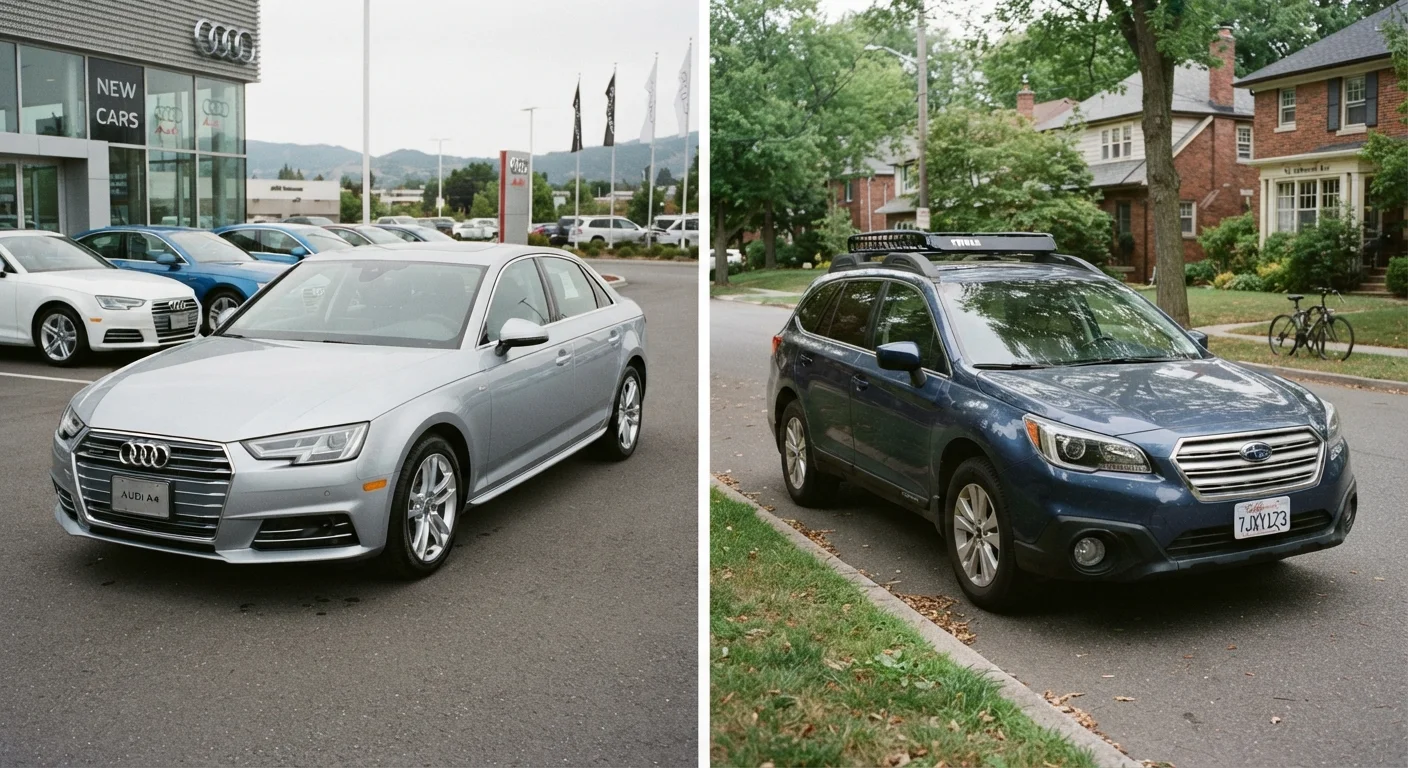
The Core Financial Tradeoff
The new-vs.-used decision is fundamentally a question about where you want to absorb risk and cost. New cars transfer most of the financial risk to you in the form of depreciation during the first few years of ownership. Used cars shift the risk toward mechanical uncertainty—you don't fully know the vehicle's history, regardless of what paperwork says.
Neither option is universally superior. The goal is to identify which type of risk your financial situation can better absorb, then structure your purchase to minimize exposure. For value-driven buyers, that means running the actual numbers—not relying on intuition or dealership framing. For broader money-management context, the Smart Spending hub offers frameworks for evaluating large purchases within your overall budget.
Depreciation: Where the Money Actually Goes
Depreciation is the single largest cost most vehicle owners never see on a bill. A new vehicle can lose roughly 15–25% of its value within the first year of ownership, and up to 50% or more over five years, though exact figures vary by segment, brand, and market conditions.
This creates an opportunity for used-car buyers. A vehicle that is two to four years old has already absorbed its steepest depreciation curve. The previous owner, not you, paid for that initial value loss. You inherit a vehicle with significant remaining useful life at a meaningfully lower cost basis.
~20%
Average first-year new car depreciation
Industry data from sources including Edmunds and iSeeCars consistently shows new vehicles lose roughly 15–25% of value in year one, varying by segment.
2–4 years
Used vehicle age with strongest value-per-dollar
Vehicles in this age range have absorbed the steepest depreciation while typically retaining significant remaining service life and available warranty coverage.
1–4 pts
Typical interest rate premium on used auto loans
Lenders generally charge higher rates on used vehicles; the precise gap depends on credit score, loan term, and prevailing market rates.
The flip side: if you plan to keep a new vehicle for ten or more years and drive high annual mileage, the per-mile depreciation cost shrinks considerably. Depreciation becomes less decisive the longer your ownership horizon extends.
Financing Rates and Total Cost of Ownership
Loan interest rates for new vehicles are typically lower than those available for used vehicles, because lenders view new cars as lower-risk collateral. That rate gap—which can range from one to several percentage points depending on the lending environment and your credit profile—partially offsets the higher sticker price of a new car over the life of a loan.
Total cost of ownership (TCO) is the more honest metric. TCO bundles depreciation, financing costs, insurance premiums, fuel, routine maintenance, and anticipated repairs into a single comparable figure across a planned ownership period. Insurance premiums tend to be higher on newer vehicles, while older used cars may carry lower premiums but higher repair exposure.
Before comparing monthly payments, compare total loan cost: multiply the monthly payment by the number of months and add your down payment. This reveals what you actually pay, not just what you owe each month.
Monthly payment figures are easy for dealerships to manipulate by extending loan terms. The total-out-of-pocket figure is the honest comparison point.
When evaluating a CPO vehicle, request the actual inspection report—not just the CPO certification label. The depth of reconditioning varies considerably between programs.
CPO standards differ by manufacturer and dealer. Reviewing the inspection report helps you understand exactly what was checked and what was corrected.
Understanding how to structure an auto loan is a separate skill from choosing the vehicle. The Financing & Loans hub covers how to evaluate loan terms, compare lender offers, and reduce total interest paid—all of which apply regardless of whether you buy new or used.
This article provides general financial information for educational purposes. Consult a qualified financial adviser for guidance specific to your situation.
Reliability, Warranty, and Risk Management
New vehicles come with manufacturer warranties—typically a bumper-to-bumper coverage period of three years and a powertrain warranty extending five years or more, though terms vary by manufacturer. This substantially reduces your out-of-pocket repair exposure during early ownership.
Used vehicles generally come with limited or no factory warranty, though certified pre-owned (CPO) programs offered through manufacturer-affiliated dealers often include an extension of original warranty coverage. CPO vehicles cost more than comparable non-certified used vehicles, but they undergo a standardized inspection process and carry documented reconditioning standards.
For non-CPO used vehicles, a third-party pre-purchase inspection (PPI) by an independent mechanic is your primary risk-management tool. It is not optional—it is the due diligence that determines whether a seemingly attractive price holds up. Our pre-purchase inspection checklist walks through the mechanical, cosmetic, and documentation items to cover before committing.
Lifestyle Fit: Matching the Vehicle to Your Situation
Beyond the financial arithmetic, several practical factors should shape your decision:
- Annual mileage: High-mileage drivers may find that a newer vehicle with a full warranty is worth the premium, since repair risk accumulates faster under heavy use.
- Ownership duration: Buyers who typically trade in every two to three years absorb the most depreciation on new vehicles. Those who hold vehicles long-term dilute that cost over more years.
- Feature priorities: If specific safety technology or fuel efficiency is important, a recent model year—new or lightly used—may be necessary to access those features at a reasonable price.
- Budget flexibility: A tight monthly budget often favors a used vehicle with a lower loan balance, even if the interest rate is slightly higher. Total monthly payment matters for cash flow.
- Risk tolerance: Buyers who strongly prefer predictable costs may find that new-vehicle warranty coverage is worth paying for. Those comfortable managing occasional repair costs may prefer the lower entry price of an older vehicle.
Making the Final Call
No decision framework replaces running the specific numbers on the specific vehicles you are considering. Use these four questions as a filter:
- What is the five-year total cost of ownership for each option, including financing, insurance, estimated maintenance, and depreciation?
- What is my realistic ownership horizon? Longer holding periods favor new; shorter ones often favor used.
- Can I absorb an unexpected repair? If a $2,000 bill would create serious financial hardship, warranty coverage has measurable value beyond its sticker cost.
- Has the used vehicle passed an independent inspection? If not, treat the price as unknown until it does.
Buyers who answer these questions with actual figures—not approximations—consistently make more confident and financially sound decisions. The goal is not to find the cheapest vehicle; it is to find the one that costs you the least over the time you own it, given your specific driving patterns and financial constraints.