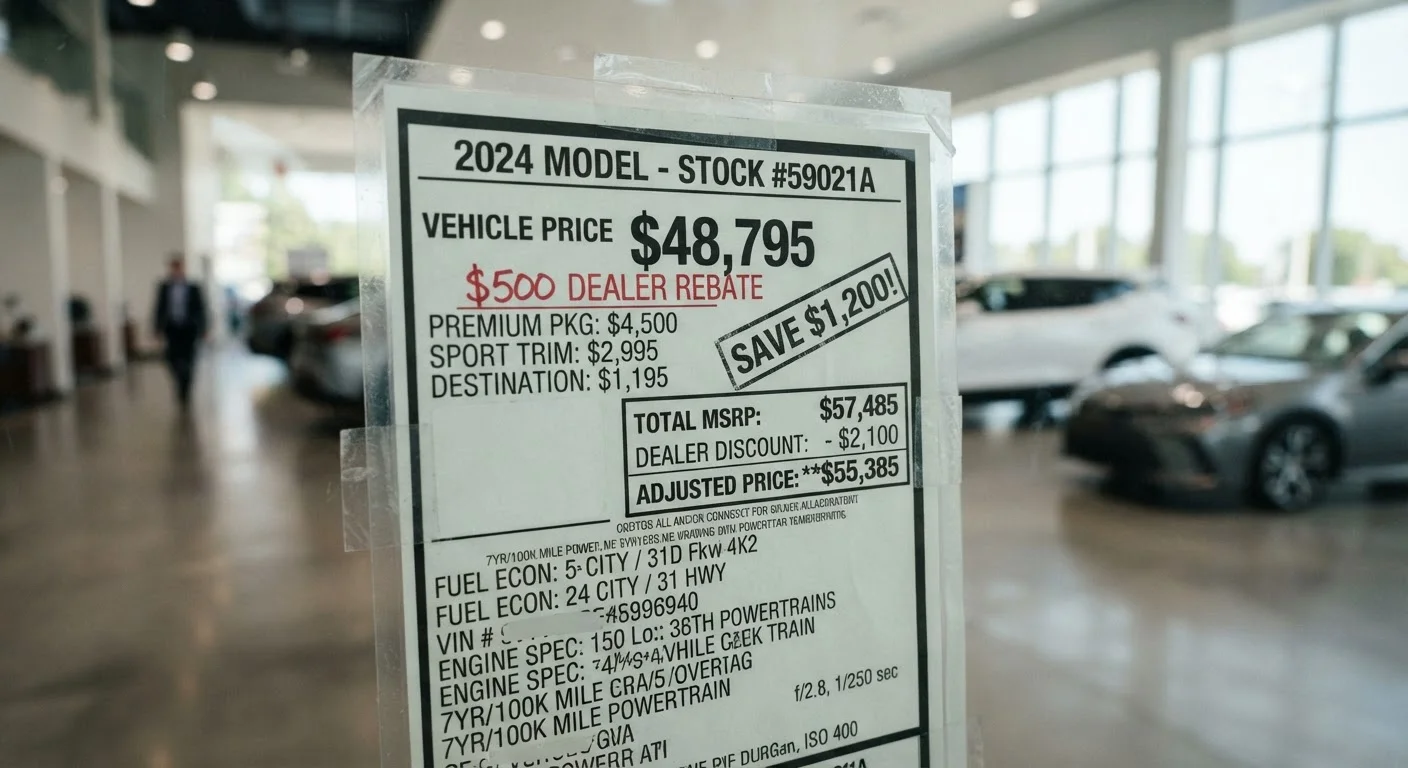
MSRP: The Starting Point, Not the Finish Line
The Manufacturer's Suggested Retail Price is exactly what the name implies — a suggestion. Automakers set MSRP to create price consistency across their dealer network, but dealers are not legally required to sell at that figure. In a competitive market with ample inventory, transaction prices routinely fall below MSRP. In a constrained market, they climb above it.
The window sticker you see in a dealership shows the base MSRP, plus the cost of any factory-installed packages and options, and a destination charge — the fee for shipping the vehicle from the factory. That final sticker number is often several thousand dollars above the base MSRP and is the figure most buyers mistakenly treat as the price floor.
Understanding what sits inside the sticker price is the first step toward a more informed negotiation. For a complete breakdown of every layer between factory cost and final signature, see the full landscape of car pricing.
Dealer Invoice Price: A Useful Reference With Real Limits
The dealer invoice is the document showing what the manufacturer charged the dealer for the vehicle. For years, buyers were told that negotiating down to invoice was effectively getting a deal at the dealer's cost. That's no longer an accurate picture — and arguably never was.
Several mechanisms reduce what a dealer actually pays after the transaction closes:
- Holdback: A percentage of MSRP (commonly 1–3%) that the manufacturer refunds to the dealer quarterly, regardless of what the vehicle sold for.
- Dealer incentives: Manufacturer-to-dealer cash payments tied to volume targets or specific models, which don't appear on the invoice.
- Dealer cash: Direct payments from the manufacturer to move slow-selling inventory.
This means a dealer can sell a vehicle at invoice — or even below it — and still record a profit once holdback and incentives are factored in. Understanding holdback and other hidden profit sources gives a fuller picture of the margin layers most buyers never see.
Ask for the Invoice — Then Go Further
Requesting a copy of the dealer invoice is a reasonable step and most dealers will provide it. But treat it as one data point, not the final word on dealer cost. Combine it with current market transaction data for the same vehicle in your region to build a complete negotiating picture.
Market Value: The Number That Actually Reflects Reality
Market value is what buyers in your region are paying for a specific vehicle — same trim, similar mileage and options — in recent completed transactions. It's the only price figure that reflects real supply and demand at any given moment, and it's the benchmark that professional car buyers use to evaluate whether a deal is fair.
Market value moves independently of both MSRP and invoice. When a new SUV launches to strong demand and short supply, its market value can exceed MSRP by thousands. When a sedan sits on lots for 90 days, market value can fall well below invoice. Neither the sticker nor the invoice tells you this — only transaction data does.
1–3%
Typical holdback as a percentage of MSRP
Industry-standard holdback rates vary by manufacturer but commonly fall in this range, reducing the dealer's true cost below the invoice figure.
~95 days
Average new vehicle days on lot before price pressure builds
Generally, vehicles sitting beyond 60–90 days tend to attract dealer incentives and reduced pricing, reflected in falling market values.
$1,000–$4,000
Typical gap between MSRP and transaction price on slow-selling models
On vehicles with adequate inventory and normal demand, real transaction prices have historically averaged meaningfully below the sticker in balanced markets.
Buyers who anchor only to MSRP or invoice often misread the room: they either overpay in a competitive market or leave money on the table in a slow one. Grounding your offer in current market value removes that guesswork. For guidance on where to find reliable transaction data, see our overview of pricing tools and market data sources.
How These Three Numbers Interact at the Negotiating Table
In practice, all three figures shape the conversation — even if only one should drive your offer. Dealers frequently anchor buyers to MSRP because it's the highest number. Informed buyers counter by referencing invoice, which is a reasonable move but still leaves dealer profit sources unaddressed. The strongest position is knowing current market value and building your offer around it.
A few practical principles follow from understanding all three numbers:
- Don't let MSRP set your ceiling. In most market conditions, paying full MSRP on a vehicle with adequate inventory means leaving money on the table.
- Invoice is a floor estimate, not the dealer's true cost. Use it as a sanity check, not your target price.
- Market value is your anchor. If local transaction data shows a vehicle selling at $1,500 below MSRP, that's your starting frame — not invoice, not sticker.
- Adjust for local conditions. Market value varies by region, time of year, and inventory levels. A vehicle priced aggressively in one city may carry a premium in another.
It's also worth knowing that many negotiation assumptions buyers carry into dealerships don't hold up under scrutiny. Common dealership negotiation myths walks through the most costly misconceptions. And if you want to brush up on the full vocabulary of car pricing, key terms every car buyer should know covers the essential glossary before you compare new and used prices.
Market Value Varies by Region and Trim
Market value is not a single national number — it reflects transactions in specific geographic markets and applies to specific trim levels and option configurations. A well-equipped trim in a high-demand metro may carry a very different market value than the same trim in a less competitive market. Always source transaction data that matches your local conditions as closely as possible.