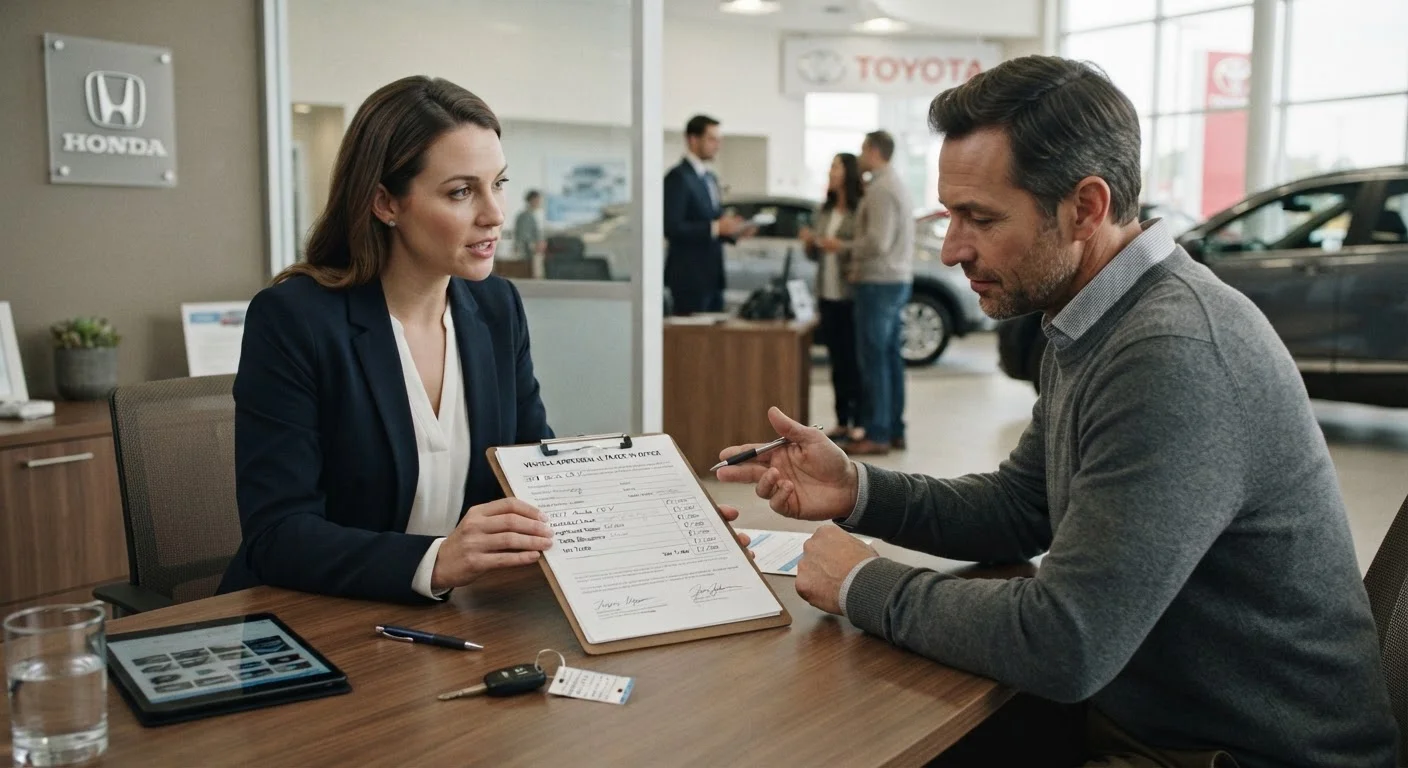
How Dealers Arrive at a Trade-In Number
Trade-in valuation is not a straightforward formula, and the number a dealer offers is almost never their opening assumption about what your vehicle is worth on the open market. Dealers typically start with regional wholesale auction data — the prices similar vehicles are currently fetching at dealer-only auctions — and then subtract projected reconditioning costs, transportation costs if they plan to send it to auction, and their own profit margin on the resale.
This is why trade-in offers are structurally lower than private-party sale prices. A private buyer pays retail; a dealer pays wholesale (or below) because they are absorbing the risk and cost of reselling. The gap between what a dealer offers and what a private buyer might pay can range from a few hundred dollars to several thousand, depending on the vehicle's age, demand, and condition.
Reconditioning is a key variable dealers control. If your vehicle needs tires, a detail, or minor mechanical work, they will estimate those costs and subtract them from the offer. These estimates are not always transparent, and asking for an itemized breakdown is a reasonable request.
Third-Party Vehicle Valuation Tool
Establishes an independent wholesale and retail market estimate for your trade-in before you speak with any dealer.
Vehicle History Report
Documents accident history, title status, and ownership chain — factors dealers will check anyway and that directly affect appraisal value.
Written Dealer Appraisal (second dealership)
Provides a competing offer you can reference during negotiation, creating measurable pressure on the primary dealer's number.
Loan Payoff Statement
Confirms the exact remaining balance on your current vehicle so you can accurately calculate your net equity position.
Understanding this structure matters because it reframes the negotiation. You are not arguing about what your car is "worth" in some abstract sense — you are negotiating the spread between the dealer's wholesale cost and what they can realistically resell it for. That spread is where there is genuine room to move. See also how focusing on total price rather than monthly payments applies the same logic to the purchase side of the deal.
Why Separating the Negotiations Protects Your Position
The core problem with bundled negotiations is that they create a four-variable equation — purchase price, trade-in value, financing rate, and monthly payment — that dealers are experienced at managing simultaneously while buyers typically are not. Giving ground on one variable is easy to obscure when attention is on another.
A common pattern: a buyer pushes hard on the purchase price and gets a meaningful concession. The dealer then offers a trade-in value well below market rate, recouping the lost margin. Alternatively, a buyer gets a strong trade-in offer, but the purchase price quietly hardens. Neither outcome is visible unless each transaction is evaluated independently against market data.
Bundled Deals Hide Real Numbers
When a salesperson asks about your trade-in before you've agreed on a purchase price, they can absorb concessions on one side by tightening margins on the other. This is not inherently deceptive, but it does mean you cannot verify whether either number is fair without treating them separately. Always establish the purchase price first, in writing, before introducing your trade-in.
Keeping the conversations sequential — purchase price first, trade-in second — forces each number to stand on its own. It also makes any mid-negotiation adjustment obvious: if the purchase price changes after you introduce the trade-in, that is a signal worth examining. For additional context on how financing layer into this dynamic, our article on dealer financing versus pre-arranged loans covers how a pre-approved loan rate removes one more variable from the bundle.
Instant Online Offers Expire Quickly
Online appraisal tools from third-party vehicle marketplaces typically generate offers valid for only a few days, and actual payout may require an in-person inspection. Treat these figures as directional benchmarks, not guaranteed checks. Market conditions and vehicle inspection findings can reduce the final number.
Timing your trade-in conversation strategically also intersects with broader dealership dynamics. Dealers managing end-of-period sales targets may have more flexibility on purchase price — but that flexibility can disappear if they feel they are giving up margin on the trade-in simultaneously. Our piece on whether end-of-month timing affects price examines this trade-off in depth.
Following the Steps: What to Expect
Most dealers will ask about your trade-in early — often before you have test-driven anything. Politely deferring that conversation is entirely within your rights as a buyer. A straightforward response is: "I do have a vehicle to trade, but I'd like to work on the purchase price first." Most salespeople will proceed.
Research your vehicle's wholesale market value independently
Dealers appraise trade-ins against wholesale auction data — what they expect to get when reselling your vehicle, minus reconditioning costs and profit margin. Start by gathering your own market data from established third-party automotive valuation sources. Note both the trade-in and private-party ranges, as these define your negotiation corridor. The difference between the two represents the realistic upside of selling privately versus the convenience premium of trading in.
Collect at least one written appraisal before visiting your target dealer
Visit a competing dealership — or use a participating independent dealer — to get a written appraisal on your vehicle. This gives you a floor number that is backed by a real offer, not a calculator estimate. Some large used-car operations will provide written purchase offers valid for a set number of days; retain that document. A concrete competing offer is significantly more persuasive in negotiation than a printed web estimate.
Negotiate the purchase price of the new vehicle first
Before mentioning your trade-in at all, reach a firm, documented agreement on the purchase price of the vehicle you are buying. This is the single most effective structural move available to you. Once a price is in writing, it becomes much harder for the dealer to quietly reduce it later to compensate for a more generous trade allowance. This principle is discussed in detail in our guide on negotiating vehicle price versus monthly payments.
Introduce your trade-in as a separate transaction
Once the purchase price is locked, present your trade-in as a separate line item. State clearly that you want the trade-in valued independently and that you have outside appraisals for reference. Ask the dealer to provide their appraisal in writing, broken down to show the offered value before any deductions. Reconditioning estimates — the projected cost to bring your vehicle to resale condition — are a common adjustment point; ask for specifics if deductions seem large.
Compare the dealer's offer against your independent benchmarks
Place the dealer's written appraisal alongside your third-party valuations and any competing written offer. If the dealer's number falls below your lowest independent figure without a credible mechanical or cosmetic justification, present the competing offer and ask them to match or improve it. This conversation is most productive when kept matter-of-fact — you are comparing documented numbers, not making demands. If the gap cannot be bridged, selling privately or to the competing appraiser remains a legitimate alternative.
Account for negative equity before finalizing
If you owe more on your current vehicle than the trade-in value, you carry negative equity — often called being "underwater" or "upside down." Dealers will typically roll this balance into your new loan, which increases both the principal and total interest paid. Understand this number precisely using your loan payoff statement before agreeing to any deal. Rolling significant negative equity into a new loan can undermine an otherwise sound purchase decision. For a broader look at how loan structure affects total cost, see our financing and loans hub.
Once both numbers are on the table independently, you can assess the full transaction clearly. If you're also evaluating whether a new or certified pre-owned vehicle represents better overall value, the analysis in new car versus CPO pricing is a useful reference point — the trade-in dynamic plays out differently depending on which type of vehicle you're purchasing.
Bring Multiple Appraisals to the Table
Collecting two or three independent valuations — from different sources — gives you a defensible range rather than a single data point. When a dealer's offer falls below your lowest appraisal, you have concrete grounds to push back rather than relying on instinct alone.
This article provides general educational information about vehicle trade-in negotiations. It is not financial or legal advice. Consult a qualified professional for guidance specific to your financial situation.