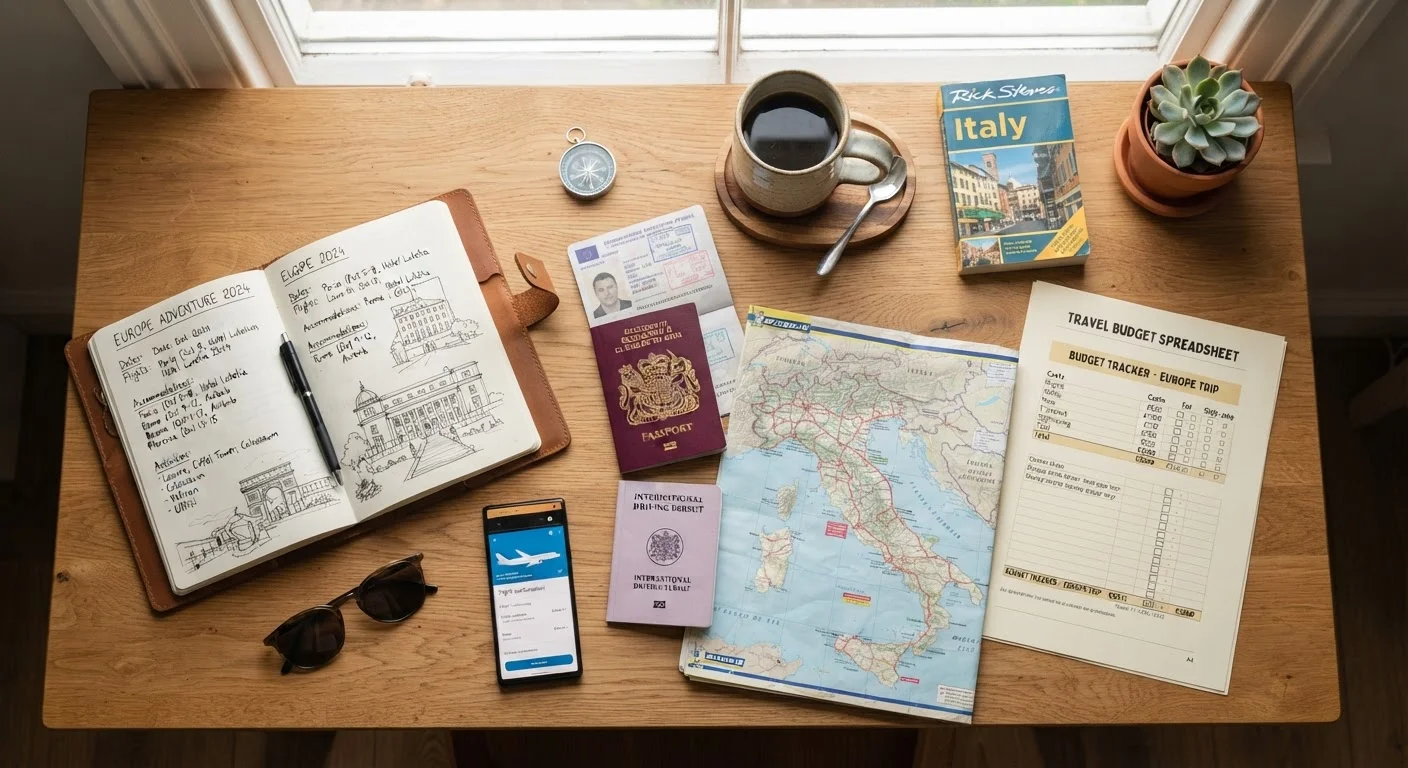
Why Most Trips Go Wrong Before They Begin
The difference between a frustrating trip and a smooth one is rarely luck. It almost always traces back to decisions — or the absence of them — made weeks before departure. Chaotic travel tends to share common failure points: budgets set without real research, itineraries that leave no room for transit time, and key logistics assumptions that turn out to be wrong on arrival.
A well-planned trip doesn't mean every hour is scripted. It means the decisions that are expensive or difficult to reverse have been made intentionally, and the rest has been left appropriately loose. Before you commit to anything, see the pre-trip research checklist — covering entry requirements, seasonal conditions, and logistics that are easy to overlook until they become a problem.
Entry Requirements Change Frequently
Visa rules, health documentation requirements, and travel advisories can shift with little notice. Always verify current entry requirements directly with the official embassy or consulate of your destination country, and check your government's travel advisory page before booking. Do not rely on third-party travel sites as the authoritative source for this information.
The Four Planning Phases
Effective trip planning moves through four distinct phases, each building on the last:
- Research phase: Define your destination, travel window, and realistic budget ceiling. Compare destination costs, not just flight prices. Factor in accommodation tiers, daily meal costs, and activity expenses for the specific region.
- Booking phase: Lock in the high-cost, hard-to-change elements first — typically flights, then accommodation. Ground transport, tours, and dining can stay flexible longer.
- Logistics phase: Map out how you actually get from the airport to your accommodation, between cities, and to key sites. This is where most itineraries reveal hidden time costs that compress the schedule.
- Buffer phase: Review your plan and deliberately add slack — both financial (10–20% contingency in the budget) and temporal (unscheduled blocks in the itinerary).
For a practical walkthrough of building out the daily structure, the itinerary-building guide covers how to balance sightseeing, rest, and genuine flexibility without over-engineering the schedule.
10–20%
Recommended travel budget contingency reserve
A commonly cited guideline among travel planners for absorbing unexpected costs without derailing a trip.
3–6 months
Typical lead time for international trip planning
General travel guidance suggests this window allows for research and early booking of high-cost elements like flights and accommodation.
2–3
Anchored activities recommended per travel day
Travel pacing frameworks widely suggest limiting fixed daily commitments to avoid over-scheduling fatigue.
Budget Architecture: What a Real Travel Budget Covers
A travel budget has layers that first-time planners frequently collapse into a single number. Breaking it into categories — transportation, accommodation, food, activities, and miscellaneous — produces a figure that actually holds up in the field.
Transportation often gets underestimated because people account for flights but not for airport transfers, local transit passes, inter-city trains, or ride-share costs that accumulate daily. Meals are similarly underestimated when travelers assume they'll cook more than they realistically will while traveling. Activities vary enormously by destination — some regions have high museum and tour costs; others are low-cost but expensive to reach.
The contingency reserve is not optional padding. It exists for the delayed flight that requires an extra night, the prescription you left at home, or the entrance fee you didn't know was cash-only. Setting this at 10–20% of total estimated costs is a reasonable target, though higher-risk or longer trips may warrant more. For broader guidance on managing travel spending, the guide to traveling affordably without sacrificing comfort covers destination selection through daily spending habits.
Pacing and the Flexibility Framework
One of the most underrated planning skills is calibrating trip pace to match your actual energy and interests — not an idealized version of yourself who never needs rest. Research consistently shows that over-scheduled trips lead to fatigue and diminished satisfaction, not greater value for money spent.
A workable framework: anchor each day around one or two fixed commitments (a booked tour, a timed entry, a transit departure) and leave the surrounding time unstructured. This approach absorbs delays, serendipitous discoveries, and the simple reality that travel days are more tiring than they look on a spreadsheet.
The comparison of slow travel vs. fast-paced itineraries offers an honest look at the cost and fatigue trade-offs of each approach — useful context if you're deciding how many destinations to include.
Build Your 'Drop List' Before You Go
For every day of your trip, identify one activity or plan that you'd willingly skip if pacing or energy demands it. Having this list ready prevents the stress of in-the-moment decision-making when the trip doesn't go exactly to plan. The goal is intentional flexibility, not reactive scrambling.
Putting It Together: From Plan to Practice
A well-planned trip is ultimately a decision framework disguised as an itinerary. The goal is to walk into each travel day knowing what's fixed, what's flexible, and what you can simply drop without consequence. That clarity is what separates travelers who finish a trip energized from those who return exhausted and over-budget.
If you're coordinating travel for multiple people, the added complexity of shared budgets and group decision-making requires its own approach — the group travel planning guide addresses those dynamics specifically. For an end-to-end planning reference covering every stage from destination research to on-the-ground preparation, the complete trip planning framework is the logical next step.
This article provides general travel planning information for educational purposes. Prices, entry requirements, and local conditions change; always verify details with official sources before booking or traveling.