Why Nutrition Advice Seems to Change Constantly
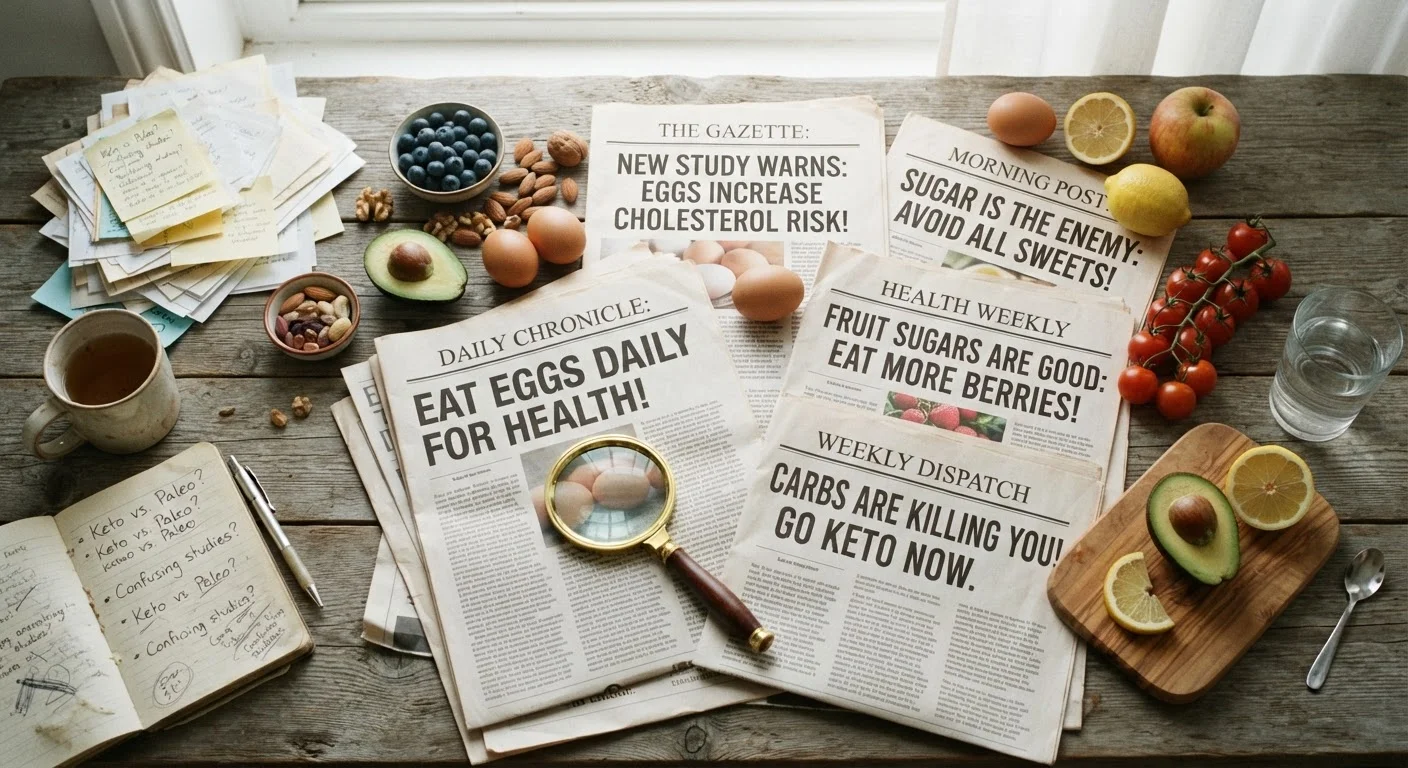
If you've ever felt whiplash from contradictory nutrition headlines - eggs are harmful, eggs are fine; fat is the enemy, fat is essential - you're not imagining the inconsistency. The appearance of constant reversal is partly a communication problem and partly a reflection of how nutrition science actually works.
Nutrition research is genuinely difficult to conduct. Unlike pharmaceutical trials, where a drug can be compared against a placebo in a controlled environment, studying diet requires tracking complex, shifting patterns of food consumption over years or decades, often using self-reported data. The signals are real but rarely clean.
The gap between what a study actually shows and how it gets reported is where most confusion enters. Understanding a few recurring pitfalls can help you read nutrition information with more confidence - and more appropriate skepticism. For a complementary perspective on how specific beliefs have accumulated over time, see persistent nutrition myths research has repeatedly challenged.
This Is General Information, Not Medical Advice
The content in this article is intended for educational purposes only. It does not constitute medical or dietary advice, nor should it be used to diagnose, treat, or manage any health condition. Always consult a qualified healthcare professional or registered dietitian before making significant changes to your diet.
Common Mistakes in How We Interpret Nutrition Information
These errors appear repeatedly - in popular media, in social conversations, and in well-meaning personal decisions. Recognizing them is the first step toward a more grounded relationship with food information.
Treating a single study's findings as settled nutrition science.
Why it happens: Media outlets often frame one new study as a breakthrough, and headlines rarely mention that the finding is preliminary or needs replication.
Confusing correlation with causation in observational nutrition research.
Why it happens: Most large-scale nutrition studies are observational, meaning researchers track what people eat and what happens to them. These designs cannot prove that one variable caused an outcome.
Eliminating entire macronutrient categories - such as all fats or all carbohydrates - based on a popular trend.
Why it happens: Diet cultures tend to vilify one macronutrient at a time, and sweeping rules feel simpler to follow than nuanced guidance about food quality and portion context.
Assuming that a supplement can replicate the benefits of the whole food it was derived from.
Why it happens: Supplement marketing frequently highlights individual nutrients shown to be beneficial in research, creating the impression that an isolated pill delivers equivalent results.
Applying population-level dietary guidelines directly to individual circumstances without adjustment.
Why it happens: Public health guidelines are designed for broad populations and represent averages; they are not automatically the right fit for every individual's health status, activity level, or medical history.
If you want to evaluate your own eating patterns without falling into these traps, a reflective nutrition check-in can help you examine your habits against core principles rather than trending rules.
Building a More Reliable Foundation
Navigating nutrition doesn't require a background in research methods. A few practical habits can meaningfully improve how you filter the information you encounter.
- Prioritize patterns over single nutrients. The overall composition of your diet - varied, minimally processed, rich in vegetables, legumes, whole grains, and quality proteins - has far more consistent support than any single food or compound.
- Check who conducted the research and who funded it. Nutritional studies funded by industry groups with a financial interest in the outcome deserve extra scrutiny, though funding source alone doesn't invalidate findings.
- Understand what kind of study is being cited. Randomized controlled trials and meta-analyses of multiple studies generally carry more evidentiary weight than a single observational study or animal study.
- Use labels as one tool, not the whole picture. Reading a nutrition label carefully is a useful skill, but it captures a limited slice of what makes a food pattern healthful.
~95%
Americans falling short of daily fiber intake
Research published in the American Journal of Lifestyle Medicine estimates that the vast majority of US adults consume less dietary fiber than recommended guidelines suggest.
Less than 20%
Nutrition studies that are randomized controlled trials
A review in PLOS Medicine found that the substantial majority of nutrition research relies on observational designs, which cannot establish causation between diet and health outcomes.
For a closer look at one consistently under-discussed nutrient, the fiber gap in American diets illustrates how structural gaps in intake often go unnoticed despite strong evidence for their importance.
Ultimately, the goal isn't to follow nutrition news perfectly - it's to build habits that hold up over time. Consistent, balanced eating habits tend to matter far more than any single dietary decision.
This article is for general informational and educational purposes only and does not constitute medical or dietary advice. Consult a qualified healthcare professional or registered dietitian before making changes to your diet, particularly if you have an existing health condition.