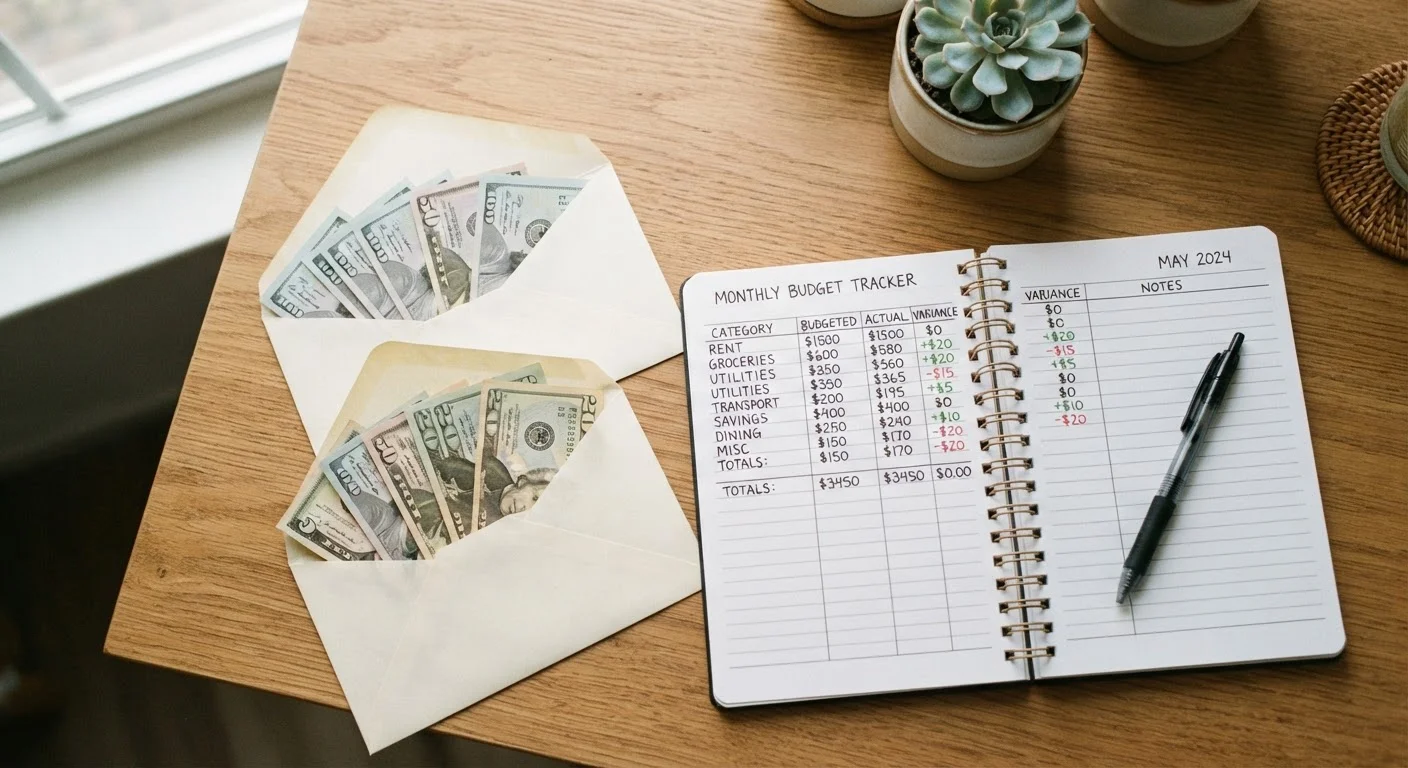
How Each System Actually Works
Understanding the mechanics of each method prevents the common mistake of adopting a budgeting label without following through on its core discipline.
Zero-based budgeting starts with your total monthly income and requires you to assign every dollar to a category - housing, food, transportation, savings, debt payments, and so on - until the difference between income and allocated spending reaches exactly zero. Zero doesn't mean you spend everything; it means every dollar has a job. A dollar assigned to your emergency fund is still accounted for. The process resets each month, so you revisit and intentionally rebuild your budget rather than rolling the same plan forward automatically.
The envelope method works by dividing your cash - or a designated digital equivalent - into labeled envelopes for each spending category at the start of a budget period. You spend only what's in the envelope for that category. Once it's gone, spending stops unless you consciously transfer money from another envelope. Traditionally this uses physical currency, though many people now use digital envelope apps that replicate the same constraint with bank transfers or virtual buckets.
For a broader look at how these fit among other approaches, see budgeting methods compared.
| Criterion | Zero-Based Budgeting | The Envelope Method |
|---|---|---|
| Core mechanism | Assign every dollar to a category until balance = zero | Allocate cash to labeled envelopes per category |
| Setup time | Moderate to high - rebuilt each month | Low - allocate cash at start of period |
| Works with digital payments | Yes - fully compatible with card spending | Traditionally cash-based; digital apps available |
| Budget coverage | Whole budget, every category | Often discretionary categories only |
| Spending limit enforcement | Requires self-monitoring and discipline | Hard stop when envelope is empty |
| Best income type | Variable or complex income | Stable, predictable income |
| Learning curve | Steeper - requires planning each category | Gentle - intuitive and visual |
Where Each Method Tends to Shine - and Struggle
Neither system is universally superior. Their value depends heavily on how you earn, spend, and stay accountable.
Zero-based budgeting gives you a complete financial picture - every obligation, every goal, every discretionary category is visible and deliberate. That thoroughness is its strength, particularly for households managing multiple income streams, irregular pay, or specific savings milestones. The tradeoff is time: rebuilding a budget each month requires discipline, and it can feel burdensome for people whose finances are straightforward or who find detailed planning demotivating.
The envelope method excels at behavioral change in specific problem categories. Research in consumer behavior consistently shows that spending physical cash activates a stronger sense of loss than tapping a card, which is why many people find envelope-style limits more effective for categories where they habitually overspend. Its limitation is scope: most people pay rent, utilities, and loan payments digitally, so the envelope method often covers only a slice of the total budget rather than the whole picture.
Can You Use Both at Once?
Yes - and many people do. A common hybrid approach uses zero-based budgeting to plan the full month, then applies envelope-style cash limits to a handful of high-risk discretionary categories like dining out or entertainment. This captures the whole-picture visibility of zero-based budgeting while adding the behavioral guardrails of the envelope method where they're most useful. There's no rule requiring you to pick only one.
If you are new to budgeting altogether, building your first budget is a practical starting point before choosing a specific system.
Choosing the Right Fit - or Combining Both
The most useful question isn't which method is objectively better - it's which one you'll actually maintain. A technically superior system abandoned after three weeks produces worse outcomes than a simpler system followed consistently for a year.
Consider zero-based budgeting if you want holistic control, have a complex financial picture, or are working toward specific savings or debt-payoff targets. It pairs well with digital spreadsheets or dedicated apps. For guidance on tracking formats, choosing your tracking method can help you find the right tool.
Consider the envelope method if you've identified one or two categories where you chronically overspend, prefer simplicity, or respond better to visual and physical cues than to spreadsheet columns. Many people use envelope-style limits for two or three categories within an otherwise digital budget - a hybrid approach that captures the behavioral benefit without requiring an all-cash lifestyle.
Whatever system you choose, the habits that keep it working over time matter more than the method itself. Principles behind sustainable monthly spending plans covers the design choices that separate short-lived efforts from ones people actually follow.
This article is for general informational and educational purposes only and does not constitute personalized financial advice. Consult a qualified financial professional for guidance specific to your situation.