Why Credit Card Debt Is Especially Costly
Credit card balances are among the most expensive forms of consumer debt. Average annual percentage rates (APRs) regularly run well above 20%, meaning interest compounds quickly on any balance you carry month to month. The minimum payment trap is real: making only the required minimum keeps you current but directs most of your payment toward interest rather than principal, extending repayment by years and costing significantly more in total interest paid.
The good news is that several well-established strategies can meaningfully accelerate payoff - though none work identically for every household. The approaches below span behavioral changes, payment mechanics, and financial products. Understanding how each works - and where each falls short - puts you in a stronger position to choose what fits your situation. For broader context on structuring your money each month, the Budgeting Basics hub is a useful companion resource.
This article is for general informational purposes only and is not personalized financial advice. Consider consulting a qualified financial professional for guidance specific to your circumstances.
Pay More Than the Minimum - Every Month
The minimum payment on most credit cards is set at roughly 1-2% of the balance, or a small fixed dollar amount, whichever is greater. At this rate, a $5,000 balance at 22% APR could take over a decade to pay off and cost more in interest than the original balance. Increasing your monthly payment - even by $50 or $100 - compresses the repayment timeline significantly and reduces total interest paid. Treat any extra payment as a fixed line item in your budget rather than something you add when money feels available.
Even a modest monthly increase above the minimum can cut years off your repayment timeline.
Choose a Repayment Order: Avalanche or Snowball
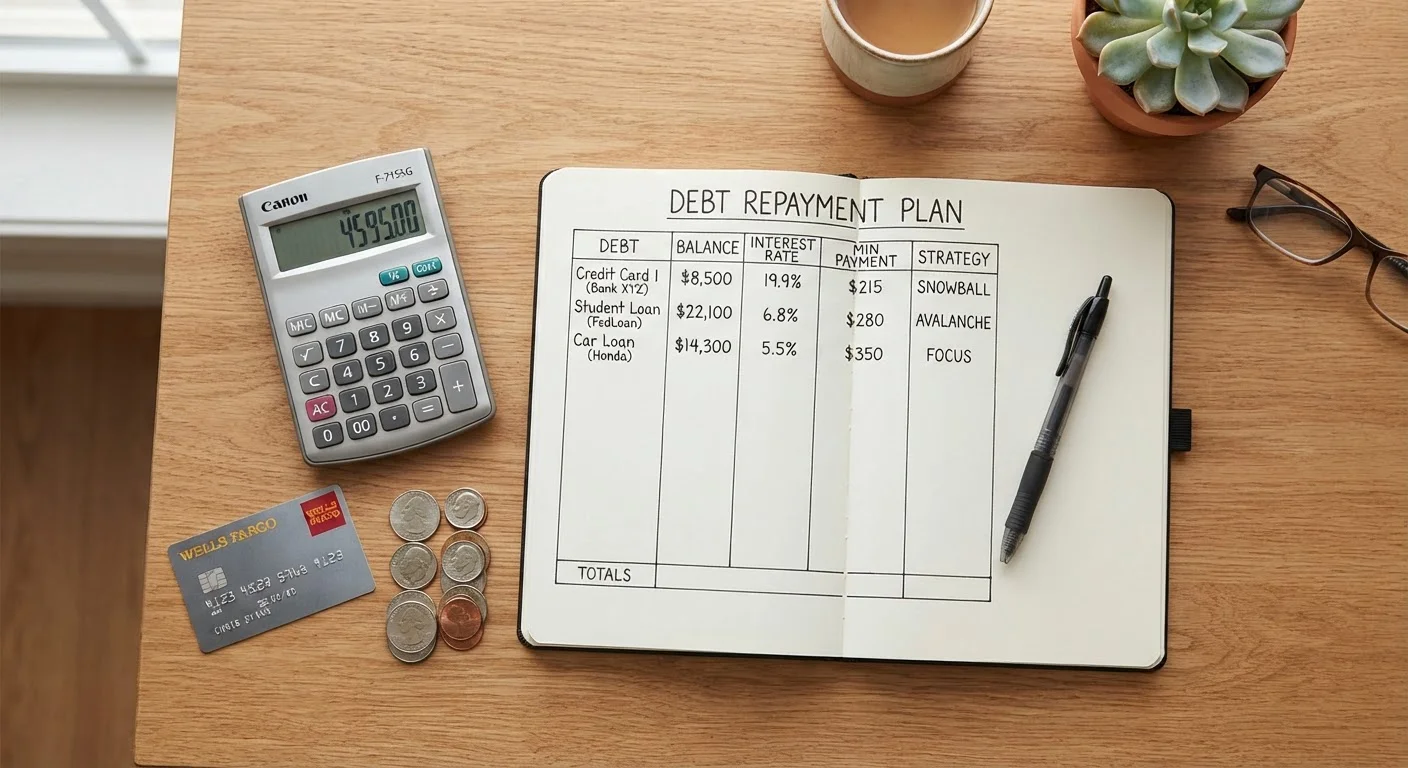
If you carry balances on multiple cards, the order in which you pay them down matters. The debt avalanche directs extra payments toward the card with the highest APR first, minimizing total interest paid. The debt snowball targets the smallest balance first, generating quick wins that some people find motivating enough to stay on track. Research in behavioral economics suggests that visible progress matters for long-term follow-through, which is why the snowball approach works well for some people even though it costs slightly more in interest. A detailed breakdown of both methods can help you decide which fits your personality and financial picture.
The avalanche saves the most money; the snowball builds momentum - your temperament should guide the choice.
Switch to Biweekly Payments
Most cardholders make one payment per month. Switching to half-payment every two weeks results in 26 half-payments per year - equivalent to 13 full monthly payments instead of 12. The extra payment reduces your average daily balance, which is the figure credit card issuers use to calculate interest. Lower average daily balances mean less interest accrues each billing cycle. Before switching, confirm your card issuer applies mid-cycle payments correctly and doesn't hold them until the due date - if they do, the timing benefit disappears.
Biweekly payments effectively add one full extra payment per year without requiring a larger budget.
Use a Balance Transfer Card Strategically
Many credit cards offer 0% introductory APR periods on balance transfers - commonly 12 to 21 months. During this window, every dollar you pay reduces principal rather than being partially absorbed by interest. The caveats are significant: most cards charge a balance transfer fee of 3-5% of the amount moved, you typically need good-to-excellent credit to qualify, and any remaining balance at the end of the promotional period reverts to a standard (often high) APR. This strategy works best when you can realistically pay off the transferred balance within the promotional window and don't add new charges to the card.
A 0% balance transfer window is only valuable if you can clear the balance before the promotional rate expires.
Apply Windfalls Directly to Balances
Tax refunds, bonuses, gifts, or proceeds from selling unused items represent lump-sum opportunities to make meaningful dents in a balance. Rather than treating these as discretionary income, applying them directly to the card with your highest APR (or smallest balance, depending on your chosen method) produces a compounding benefit - less principal means less interest accrues each month going forward. Even a single $500 application to a high-APR card reduces the total cost of carrying that debt more than most monthly adjustments can achieve in the same period.
A single windfall applied to a high-APR balance can do more than months of incremental adjustments.
Temporarily Redirect Discretionary Spending
Reviewing your monthly spending through a smart spending lens often reveals categories where short-term reductions are feasible - streaming subscriptions, dining out, or discretionary shopping. Redirecting even $100-$200 monthly to credit card principal during a focused payoff period can compress a multi-year timeline considerably. This approach requires no new financial product and carries no fees or credit requirements. The key is treating it as a defined sprint rather than an indefinite austerity measure, which makes it psychologically sustainable.
A short-term spending sprint - not permanent austerity - can redirect meaningful cash toward debt principal.
Choosing the Right Approach for Your Situation
No single strategy works best in every case. The right combination depends on your total balance, the number of cards you carry, your monthly cash flow, and your credit profile. Many people use a hybrid approach - for instance, applying the avalanche method while also switching to biweekly payments and temporarily cutting discretionary spending to fund larger extra payments.
Track Your Progress Visually
Keeping a simple running total of your balance - even just in a notes app or a paper tracker - has been shown to reinforce consistent behavior. When each payment produces a visible number change, the psychological feedback loop supports follow-through. Review your balance weekly rather than waiting for a monthly statement.
If you're weighing whether to consolidate multiple balances into a single product, the debt consolidation guide explains how these arrangements work and when they tend to make sense. Similarly, using a personal loan to pay off debt has genuine appeal in some situations but adds risk in others - that article walks through the trade-offs clearly. And if the broader question of whether to pay off debt before building savings feels unresolved, paying off debt while saving at the same time offers a practical framework. Whichever path you take, consistent action matters more than finding the theoretically perfect strategy.