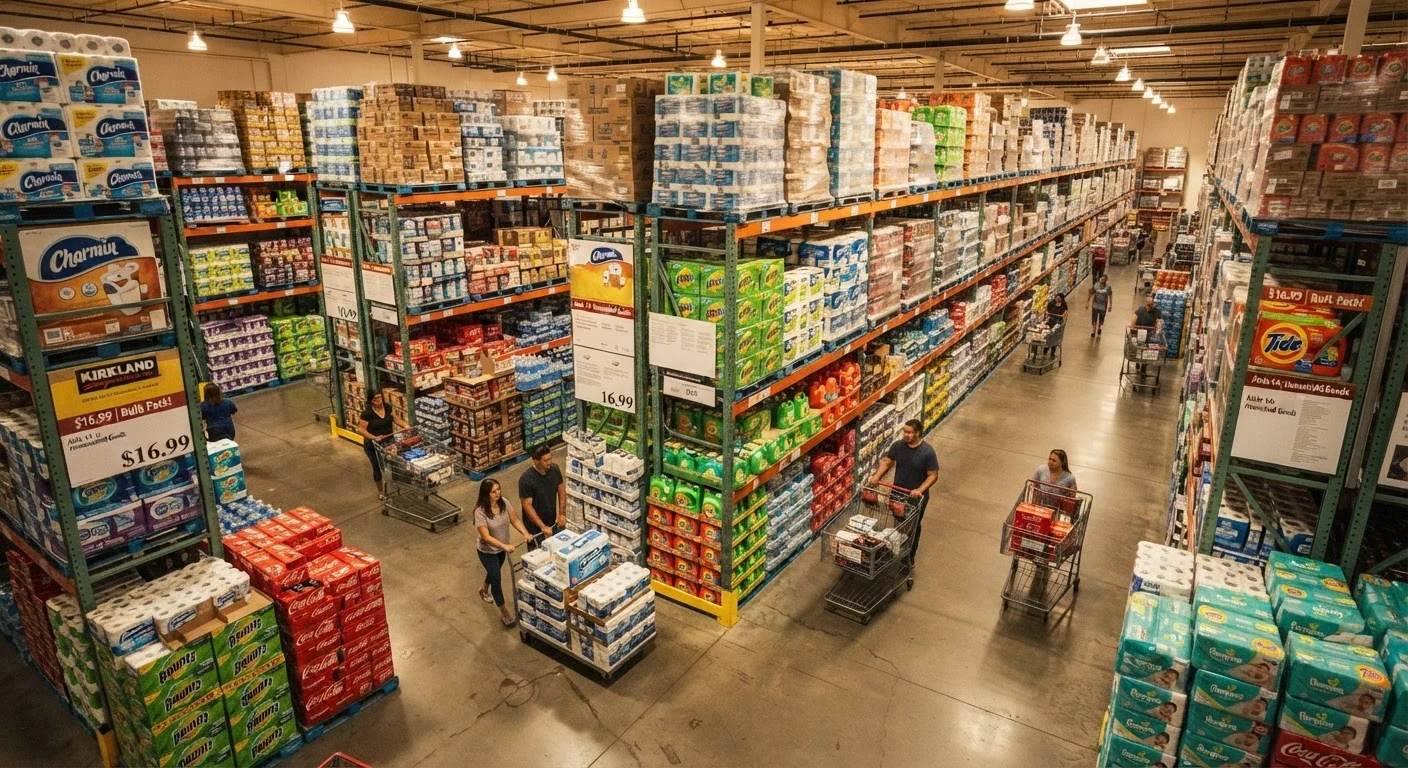
The Basic Math Behind Bulk Buying
The appeal of bulk buying is straightforward: pay a lower unit price by purchasing more at once. A 200-count bottle of pain reliever costs less per tablet than a 50-count version. A 30-pound bag of dry dog food costs less per pound than a 5-pound bag. That unit price gap is real - and for the right products, it compounds into meaningful annual savings.
The calculation that matters most is cost per unit, not the sticker price. Divide the total price by the number of units (ounces, sheets, loads, servings) and compare that figure directly against smaller package options. This cost-per-use approach cuts through the noise and reveals whether you're actually getting a better deal or just buying more of something at roughly the same effective price.
One variable shoppers frequently overlook: the membership fee at warehouse clubs. If you pay $65 per year for membership access, that cost should be spread across every bulk purchase you make there. A household that only visits twice a year and spends modestly may not recover that fee in savings.
~$65-$130
Typical annual warehouse club membership fee range
Major warehouse retailers in the US charge annual membership fees that must be recovered through actual purchasing savings to make membership financially worthwhile.
30-40%
Estimated unit price reduction common in bulk goods
Consumer research broadly suggests non-perishable staples purchased in bulk often cost 30-40% less per unit than equivalent smaller packages, though this varies widely by category and retailer.
When Bulk Buying Genuinely Saves Money
Certain categories are reliably strong candidates for bulk purchase. The common thread is predictable, consistent consumption combined with long shelf life or slow degradation.
Lower cost per unit on frequently used items
Volume pricing typically reduces the per-unit cost meaningfully on staple goods. For households that use these items steadily, the savings accumulate across every purchase cycle.
Fewer shopping trips and less restock effort
Maintaining a deep supply of staples reduces how often you need to shop for them, saving both time and the incidental spending that tends to occur during extra store visits.
Protection against short-term price increases
Stocking up on non-perishables when prices are favorable locks in the current cost. This is a modest but real hedge against routine consumer goods inflation.
Reduces risk of running out during inconvenient times
Having supply on hand means you avoid last-minute, full-price purchases at inconvenient retailers when you run out unexpectedly.
Cleaning supplies, paper products, canned goods, dried pasta, and pet food tend to perform well in this framework. So do personal care staples like shampoo, toothpaste, and razors - items you will definitely use, on a schedule you can predict. Pairing bulk buying with store-brand selection can extend savings further, particularly in categories where formulation differences between private-label and national brands are minimal.
Households that freeze food effectively can also extend bulk savings into perishable categories like meat and bread, provided the storage capacity exists and the household actually uses what it freezes.
When Bulk Buying Wastes Money
The financial case for bulk buying breaks down quickly under a few predictable conditions. Understanding these failure modes is just as important as knowing the benefits.
Upfront cost strains monthly cash flow
Bulk purchases require a larger payment today in exchange for savings spread over months. If that lump sum disrupts your budget or requires carrying a credit balance, the interest can erase the per-unit savings.
Perishable items expire before use
Food, some medications, and certain personal care products have shelf lives. Buying more than you can consume before expiration turns a discount into a loss.
Storage requirements add hidden costs or constraints
Bulk goods require physical space. Renting additional storage, or simply living with clutter, is a real cost that the unit-price comparison never captures.
Locks you into a product before you know you like it
Purchasing a large quantity of an untested item is a gamble. If the product doesn't meet expectations, you're stuck with excess that you either force yourself to use or discard.
Membership fees reduce net savings
Warehouse club memberships carry annual fees. Shoppers who don't buy frequently or in sufficient volume may find that their fee-adjusted savings are smaller than expected.
Fresh produce, dairy, and bakery items are obvious pitfalls - expiration dates punish over-purchasing directly. But the same logic applies to any product you haven't yet confirmed you like. Buying 96 ounces of a new hot sauce or a jumbo container of a supplement you've never tried before carries real waste risk if the product doesn't suit you.
Frugality becomes false economy when you spend $80 on a bulk item you use halfway and throw out, compared with spending $25 for a quantity you'd actually finish. Tally the total cost of what you discard - including the time managing overstock - and the math on many bulk purchases becomes far less impressive.
Practical Rules for Smarter Bulk Decisions
A few straightforward principles help separate high-value bulk opportunities from costly impulse purchases.
- Verify the unit price difference. Not every bulk package is cheaper per unit. Retailers occasionally price large sizes at parity or higher; always check the shelf tag's per-unit price or calculate it yourself.
- Assess your storage honestly. If an item has to sit in a cluttered garage or expire in a cabinet you rarely open, the savings are illusory. Storage constraints are a real limit.
- Buy bulk only for proven staples. Stick to products you've used in standard sizes and confirmed you like and use consistently.
- Track what you actually consume. A grocery budget grounded in real habits helps you estimate realistic consumption rates, making it much easier to judge how much of any item to buy at once.
- Factor in cash flow. A bulk purchase that stretches your budget uncomfortably this month, forcing you into high-interest credit card debt, is not a savings strategy. The interest cost can easily outpace the unit-price discount.
Bulk Buying and Household Size
The calculus of bulk buying shifts significantly with household size. A single-person household may struggle to consume a bulk quantity of perishables or even some non-perishables before quality declines. Larger households or those who share bulk purchases with friends or family tend to extract more consistent value. Consider your actual consumption rate before committing to volume, regardless of how attractive the per-unit price appears.
Bulk buying is a tactic, not a philosophy. Applied selectively to the right items for your household's actual patterns, it is one of the more dependable ways to reduce routine spending over time.