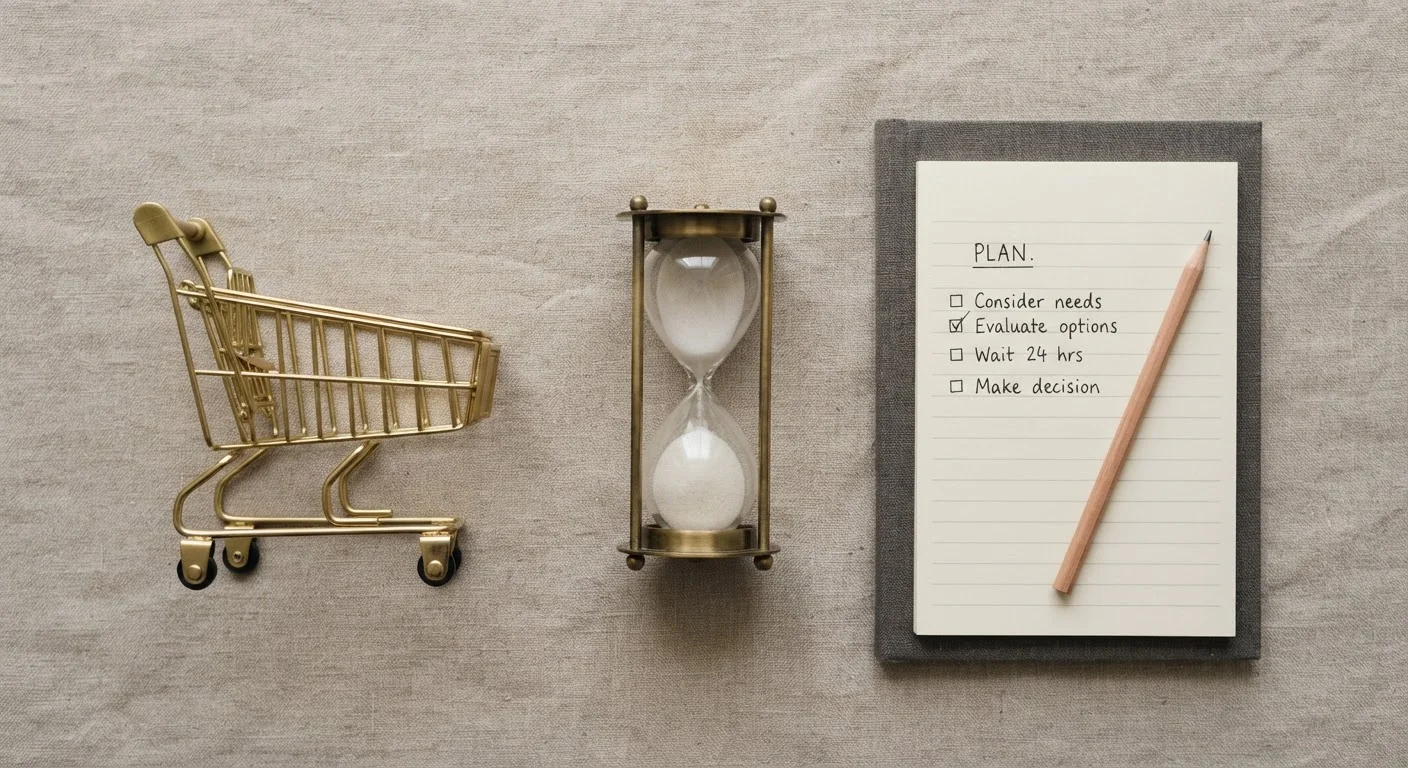
Why Impulse Spending Is So Hard to Stop
Impulse spending isn't a willpower failure - it's a predictable response to how the brain processes reward. When you encounter something appealing, dopamine activity spikes before you've had a chance to weigh costs against priorities. Retailers design entire experiences around compressing the gap between that spike and the moment you pay.
The practical fix isn't to suppress desire; it's to widen the gap. Pause strategies do exactly that. By introducing a mandatory waiting period between spotting a purchase and completing it, you give the emotional signal time to fade so a clearer-headed evaluation can take over. If you're still building the financial habits that make these tactics stick, this overview of smart spending fundamentals is a useful starting point.
The Core Pause Strategies Explained
Different situations call for different waiting windows. Here are the most widely used approaches:
- The 30-Day Rule: When you feel the urge to buy a non-essential item above a threshold you define (commonly $30-$100), you add it to a wishlist and revisit it in 30 days. If you still want it and it fits your budget, you buy it. Many people find the desire has simply faded.
- The 72-Hour Rule: A practical middle ground for moderate purchases. Three days is long enough to deflate most excitement-driven impulses without feeling like a punishment.
- The 24-Hour Rule: Effective for smaller everyday purchases - clothing, gadgets, online flash deals. Sleep on it; if you wake up and it still makes sense, proceed.
- The Sleep-On-It Rule: A simpler framing for the same idea: never finalize a non-essential purchase in the same session you discover it. Close the tab, leave the store, and decide tomorrow.
Each of these complements any formal budgeting structure. If you use a framework like the one outlined in the 50/30/20 rule, pause strategies help you protect the boundaries between your wants allocation and your savings goals.
Shorter Rules Still Beat No Rule
If 30 days feels too long to commit to upfront, start with a 24-hour or 72-hour rule. Research on habit formation suggests that consistency matters more than the length of the waiting period. A rule you actually use beats an ambitious one you abandon after a week. Build up to longer windows as the habit becomes automatic.
How to Apply a Pause Strategy Step by Step
What you will need
Set your personal spending threshold
Decide in advance the dollar amount above which you'll apply a pause. Common starting points are $30, $50, or $100 - choose a figure that represents a meaningful but not trivial sum given your income. Write it down or note it in your budgeting app so it's not a judgment call in the moment.
Create a dedicated wishlist
When you feel the urge to buy something above your threshold, capture it immediately - but don't purchase it. Add the item to a running list: a notes app, a spreadsheet, or a paper notebook. Record the item name, the price, where you found it, and today's date.
Choose the right waiting window
Match the waiting period to the purchase size and urgency. Use 24 hours for smaller items (under $50), 72 hours for mid-range purchases, and the full 30-day rule for anything significant or non-essential. If a genuine deadline exists - such as a utility replacement - a shorter window is appropriate; the goal is reflection, not deprivation.
Revisit the item when the waiting period ends
Return to your wishlist on the scheduled date. Ask yourself three questions: Do I still want this? Do I know exactly how I'll use it? Does buying it fit within my current budget without displacing a priority? If you can answer yes to all three, the purchase is a considered decision rather than an impulse.
Decide and log the outcome
Either remove the item from your wishlist (most common) or proceed with the purchase in a planned way - meaning you account for it in your current budget period rather than treating it as an extra. Logging outcomes helps you spot patterns over time: which categories tempt you most, and how often the urge fades on its own.
Once the habit is established, most people find the steps take under two minutes in the moment - the waiting period does the real work automatically.
These tactics address a specific form of quiet budget drain - the unplanned purchase that feels small in isolation but accumulates over time. For a broader look at how spending choices fit into a monthly plan, see how to build a budget that lasts.
This article is for general informational purposes only and does not constitute personalized financial advice. Consider consulting a qualified financial professional for guidance tailored to your individual circumstances.