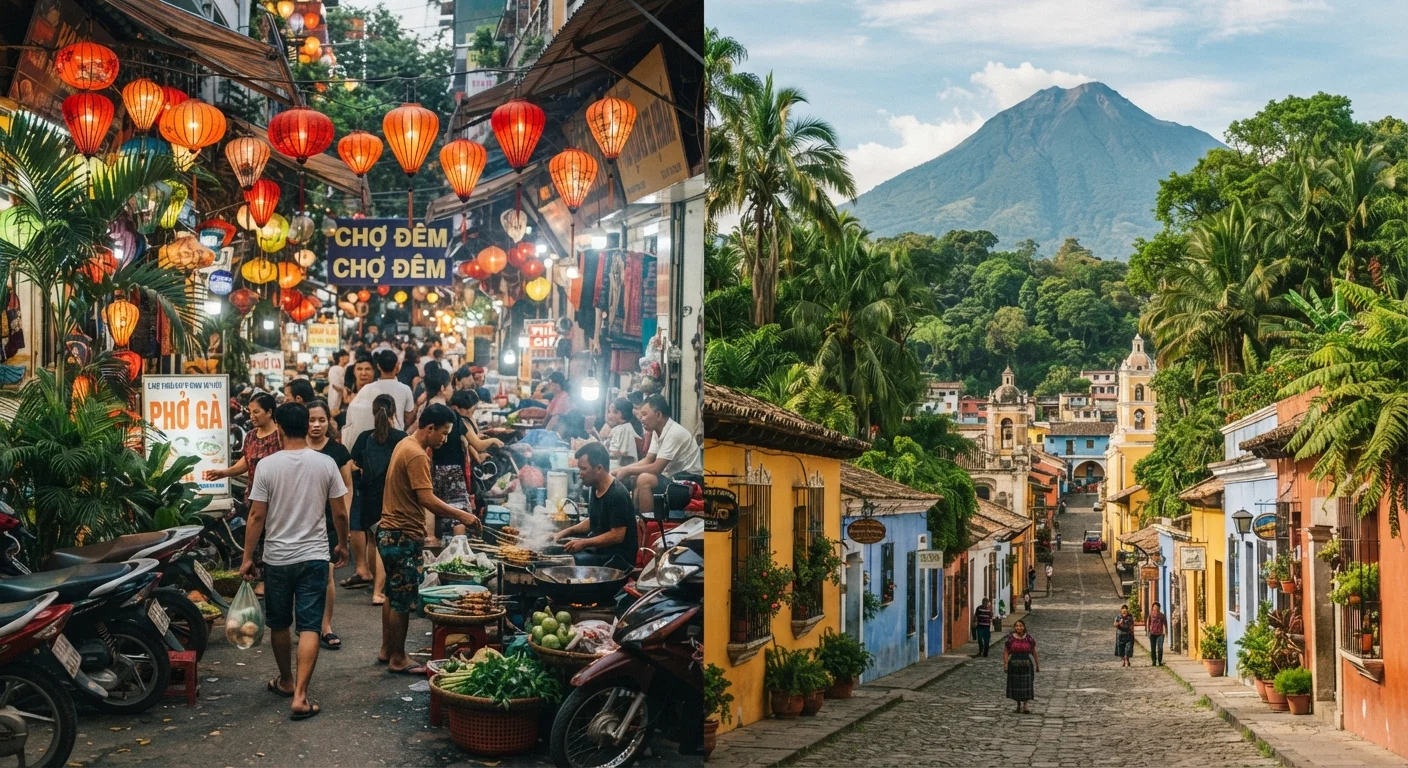
Daily Costs: What Your Money Actually Buys
When comparing budget regions, the most useful starting point is the realistic daily spending range — not the theoretical minimum, but what a cost-conscious traveler actually spends including accommodation, food, local transport, and activities.
In Southeast Asia, that range typically runs from $30 to $70 per day across destinations like Vietnam, Thailand, Cambodia, and Indonesia. Street food meals regularly cost under $2, guesthouse dorm beds $5–$12, and motorbike rentals $5–$10 per day. Private budget rooms in most of the region run $15–$35. The floor is genuinely low.
In Central America, the range is wider and less predictable. Guatemala and Nicaragua sit closer to Southeast Asian pricing, with daily budgets of $35–$60 being realistic. Costa Rica, however, is a different story — daily costs there often rival those of Southern Europe, with budget accommodation alone running $25–$50 and restaurant meals averaging $10–$20. Panama City trends similarly upward. Country selection within Central America has an outsized effect on your total spend.
| Criterion | Southeast Asia | Central America |
|---|---|---|
| Typical daily budget (mid-range) | $30–$70 | $35–$90 (varies widely) |
| Round-trip flight from US | $600–$1,200+ | $250–$500 |
| Street food meal cost | $1–$3 | $2–$6 |
| Budget accommodation (private room) | $10–$35/night | $15–$50/night |
| Visa access (US passport) | Mostly visa-free or e-visa | Mostly visa-free (90 days) |
| Backpacker infrastructure | Extensive and well-established | Moderate; varies by country |
| Flight duration from US | 15–22 hours | 3–6 hours |
| Country-hopping ease | High (overland + cheap flights) | Moderate (overland feasible) |
For a deeper look at what drives up costs in destinations that appear affordable on the surface, see The Hidden Costs of "Cheap" Destinations.
Flights, Visas, and Getting There
The total cost of a trip isn't just what you spend on the ground. For US-based travelers, the flight is often the single largest line item — and here, Central America holds a structural advantage.
Round-trip airfare from major US hubs (New York, Chicago, Los Angeles) to Guatemala City, San José, or Belize City frequently ranges from $250 to $500, with flight times of 3–6 hours. By contrast, transpacific flights to Bangkok, Hanoi, or Bali typically run $600–$1,200 or more and involve 15–22 hours of travel. A trip that's 20% cheaper per day in Southeast Asia can still cost more overall if the flight differential isn't offset by trip length.
On visas: most Southeast Asian countries offer visa-on-arrival or visa-free entry to US passport holders — Thailand allows 30 days, Vietnam offers e-visas for 90 days, and Indonesia grants 30-day arrivals. Central America is similarly accessible; most countries grant US citizens 90-day tourist entries with no pre-arranged visa required. Always verify current entry requirements directly with the relevant embassy or official government source before booking, as rules can change.
Visa Rules Change — Always Verify
Visa policies for both Southeast Asia and Central America are subject to change based on bilateral agreements, health situations, and political developments. What was visa-free last year may not be this year. Always check directly with the relevant country's official embassy website or the US State Department's travel pages before booking your flights.
Before committing to either region, review the pre-trip planning checklist to verify entry rules, health advisories, and safety conditions specific to your destination and travel dates.
Infrastructure, Safety, and Practical Realities
Southeast Asia has had decades to build out budget travel infrastructure. Hostels, tourist buses, guesthouses, and food stalls are woven into the fabric of cities and towns across Thailand, Vietnam, and Cambodia. Booking accommodation is straightforward, transportation options are plentiful, and first-time travelers will find well-worn paths to follow. For context on navigating the region practically, Budget Travel in Southeast Asia: A First-Timer's Complete Orientation covers the logistics in detail.
Central America's infrastructure is more variable. Guatemala, Belize, and Costa Rica have reasonably developed tourist corridors. Honduras and Nicaragua, while cheaper, require more independent research and have historically carried higher safety advisories in certain areas. Road quality varies significantly, and reliable public transport is less consistent than in Southeast Asia.
Both regions carry health considerations — tropical destinations in general may require vaccinations or preventive medications depending on the specific area visited. Consult a travel medicine professional or your physician well before departure; don't rely on general web guidance for health decisions.
For country-by-country cost context in Central America, Central America on a Budget: Country-by-Country Cost Snapshot provides a useful reference. And if you're weighing other affordable regions, Eastern Europe's value case is worth reading alongside this comparison.
Travel conditions, entry requirements, and safety advisories can change. Always verify current information with official government sources and your country's foreign affairs or state department before traveling.