Why Kitchen Drawers Become Catch-Alls
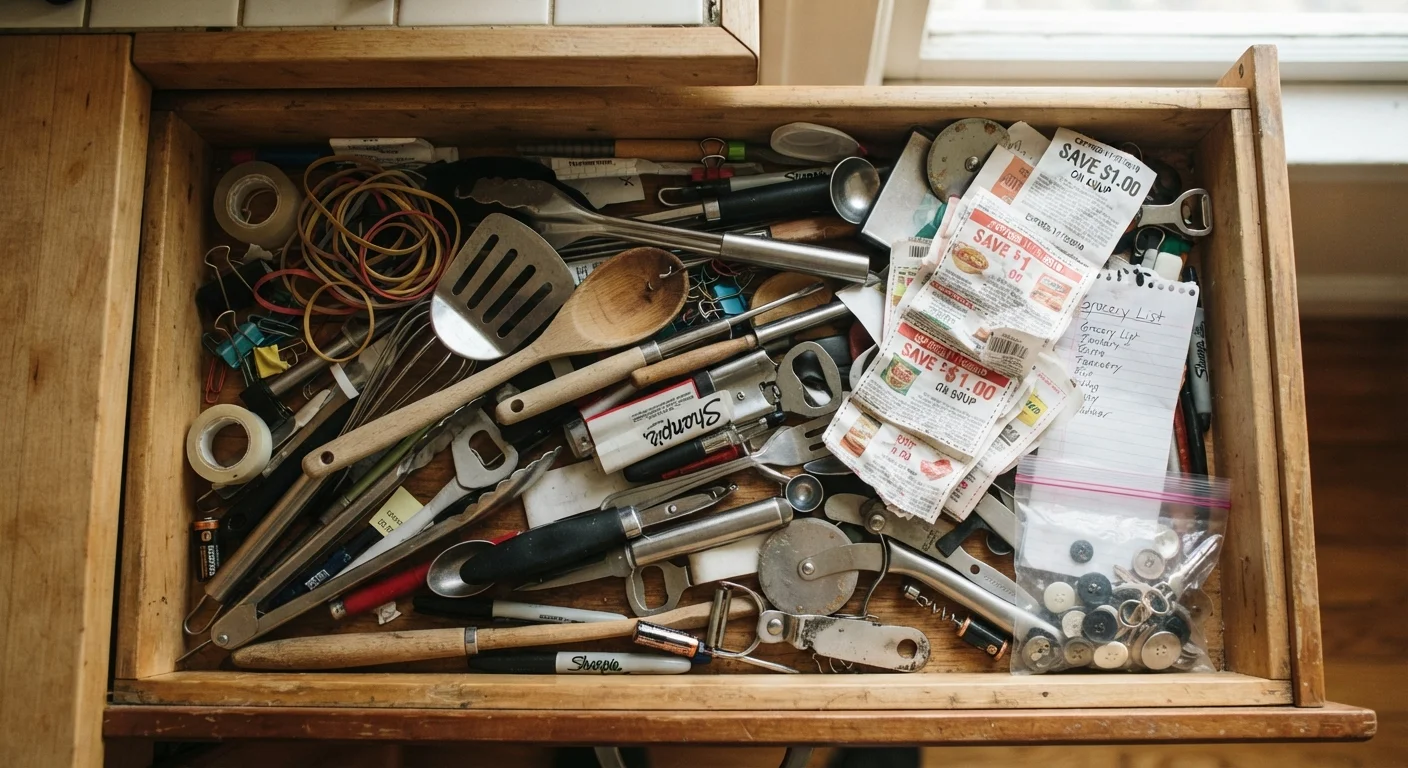
Kitchen drawers attract clutter for a simple reason: they're accessible, enclosed, and easy to close. That combination makes them the default destination for anything without an obvious home - spare batteries, twist ties, takeout menus, mystery keys. The problem isn't usually a shortage of storage space. It's a pattern of small decisions that accumulate into genuine dysfunction.
Understanding what's driving the chaos is the first step. Most of the time, it comes down to a handful of organizational mistakes that are easy to repeat and equally easy to correct once you recognize them. Before reaching for drawer dividers or storage bins, it helps to read what's actually going wrong.
Skipping decluttering and going straight to organizing.
Why it happens: Buying organizers feels productive, and sorting through items feels tedious. Most people want to solve the visible problem - the mess - rather than address what's creating it.
Using one drawer for too many unrelated item categories.
Why it happens: When a drawer is large or conveniently located, it becomes tempting to treat it as a general-purpose storage zone. Over time, batteries, scissors, pens, rubber bands, and takeout menus all share the same space with no logic.
Buying organizers before measuring or testing fit.
Why it happens: Standard-size organizers look like an obvious solution, but kitchen drawers vary considerably in depth, width, and height. Ill-fitting inserts leave awkward gaps that immediately collect clutter.
Keeping items in a drawer that are rarely or never used.
Why it happens: People hold onto low-use items "just in case," and drawers absorb them without obvious consequence - until the drawer is too full to function.
Organizing once and never revisiting the system.
Why it happens: After a successful reorganization, it's easy to assume the work is done. But kitchen use patterns shift, new items arrive, and zones drift without periodic resets.
How to Build a System That Holds
Fixing drawer chaos isn't a one-afternoon project if you skip the groundwork. The most durable approach starts with a full clear-out - remove everything, sort by category, and discard or relocate items that don't belong in that drawer at all. As our guide on decluttering before organizing explains, adding a system on top of unresolved clutter just reorganizes the problem rather than solving it.
Once you're working with only what belongs, assign each category a fixed zone in the drawer. Frequently used items - the tools you reach for daily - should sit at the front. Rarely used items go toward the back or get relocated to a less prime drawer. Use physical dividers to hold those zones in place; without them, items drift and categories collapse within days.
Adjustable dividers tend to outperform fixed inserts because kitchen use patterns shift over time. A rigid bamboo tray that perfectly fits today's layout may not work after a kitchen reorganization. Flexibility helps the system adapt rather than forcing you to start over.
Don't Over-Invest in Storage Products Upfront
It's easy to spend more than necessary on drawer organizers before you know exactly what you're working with. Start with a declutter pass first - you may find you need far fewer dividers than expected, or that a different drawer layout makes more sense than what you originally planned. Spending on storage solutions before the sorting phase often means buying the wrong things.
Finally, any physical fix needs behavioral support to last. If items are being dropped into the drawer because there's no other established spot for them, the drawer will refill regardless of how well it's organized. Building a habit of returning items to their assigned zones - and creating a genuine home for drawer orphans elsewhere - is what separates a two-week fix from a long-term solution. For more on the habit side of home organization, see our article on habits that keep a home organized.
In shared households, mismatched standards often undermine drawer organization faster than anything else. If one person consistently returns items to their zones and another doesn't, the system degrades quickly. Our piece on organizing shared spaces with different standards covers how to find workable middle ground without ongoing friction.