Why Hardware Alone Fails
Walk into any home improvement store and you'll find entire aisles dedicated to bins, baskets, drawer dividers, and closet systems. These tools can genuinely help - but only when the daily behaviors around them support their purpose. Without consistent habits, even a perfectly designed storage system fills up and collapses within weeks.
The core problem is that clutter isn't a storage shortage; it's a decision backlog. Items pile up because putting something away requires a small decision - and when that decision is deferred repeatedly, the pile grows. No container solves a habit gap.
If you've reorganized a drawer or a closet only to find it chaotic again three months later, the system wasn't wrong. The routine to maintain it just wasn't in place. That's the starting point: building behavior around the space you already have. For readers working with limited square footage, our practical guide to small-space organization covers foundational principles before adding any hardware.
The Core Practices That Keep Homes Organized
The following practices aren't about being a naturally tidy person. They're about creating low-friction defaults that make putting things away easier than leaving them out.
Designate a landing zone near your entry for items that travel in and out daily.
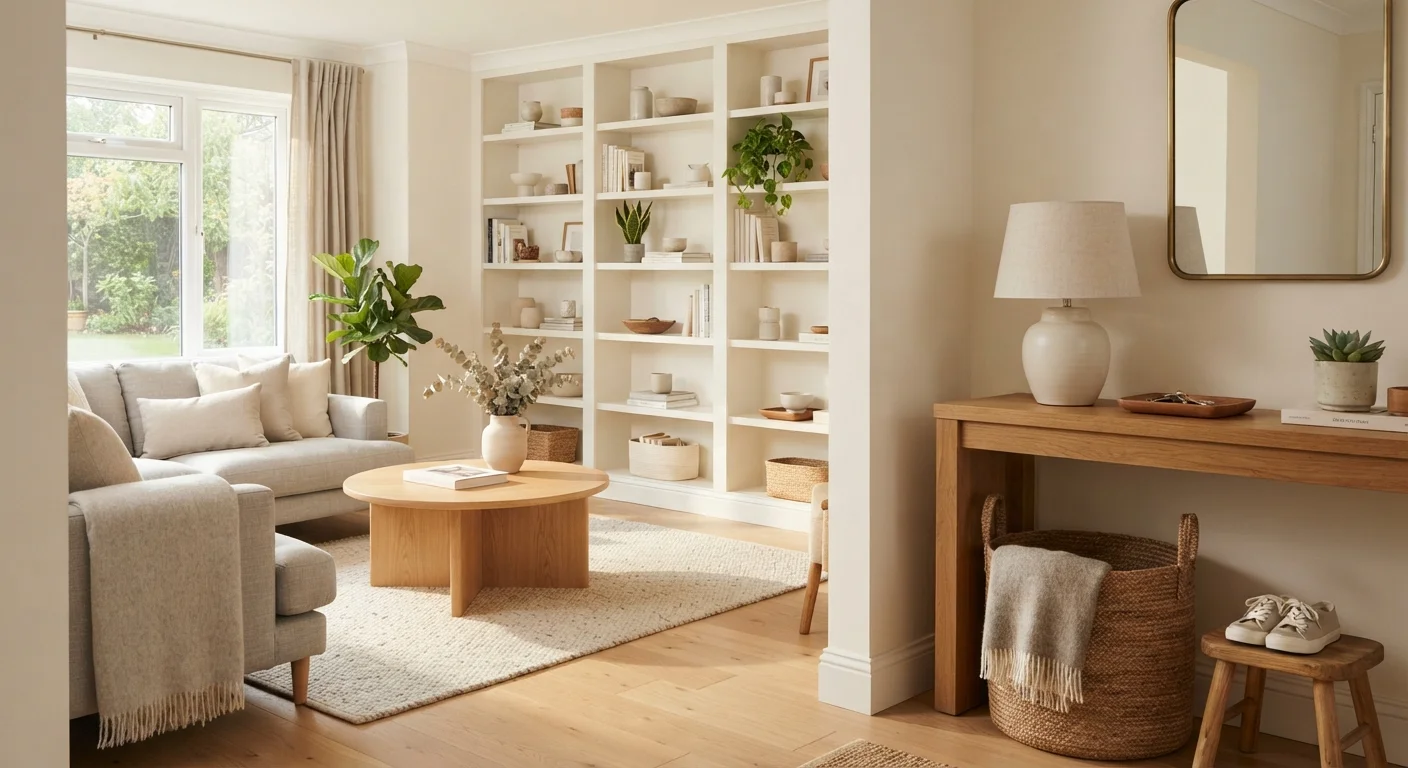
Keys, bags, mail, and shoes create the most persistent entry clutter because there's no default home for them. A landing zone removes the decision of where to put things by making one spot the obvious answer. This also prevents items from migrating deeper into the home.
Adopt a 'one in, one out' default when bringing new items into the home.
Most clutter accumulates through gradual addition without equivalent removal. The one-in-one-out principle maintains equilibrium without requiring periodic purges. It works best as a mindset applied at the point of acquisition rather than as a rigid rule enforced after the fact.
Build a brief daily reset into an existing routine rather than treating tidying as a separate task.
Standalone tidying sessions feel like chores and are easy to skip. Attaching a 10-minute reset to something you already do - like after dinner or before bed - reduces resistance and ensures it actually happens. Consistency matters more than duration.
Store items at the point of use, not where they seem logically 'correct.'
People put things down where they use them, not where storage convention suggests they belong. When storage is inconveniently far from the use point, items get left out. Reorganizing storage around actual behavior removes the friction that drives clutter.
Conduct a monthly 10-minute sweep of known clutter hot spots.
Every home has predictable clutter zones - a kitchen counter, a mudroom bench, a bedroom chair. Regular attention to these specific spots prevents accumulation from reaching an overwhelming level. Small, frequent maintenance consistently beats large, infrequent overhauls.
Quick Actions You Can Start Today
You don't need a weekend overhaul to begin building better habits. These immediate actions create momentum and establish the behavioral foundation that longer-term organization depends on.
Tackling paper specifically is often the fastest win - see our guide on managing paper clutter at home for filing and disposal strategies that hold up over time.
Making Habits Stick for Every Household Member
Organization habits are harder to sustain when household members operate by different standards. The goal isn't enforcing uniformity - it's designing systems that work with how each person actually moves through the home.
“Organizing is not about perfection; it's about efficiency, reducing stress and clutter, saving time and money, and improving your overall quality of life.”
— Julie Morgenstern, Professional organizer and author of 'Organizing from the Inside Out'
Shared spaces benefit most from agreed-upon defaults: a designated spot for keys, a rule about dishes, a weekly reset on common areas. When expectations are explicit rather than assumed, friction drops significantly. Our article on organizing a home with multiple occupants explores how to find workable middle ground when clutter tolerances differ.
It also helps to connect organization to function rather than aesthetics. When each household member understands why a habit matters - finding things faster, reducing stress before busy mornings - compliance tends to improve without needing reminders. For a room-by-room complement to these habits, the zone method for organizing by function offers a structure that reinforces these behavioral principles spatially.
40%
Of housework eliminated by reducing clutter
Research cited by the National Soap and Detergent Association suggests that reducing household clutter can eliminate roughly 40% of housework in the average home.
55 min
Average daily time lost to disorganization
A commonly referenced estimate from organizational research suggests Americans lose nearly an hour each day searching for misplaced items, though this figure varies by source and methodology.