Why Shared Homes Are Harder to Organize
Organizing a home you share with others is a fundamentally different challenge than organizing one on your own. When one person tolerates a counter covered in mail and another feels stressed by a single stray dish, no storage bin resolves that gap on its own. The disagreement isn't about objects - it's about standards, habits, and what feels like home.
The first thing to acknowledge is that neither standard is objectively correct. A higher clutter tolerance isn't laziness, and a lower one isn't controlling behavior. Both reflect different relationships with visual noise and comfort. Framing the conversation this way - as a negotiation between valid preferences - tends to produce more durable results than framing it as a problem one person needs to fix.
For a broader look at how behavioral foundations shape organization outcomes, see our guide to habits over hardware. And if your household is also navigating financial decisions together, the principles in budgeting with a partner apply equally well to shared space negotiations.
Before You Organize: Declutter as a Household
Introducing new storage systems into a cluttered shared home rarely sticks. Items without a clear purpose take up space that organizational tools need to function. The more effective sequence is to reduce what the household owns before deciding how to store what remains.
This step tends to surface disagreement quickly - one person's sentimental object is another's clutter. A practical approach: establish a clear distinction between shared items (which require joint decisions) and personal items (which each person decides about independently). No one gets a vote on another person's belongings; both people get a vote on shared belongings.
Our article on decluttering before organizing explains why this sequence matters and how to approach it systematically.
Tackle One Area at a Time
Trying to reorganize every shared space in a single session often leads to frustration and abandonment. Pick the one area that causes the most daily friction - usually the kitchen or entryway - and get that working first. A small, visible win builds momentum and demonstrates to all housemates that the system is worth maintaining.
Tools and Materials You'll Need
You don't need to spend heavily to create workable shared systems. The following items cover most situations:
Adhesive labels or masking tape and marker
Labeling shared storage so every household member knows where things belong.
Baskets or bins (one per person or zone)
Giving each occupant a designated personal storage spot within shared rooms.
A wall-mounted hook strip or over-door hooks
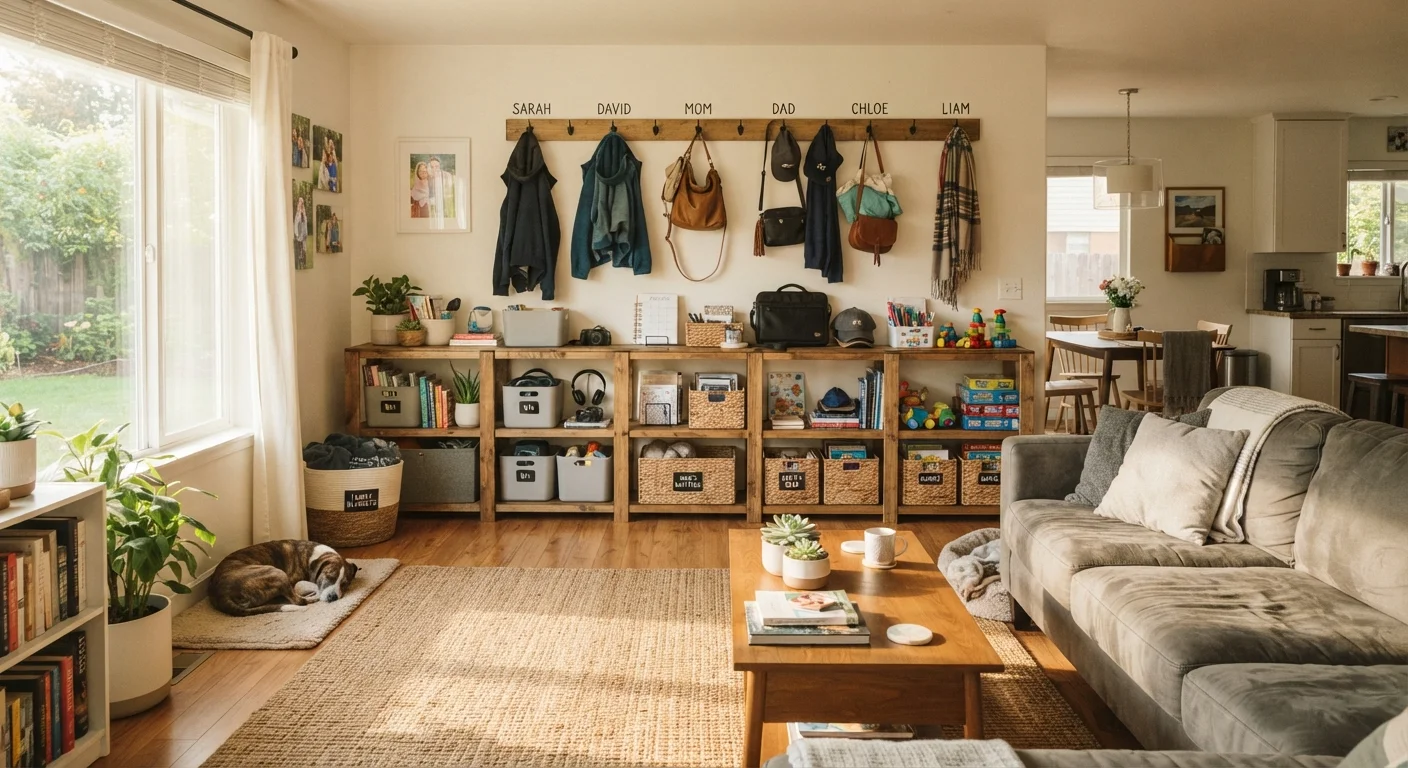
Creating a designated landing spot for bags, coats, and other frequently dropped items near entry points.
A small tray or inbox organizer
Containing incoming mail and paper clutter in one visible, designated location.
Shelf dividers
Separating shared shelf space into clearly assigned personal sections in closets or kitchens.
Before purchasing anything, do a full sweep of what you already own - repurposed boxes, spare shelving, and existing bins can often substitute for new purchases.
Step-by-Step: Building an Organization System That Works for Everyone
What you will need
Map shared vs. private spaces
Walk through the home together and explicitly designate which spaces are shared (living room, kitchen, bathrooms) and which are personal (individual bedrooms, a specific shelf or drawer). Shared spaces require agreed-upon standards. Personal spaces are each occupant's domain - organization expectations there are set by the individual, not the household.
Agree on a minimum standard for shared areas
Rather than aiming for one person's ideal, negotiate a minimum acceptable standard for each shared space. This might mean: dishes washed within 24 hours, common surfaces cleared by the end of each day, or coats hung rather than draped over chairs. Keep the list short - two or three concrete behaviors per space is more enforceable than a comprehensive rulebook.
Assign dedicated spots for high-friction items
Identify the items that cause the most recurring conflict - bags dropped at the door, charging cables spread across surfaces, mail accumulating on the counter. For each, designate a single specific location. A hook by the door, a charging station in one spot, a tray for incoming mail. When an item has an obvious home, returning it there requires far less decision-making.
For paper specifically, our article on managing paper clutter offers targeted strategies.
Label shared storage clearly
In kitchens, closets, and utility areas, label shelves and containers so that every household member knows where things belong without having to ask. Labels reduce the mental load of maintaining shared systems and eliminate the common excuse of not knowing where something goes. Simple masking tape and a marker is sufficient - no specialized tools required.
Give each person dedicated personal storage in shared rooms
In living rooms or home offices used by multiple people, consider allocating a specific basket, shelf section, or drawer to each occupant. This gives everyone a place to put personal items without those items colonizing shared surfaces. It also reduces resentment - each person has a defined space, so shared areas feel more neutral. See storage strategies by home size for ideas suited to different footprints.
Schedule a recurring household reset
Set a recurring time - weekly or monthly depending on how the home tends to drift - where everyone spends 15 to 20 minutes returning items to their designated spots, clearing shared surfaces, and flagging anything in the system that isn't working. Treat this as maintenance rather than cleanup, which makes it feel less like a reaction to failure and more like routine upkeep.
Maintaining the System Over Time
A shared organization system will drift without occasional maintenance. Schedules change, new items enter the home, and habits slip. Rather than waiting for frustration to build, consider scheduling a brief household reset - 15 to 20 minutes, once a month - where everyone returns items to their zones and flags anything that isn't working.
The goal isn't perfection; it's a system that everyone can realistically maintain. If a particular rule is being ignored consistently, treat that as information: the rule may be too demanding, unclear, or not serving anyone's actual needs. Adjust rather than escalate.
If storage space itself is the limiting factor, using vertical space can open up significant capacity without additional floor area. Organizing by function rather than by room is another approach worth exploring - our zone method article covers this in detail.
Avoid Reorganizing Without Buy-In
Rearranging shared spaces unilaterally - even with good intentions - often triggers resentment rather than appreciation. Changes to shared areas should be discussed and agreed upon before they're implemented. A system that one person designed without input tends to be maintained by only that person, which defeats its purpose.