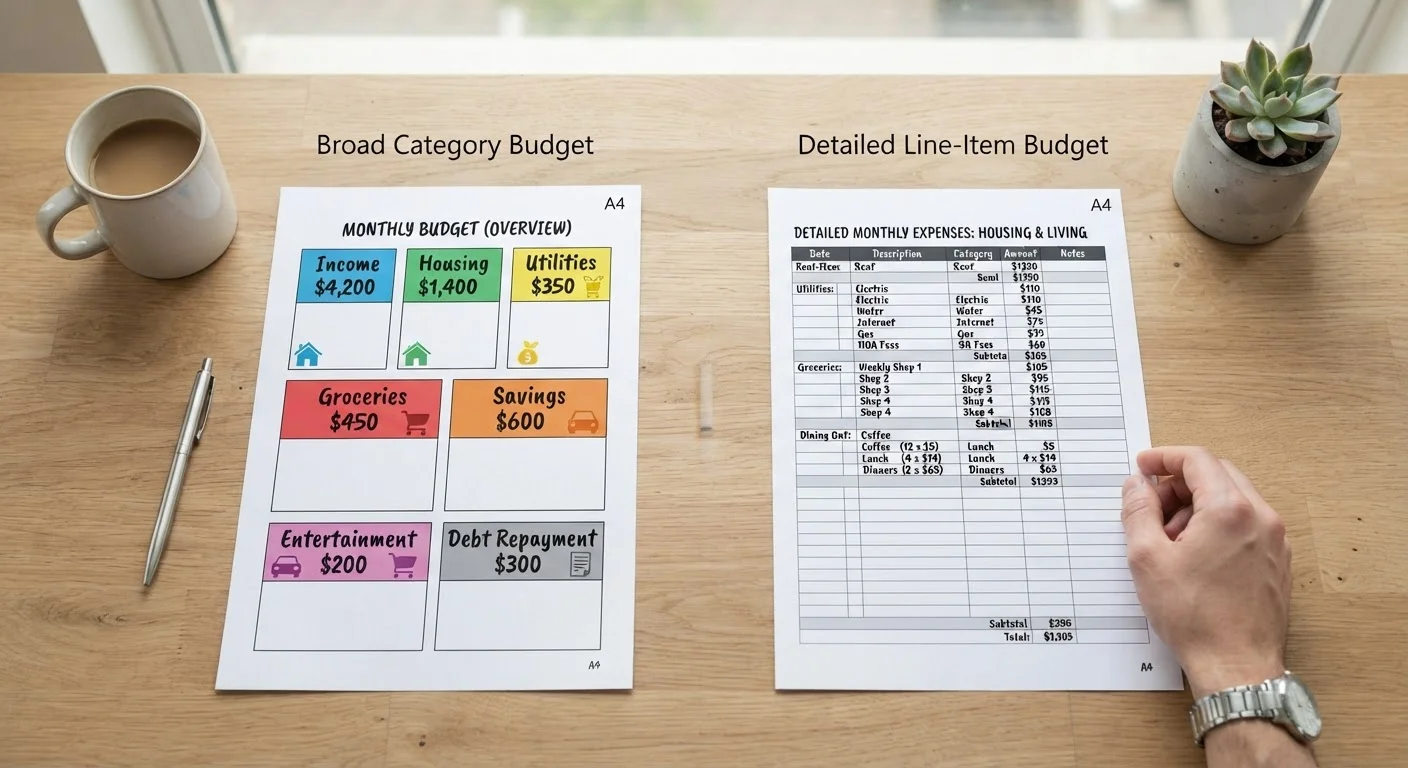
How Each Framework Works
The 50/30/20 rule - widely attributed to U.S. Senator Elizabeth Warren and co-author Amelia Warren Tyagi, who outlined it in their book All Your Worth - divides monthly after-tax income into three buckets: 50% for needs (housing, utilities, groceries, minimum debt payments), 30% for wants (dining out, entertainment, subscriptions), and 20% for savings and extra debt repayment. The appeal is its simplicity: know your take-home pay, apply the percentages, and spend within each category.
Zero-based budgeting (ZBB) operates differently. Each month you start at zero and allocate every dollar of expected income to a specific category - housing, food, transportation, savings, entertainment, and so on - until income minus all allocations equals zero. Nothing is left unassigned. The process resets each month, so the budget reflects your actual current priorities rather than a fixed template.
For a broader look at how these methods sit within the wider landscape of budgeting approaches, see Budgeting Methods Compared.
| Criterion | 50/30/20 Rule | Zero-Based Budgeting |
|---|---|---|
| Setup time | Minutes per month | 30-60 minutes per month |
| Ongoing tracking required | Light - monthly category check | Heavy - regular transaction logging |
| Spending categories | 3 broad buckets | Unlimited specific line items |
| Best income type | Stable, predictable salary | Any - adapts to variable income |
| Flexibility | High - percentages adjust naturally | Lower - requires monthly rebuild |
| Spending visibility | Category-level only | Line-item precision |
| Barrier to entry | Low | Moderate to high |
| Best for debt payoff | Moderate - 20% slot is broad | Strong - debt gets its own line |
Key Differences in Practice
The most important practical difference is time investment. The 50/30/20 rule can be reviewed in minutes each month - check that your spending categories stayed within their percentage bands and adjust only if something drifted significantly. Zero-based budgeting typically requires 30-60 minutes at the start of each month to plan categories and then ongoing tracking throughout the month to ensure you stay within each line item.
The second major difference is precision versus flexibility. The 50/30/20 rule groups a wide range of expenses under broad labels, which means a $400 grocery bill and a $400 car payment both sit inside "needs" without distinction. Zero-based budgeting separates every category, giving you a clearer picture of which individual expenses are absorbing the most income - and where cuts are realistic.
~74%
Americans living paycheck to paycheck
A 2023 LendingClub survey found approximately 74% of U.S. consumers reported living paycheck to paycheck, underscoring the stakes of choosing a sustainable budgeting method.
1 in 3
Adults with no written budget
Surveys by the National Foundation for Credit Counseling have consistently found that roughly one-third of U.S. adults do not maintain any type of monthly budget.
20%
Savings target in the 50/30/20 rule
The 20% savings-and-debt allocation is designed to cover both emergency fund contributions and accelerated debt repayment simultaneously.
That granularity is also zero-based budgeting's main friction point. It requires consistent logging and honest forecasting. If you skip tracking mid-month, the budget loses its effectiveness quickly. The 50/30/20 rule is more forgiving - a rough monthly review can still keep most people broadly on track.
If you're still deciding how to track either method, comparing paper, spreadsheet, and app-based tracking can help narrow down the format that fits your habits.
Where Each Method Falls Short
The 50/30/20 rule's simplicity is also its limitation. The 50% needs allocation can be unrealistic in high cost-of-living areas where housing alone may consume 40% of take-home pay, leaving little room for other essentials. The 30% wants allocation, meanwhile, can function as implicit permission to spend - readers who need to reduce discretionary spending may find the framework too permissive. Our deeper guide to the 50/30/20 rule explores how to adjust the percentages when they don't fit your income level.
Zero-based budgeting has its own failure modes. The monthly rebuild is genuinely time-consuming, and underestimating irregular expenses - car maintenance, medical co-pays, annual subscriptions - can cause the budget to collapse mid-month. It also requires a reliable estimate of monthly income, which makes it harder to apply when income varies significantly. People who find the upfront planning burdensome often abandon ZBB within a few months.
Both systems assume you have a handle on what you actually spend. If you're not sure where your money currently goes, building your first budget from scratch is a logical starting point before committing to either framework.
A Note on Income Definitions
The 50/30/20 rule is calculated on after-tax (take-home) income, not gross pay. Zero-based budgeting also works best when you budget from net income - the amount actually deposited in your account each month. Using gross pay in either system will cause your allocations to exceed what you can actually spend, leading to shortfalls. If your income varies, many zero-based budgeters use their lowest expected monthly income as the planning baseline and treat any additional income as a bonus to allocate when it arrives.
Choosing the Right Fit - or Combining Both
Neither framework is objectively superior. The right choice depends on your income stability, the complexity of your financial situation, and how much friction you're willing to accept in exchange for control. Some people use a hybrid: the 50/30/20 percentages as a high-level sanity check, with zero-based planning applied only to the discretionary 30% - a middle path that adds precision where it matters most without requiring full monthly rebuilds.
Whichever method you choose, consistency matters more than perfection. A budget reviewed regularly - even one that's imperfect - will outperform a theoretically optimal system that gets abandoned. Start with the framework that creates the least resistance, then add structure as your habits solidify. You can always explore zero-based budgeting compared against the envelope method if you want to see another alternative side by side. For ongoing practical guidance, the Budgeting Basics hub and the Smart Spending hub offer additional tools to help you stretch every dollar.
This article is for general informational and educational purposes only and does not constitute personalised financial advice. Consult a qualified financial professional for guidance tailored to your individual circumstances.