How Anchoring Works - and Why It's So Hard to Ignore
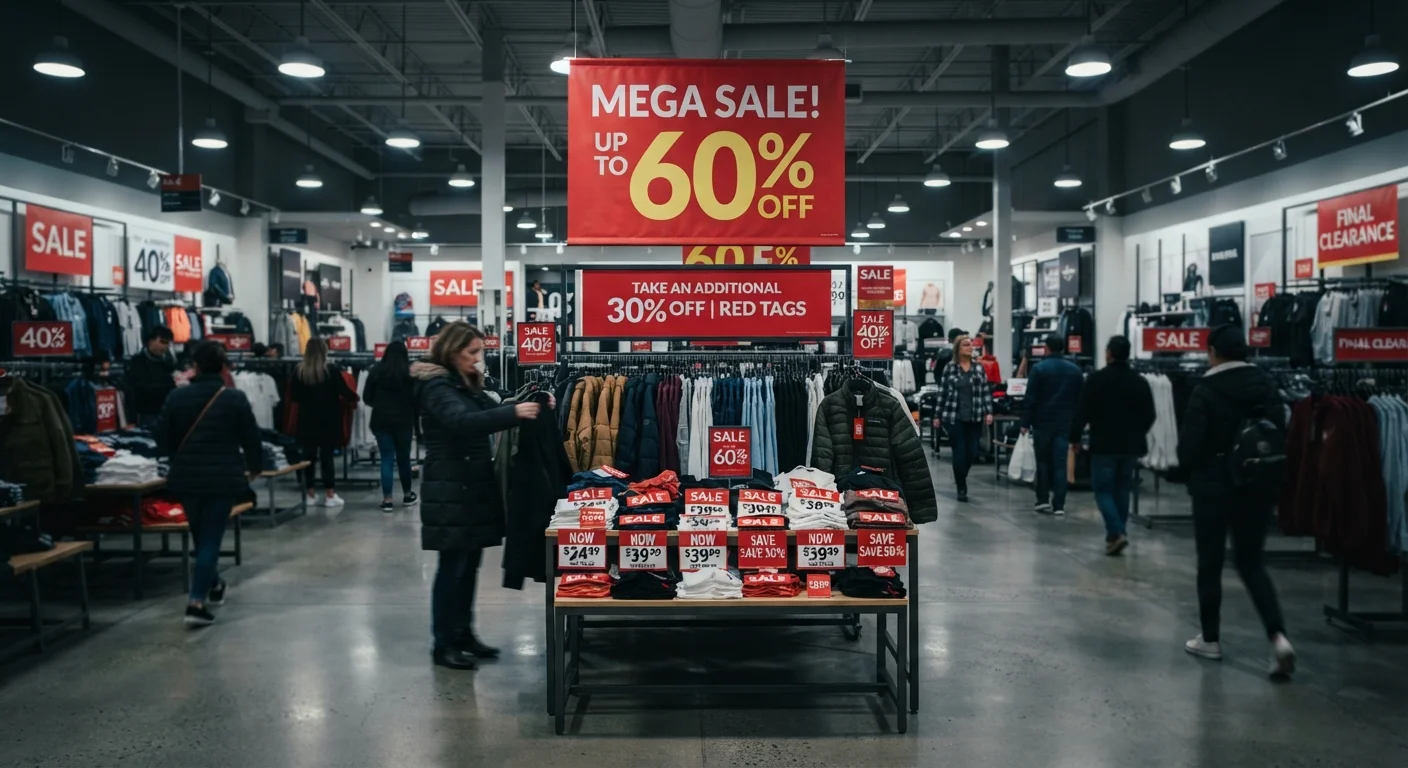
When you see a jacket priced at $250, crossed out, with $99 displayed beneath it, something specific happens in your brain: the $250 becomes your reference point. Every judgment you make about the $99 price is measured against that anchor, not against the jacket's actual production cost, its fair market value, or whether you needed it before you walked in.
This is price anchoring - one of the most reliably documented phenomena in behavioral economics. The anchor doesn't have to be credible to be effective. Research consistently shows that even arbitrary numbers influence subsequent judgments. Retailers know this, which is why "was" prices are prominently displayed even when the item rarely or never sold at that original price.
Anchoring also appears in car dealerships. A salesperson who opens with a high monthly payment figure anchors the conversation there - making a slightly lower number feel like a concession. Understanding how buyers consistently overpay starts with recognizing these opening anchors before negotiations begin.
2x
How much more losses hurt than equivalent gains
Kahneman and Tversky's foundational research on Prospect Theory found that losses are felt roughly twice as powerfully as equivalent gains, a finding replicated across decades of behavioral economics research.
~60%
Retail purchases that are unplanned at point of sale
Industry research has consistently found that a majority of in-store purchases were not planned before the shopper entered - a figure that reflects the cumulative effect of environmental pricing cues.
Over 90%
Prices ending in 9 among US retail goods
Studies of retail price distributions have found that the vast majority of consumer goods prices end in 9 or 5, reflecting the widespread adoption of charm pricing across retail categories.
Loss Aversion: Why Missing a Deal Feels Like Losing Money
Loss aversion, a concept central to Prospect Theory developed by psychologists Daniel Kahneman and Amos Tversky, describes why people feel losses more intensely than equivalent gains. In practical terms: the discomfort of losing $50 is psychologically stronger than the pleasure of finding $50.
Retailers translate this into urgency mechanics. "Sale ends tonight." "Only 2 left at this price." "Your cart is about to expire." These messages don't inform you - they manufacture a loss. The item you haven't bought yet suddenly feels like something slipping away, and the emotional drive to prevent that loss overrides the more deliberate calculation of whether the purchase makes sense.
This is why impulse purchases often feel regrettable afterward: the decision was made to avoid a feeling, not to satisfy a genuine need. Pause strategies like the 30-day rule are specifically designed to create distance between that emotional moment and the actual transaction.
Test Your Decision Before the Countdown Ends
When urgency messaging appears - a timer, a low-stock warning, a flash sale - treat it as a cue to pause rather than act. Ask yourself: was this item on my list before I saw the promotion? If it wasn't, the urgency is the product being sold, not the item itself. A 24-hour wait rarely costs you anything real, and frequently saves you from purchases you'd regret.
Other Techniques Retailers Routinely Deploy
Anchoring and loss aversion are the two most studied retail psychology mechanisms, but they rarely operate alone. Several related tactics compound their effect:
- Charm pricing: Prices ending in .99 or .95 are perceived as significantly cheaper than the next whole dollar, even though the difference is negligible. A $4.99 price reads as "four dollars and something" rather than effectively $5.
- Decoy pricing: A third, poorly valued option is introduced to make one of the other two seem obviously better. If a medium coffee costs almost as much as a large, most people choose the large - not because they wanted it, but because the comparison made it feel rational.
- Scarcity framing: Displaying low-stock counts or limited availability activates the same loss aversion pathways, independent of whether the scarcity is genuine.
- Loyalty reward framing: Points systems can create the illusion of savings while nudging you toward purchases you wouldn't otherwise make. Evaluating whether loyalty programs deliver real value requires separating the actual discount from the behavioral incentive to spend more.
What You Can Actually Do With This Knowledge
Awareness alone won't fully neutralize these effects - that's what makes them durable. But it meaningfully reduces their power when paired with deliberate habits.
Before any significant purchase, ask a simple question: Would I consider buying this item if the original price weren't displayed? If the answer is no, the anchor is doing the work, not the value. Similarly, when urgency messaging appears, treat it as a signal to slow down rather than speed up. Artificial scarcity is a technique, not a fact.
For larger purchases - vehicles, appliances, travel - it helps to research independent price benchmarks before engaging with any retailer's framing. In automotive contexts, understanding market adjustment markups is one example of how anchoring operates at scale, where thousands of dollars can hinge on what number a dealer introduces first.
The goal isn't to become immune to retail environments - that's neither realistic nor necessary. The goal is to make spending decisions that reflect your actual priorities, not the psychological sequence a sale sign was designed to trigger.
This article is for general informational and educational purposes only and does not constitute personalized financial advice. Consult a qualified financial professional for guidance specific to your situation.