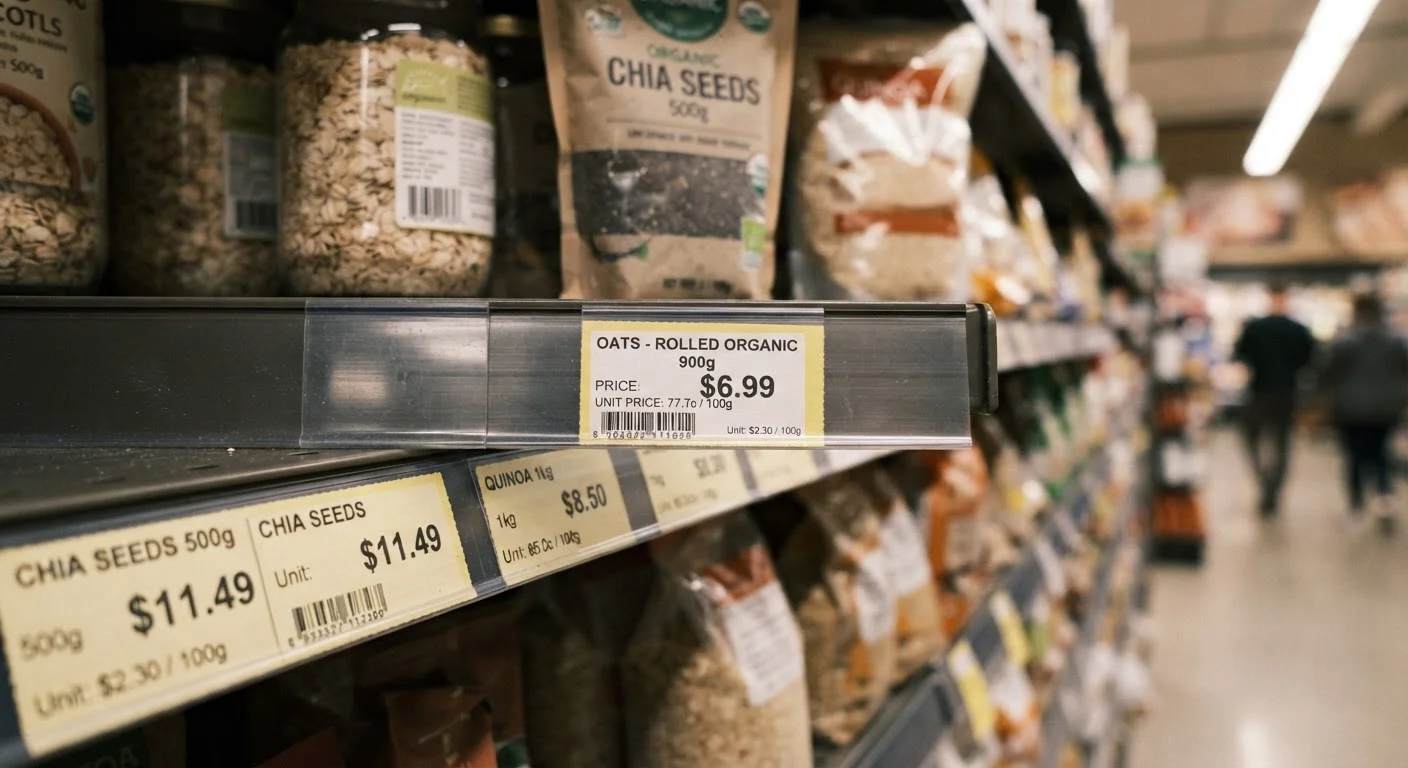
What Unit Price Actually Tells You
When you pick up two bottles of olive oil - one priced at $5.99 for 16 oz and another at $8.49 for 25.5 oz - the sticker prices tell you almost nothing useful. Unit price solves that. It converts each product to a common denominator: in this case, cost per fluid ounce. The $5.99 bottle works out to roughly $0.37/oz; the $8.49 bottle is about $0.33/oz. The larger bottle wins on value, assuming you'll use it.
This same logic applies across the entire store - laundry detergent priced per load, paper towels per sheet, yogurt per ounce, vitamins per serving. The unit price is the great equalizer, stripping away packaging size and brand positioning to show you what you're actually paying for what you're actually getting.
Pair this habit with cost-per-use thinking and you have a complete framework for evaluating almost any purchase, not just groceries.
Why Bigger Isn't Always Cheaper Per Unit
The assumption that bulk equals savings is widespread - and frequently wrong. Retailers know shoppers make this assumption, so large-size products aren't always priced to reflect it. Promotional sizes, multipacks, and warehouse quantities sometimes carry a higher unit price than the mid-size option sitting right next to them on the shelf.
~30%
Potential unit cost difference between package sizes
Consumer research has repeatedly found that the unit price of the same product can vary by 20-30% or more across different package sizes within the same store, with the largest size not always winning.
35+
U.S. states with some unit pricing regulations
According to consumer advocacy research, more than 35 states have enacted unit pricing laws or regulations for at least some retail categories, though coverage and enforcement vary significantly.
There are a few reasons this happens. Manufacturers occasionally use large sizes as premium positioning. Promotional packages may inflate the price slightly because the novelty of the format supports it. And sometimes mid-size SKUs are the ones on markdown to clear inventory.
The practical takeaway: don't skip the shelf tag on the large size just because it looks like a bargain. Check the unit price on every size you're considering. It takes about three seconds and removes all guesswork.
How to Read the Label When Units Don't Match
One of the more frustrating quirks of retail shelf labels is inconsistent reference units. Two competing paper towel brands might display their unit prices differently - one per sheet, one per 100 sheets. A breakfast cereal might be priced per ounce while a competing brand shows per serving. When that happens, you can't compare directly.
The fix is simple arithmetic: convert one to match the other. If Brand A is $0.02 per sheet and Brand B is $1.80 per 100 sheets, Brand B is $0.018 per sheet - marginally cheaper. A phone calculator makes this effortless.
Do the Math in the Aisle
When shelf labels use different reference units, open your phone's calculator and divide the total price by the package quantity to get a consistent per-unit figure. This takes under 30 seconds and immediately resolves any apples-to-oranges comparison. Shoppers who do this routinely often report that it becomes second nature within a few trips.
This same discipline is worth applying when shopping for pet food. Package sizes in that category vary enormously, and unit price is one of the clearest ways to compare value. Our guide on reading a pet food label covers what else to look for beyond price.
Unit Price in Context: When It's Not the Whole Story
Unit price is a powerful filter, but it works best alongside a few other considerations.
- Perishability: The lower unit price on a 5-lb bag of spinach is irrelevant if half of it will go bad before you use it. Factor in realistic consumption.
- Quality differences: Unit price doesn't distinguish between a store-brand product and a name-brand equivalent. If quality matters to you for a specific item, weigh that alongside the price. Our piece on store brands vs. name brands breaks down when the quality gap is real and when it isn't.
- Nutrition: Two cereals priced at $0.18/oz aren't equivalent if one has significantly more sugar or fewer nutrients per serving. Reading a nutrition label alongside the unit price gives you the full picture for food purchases.
Unit pricing is a starting point for smarter decisions, not a finish line. It reliably narrows your options - then you apply judgment to the finalists.
This article is for general informational and educational purposes only and does not constitute financial, legal, or professional advice. Consult a qualified professional for guidance specific to your situation.