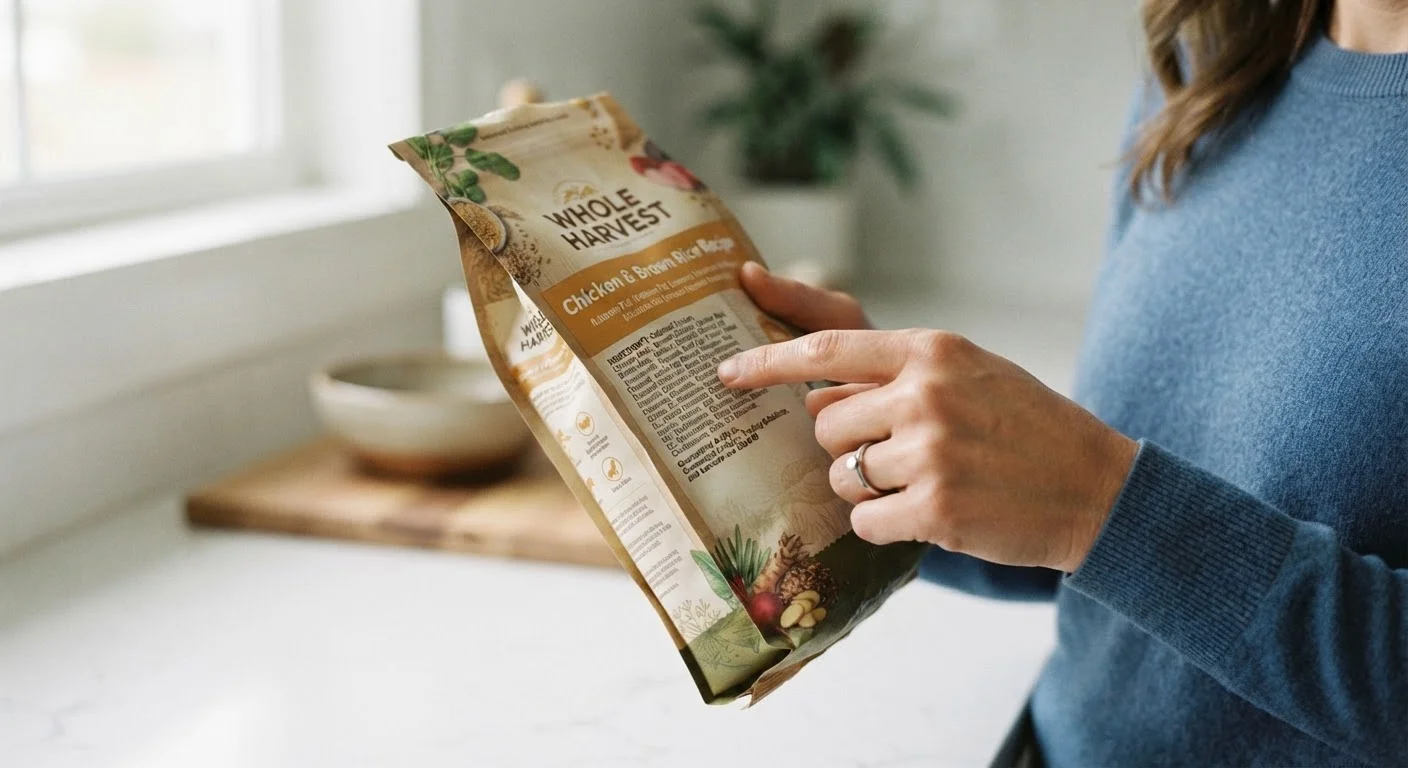
Why Pet Food Labels Exist - and Who Oversees Them
Pet food labels are not optional marketing materials - they are legally required disclosures. In the United States, the FDA sets baseline federal requirements, while AAFCO develops model regulations that most states adopt. This layered system means the label on your pet's food must meet specific formatting and content standards before it can be sold in most states.
Understanding this regulatory framework helps you separate what a label must say from what manufacturers choose to say. The required elements - ingredient list, guaranteed analysis, nutritional adequacy statement, net weight, and manufacturer contact - carry real meaning. The front-of-bag claims, on the other hand, are where marketing language tends to outpace substance.
For a broader look at how labeling works across food categories, see our guide to reading nutrition labels - many of the same interpretation challenges apply.
The AAFCO Statement: The Line That Matters Most
If you only read one section of a pet food label, make it the AAFCO nutritional adequacy statement. This statement tells you two critical things: whether the food is formulated to be nutritionally complete, and for which life stage.
There are two ways a food earns this statement:
- Formulation method: The recipe meets AAFCO's minimum nutrient profiles on paper.
- Feeding trial method: The food was fed to real animals under AAFCO protocols, with health outcomes measured.
Both are acceptable, but a feeding trial adds a layer of real-world verification. The statement will also specify a life stage: growth (puppies or kittens), adult maintenance, all life stages, or senior. A food labeled for adult maintenance has not been verified for a growing animal's higher nutritional demands.
Treat and Supplement Foods Are Different
Foods labeled as supplements, treats, or snacks are not formulated to be nutritionally complete. They do not carry an AAFCO complete and balanced statement by design. Feeding them as a primary diet can leave nutritional gaps over time. Always confirm your pet's main food carries the full nutritional adequacy statement for the appropriate life stage.
Foods labeled as a supplement or treat will not carry a complete and balanced statement. These are not intended to serve as a pet's entire diet and should be offered accordingly.
Decoding the Ingredient List
Ingredients are listed in descending order by pre-cooking weight. This detail matters because it affects how you interpret what you see. A fresh protein like chicken ranks high partly because it contains significant water weight - after the moisture cooks off during processing, its actual contribution may be smaller than its position suggests.
A few things worth knowing:
- Named proteins rank above unnamed ones. 'Chicken meal' is more specific and traceable than 'poultry meal.'
- Ingredient splitting can inflate rankings. If different forms of the same ingredient (e.g., corn flour, corn gluten meal, ground corn) appear separately, their combined weight might place that ingredient higher than any single listing suggests.
- Named by-products are regulated. 'Chicken by-products' refers to a defined set of organ and carcass components - nutrient-dense and legal - not random waste material.
For context on how ingredient processing affects nutritional quality, our pet nutrition myths article addresses several common misreads.
Use the Ingredient List as a Starting Filter
Scan the first five to eight ingredients - they represent the bulk of the food's composition. Look for a named protein source (not just 'meat') in the first few positions, and note whether whole food ingredients or by-products dominate. This quick scan won't tell you everything, but it focuses your attention where composition matters most.
The Guaranteed Analysis: What the Numbers Do and Don't Tell You
The guaranteed analysis panel lists four values at minimum: crude protein (minimum), crude fat (minimum), crude fiber (maximum), and moisture (maximum). These are not averages or exact figures - they are regulatory limits that the food must not fall below or exceed.
95%
Ingredient threshold for single-protein label claim
Under AAFCO naming rules, a food named simply 'Chicken Dog Food' must contain at least 95% of that named ingredient, excluding water added in processing.
25%
Minimum for 'dinner,' 'entrée,' or 'platter' label
AAFCO rules allow foods using descriptors like 'entrée' or 'dinner' to contain as little as 25% of the named ingredient, a meaningful difference from the 95% rule.
4
Minimum guaranteed analysis values required
US regulations require pet food labels to list at minimum crude protein, crude fat, crude fiber, and moisture - each expressed as a percentage with regulatory floor or ceiling values.
Because moisture content varies widely between wet and dry foods, raw percentages aren't directly comparable. A wet food with 78% moisture and a dry kibble with 10% moisture will show very different protein percentages, even if their dry-matter protein content is similar. To compare the two on equal footing, you'd need to calculate nutrients on a dry-matter basis - or ask the manufacturer for that data.
The guaranteed analysis is a useful starting checkpoint, not a precise nutritional profile. For pets with medical conditions requiring specific nutrient targets, your veterinarian may need detailed nutritional data that goes beyond what the label provides.
See our comparison of dry and wet pet food for more on how moisture content shapes what you're actually feeding.
Front-of-Bag Claims: Reading With Skepticism
Words like 'premium,' 'holistic,' 'gourmet,' and 'human-grade' have little or no standardized regulatory definition in US pet food labeling. They are marketing language, not verified nutritional claims. The presence or absence of these terms on the front of a bag tells you nothing definitive about a food's quality.
AAFCO does regulate some descriptive terms, however. Ingredient-naming rules govern how prominently a specific protein can be featured on the label. For example, a food labeled 'Chicken Cat Food' must contain at least 95% chicken (excluding water); 'Chicken Dinner' or 'Chicken Entrée' requires only 25%. These naming rules offer real signal about ingredient content.
When evaluating any pet food, anchor your assessment to the back-panel required information - AAFCO statement, ingredient list, guaranteed analysis - rather than front-panel claims. Our overview of grain-free diet research is a useful example of how marketing trends can move faster than the evidence behind them.
This article provides general educational information about pet food labeling and is not a substitute for personalized guidance from a licensed veterinarian. If your pet has specific health conditions or dietary needs, consult your vet before making feeding changes.