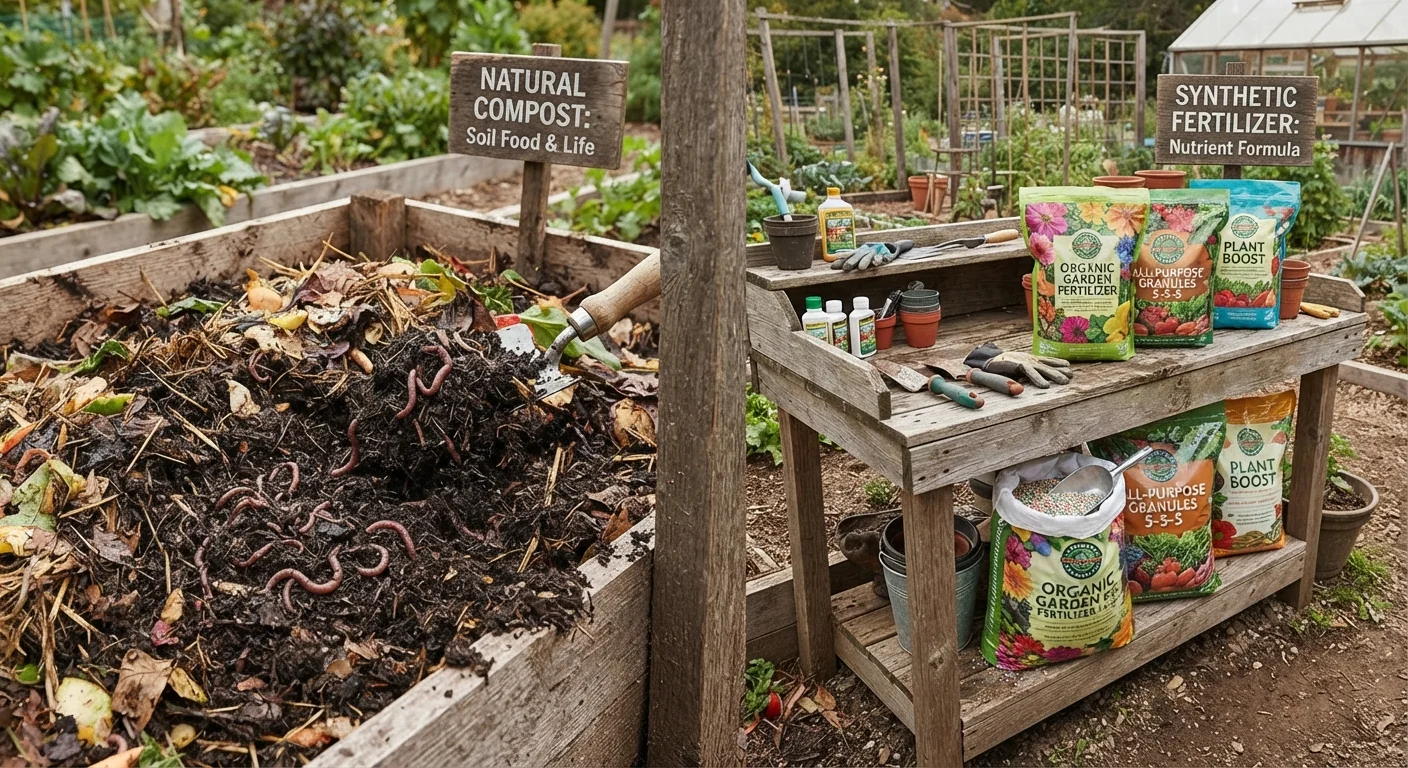
How Each One Actually Feeds Your Garden
Compost and bagged fertilizer both support plant growth, but through fundamentally different mechanisms. Understanding that difference is the first step to spending your garden budget wisely.
Compost is decomposed organic matter - food scraps, leaves, grass clippings - broken down by bacteria, fungi, and other organisms. It releases nutrients slowly as microbial activity continues in the soil. More importantly, compost improves soil structure: it helps sandy soils retain moisture and breaks up compacted clay, creating better root conditions. It also feeds the beneficial organisms that make nutrients available to plants in the first place.
Bagged fertilizer delivers a concentrated blend of specific nutrients - typically nitrogen (N), phosphorus (P), and potassium (K), shown as the N-P-K ratio on the label. Synthetic fertilizers are water-soluble and act quickly; organic bagged options (blood meal, bone meal, kelp) release more slowly. Either way, fertilizer adds nutrients without meaningfully improving soil texture, water-holding capacity, or microbial life.
For a deeper look at how nutrient availability ties into soil conditions, see our guide on soil pH and nutrient availability.
| Criterion | Compost | Bagged Fertilizer |
|---|---|---|
| Primary benefit | Soil structure + slow nutrition | Fast, targeted nutrient delivery |
| Nutrient control | Variable; depends on inputs | Precise N-P-K ratios on label |
| Speed of results | Months to seasons | Days to weeks |
| Recurring cost | Near zero (homemade) | Ongoing seasonal expense |
| Soil biology impact | Strongly supports microbial life | Minimal to neutral |
| Ease of use | Requires setup and patience | Ready to apply immediately |
| Risk of over-application | Low | Moderate to high (especially synthetic) |
| Best setting | In-ground beds, established gardens | Containers, deficiency correction |
Cost, Time, and Practicality
For budget-minded gardeners, the cost picture is stark. A backyard compost bin or pile can be built from scrap wood or purchased inexpensively, and the inputs - kitchen scraps, yard waste - cost nothing. The tradeoff is time: a functional compost system typically takes three to twelve months to produce usable material, and it requires occasional turning and moisture management.
Bagged fertilizer is available immediately and easy to apply, but it's a recurring expense. Depending on garden size and product type, annual fertilizer costs can add up significantly over several seasons. Synthetic options tend to cost less upfront but may need reapplication more frequently than slower-release organic alternatives.
~50%
Of US food waste that could be composted
The EPA estimates that food and yard waste together make up roughly half of what American households send to landfills - much of it compostable.
3-12 months
Typical time to finished compost
University extension programs generally report that a managed compost pile turns raw organic material into usable amendment within three to twelve months depending on method and climate.
5-10%
Typical organic matter in healthy topsoil
Soil scientists generally consider five to ten percent organic matter a marker of productive, biologically active topsoil - a level compost additions support over time.
If you're looking for additional low-cost ways to improve your soil beyond compost, our article on cheap ways to improve garden soil covers a range of accessible amendments. You can also explore how mulching complements soil nutrition in our practical guide to mulching garden beds.
When to Use Each - or Both
The most effective approach for most home gardeners isn't strictly one or the other. Compost lays the foundation: applied each season as a two- to three-inch top dressing or worked into beds before planting, it steadily builds the kind of soil that grows resilient plants. It's especially valuable in new beds with poor or depleted soil.
Bagged fertilizer earns its place when speed or precision matters. If a soil test confirms your garden is nitrogen-deficient heading into spring planting, waiting months for compost to cycle through isn't practical. A targeted fertilizer application addresses that gap while your compost program builds long-term capacity.
Container gardens and raised beds with limited native soil are another case where fertilizer is often necessary - compost works best when it can integrate with an existing soil ecosystem. Our comparison of container vs. in-ground gardening explains why the two setups have different amendment needs.
One practical rule of thumb: if your soil is structurally poor (compacted, sandy, or low in organic matter), prioritize compost. If your soil structure is reasonable but plant performance lags, a soil test will tell you whether targeted fertilizer makes sense - and prevent over-applying nutrients that plants can't use and that may wash into waterways.
This article provides general gardening guidance for educational purposes. Soil conditions vary; consult your local cooperative extension service for region-specific recommendations and soil testing resources.