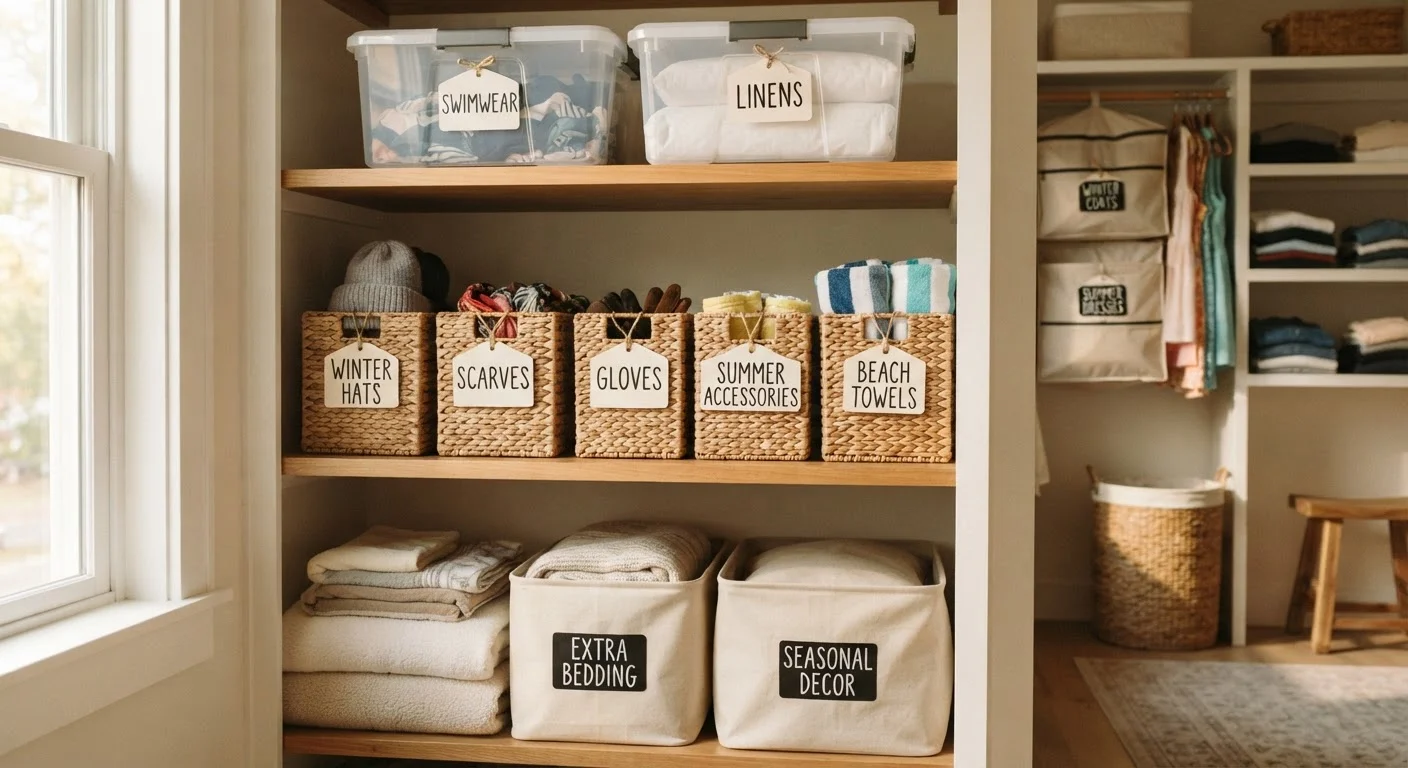
Why Seasonal Rotation Works
Most home storage problems aren't caused by having too much stuff - they're caused by having the wrong stuff within reach at the wrong time. Winter coats crowding a summer entryway, camping gear blocking the everyday shoe rack, spare blankets stacked on accessible shelves in July: these are friction points that make spaces feel cluttered even when they're technically organized.
Seasonal rotation addresses this by matching your accessible storage to your actual, current needs. The principle is straightforward: items you'll use in the next 60-90 days stay in prime, easy-to-reach spots; everything else moves to secondary storage. The result is a home that functions more efficiently without requiring more space or more spending.
See how this connects to organizing your home by function - both approaches prioritize matching physical layout to real daily use.
Best Practices for an Effective Rotation System
Building a reliable seasonal rotation system comes down to a handful of habits and structural choices. The practices below are designed to work across different home sizes and budgets.
Define two storage tiers - prime access and secondary - before you start rotating.
Without a clear distinction between everyday-accessible and off-season storage, items end up scattered across both zones and the system breaks down. Defining tiers upfront gives every item a logical home and makes the swap process repeatable.
Use a consistent container system with clear, specific labels.
Standardized containers stack efficiently and signal at a glance where everything belongs. Vague labels like 'misc winter' slow down both the packing and unpacking process and often lead to overfilling.
Schedule two fixed rotation dates per year and add them to your calendar.
Rotation only works if it actually happens. Without a set date, the swap gets deferred indefinitely and out-of-season items accumulate in prime space. Two dates - typically spring and fall - cover the major climate and activity shifts.
Treat each rotation as a use-it-or-lose-it audit.
Off-season storage can quietly fill with items that haven't been used in years. Making each rotation a light audit - asking whether each item was used in the past season - prevents secondary storage from becoming indefinite overflow.
Keep a short inventory list for each secondary storage container.
Searching through multiple bins to find one item wastes time and often leaves storage areas disrupted. A simple list taped inside the lid or stored in a phone note means you can locate items without unpacking.
Where to Store Off-Season Items
The effectiveness of any rotation system depends on having a designated home for off-season items - somewhere accessible enough to swap without a major production, but out of the way of daily life. Common options include under-bed bins, high closet shelves, garage wall systems, attic space, and basement shelving.
If floor space is tight, think upward. Vertical storage approaches - wall-mounted shelves, ceiling hooks, and over-door organizers - can absorb a surprising volume of off-season gear without consuming any additional floor area. Garages in particular benefit from ceiling-hung storage for bulkier seasonal items like sleds, fans, or holiday décor.
Vacuum-Seal Bags for Bulky Textiles
Comforters, heavy sweaters, and winter jackets take up disproportionate space in off-season storage. Vacuum-seal storage bags compress soft goods significantly, freeing up bin space for other items. They're widely available at modest cost and reusable across many rotation cycles. Reserve them for genuinely bulky textiles rather than everyday folded clothes, where the compression benefit is less pronounced.
For households managing tight square footage, storage strategies scaled to your home's footprint can help you find workable off-season spots regardless of layout.
Making Rotation a Habit, Not a Chore
The biggest risk with any organizational system is that it works beautifully once and then quietly falls apart. Seasonal rotation is easier to maintain when it's tied to an existing calendar event - many households anchor their swap to daylight saving time changes or the first day of each new season. Picking a consistent trigger removes the need to remember.
The rotation moment is also a natural decluttering checkpoint. Before packing anything into off-season storage, ask whether each item was actually used in the past year. Items that weren't used are good candidates for donation or disposal rather than storage. This keeps secondary storage from becoming a holding zone for things you've quietly stopped using.
Pairing rotation with steady daily habits is what keeps the system intact between swap seasons. Habits, more than hardware, determine whether organization sticks - and seasonal rotation is one of the highest-leverage habits a household can build.