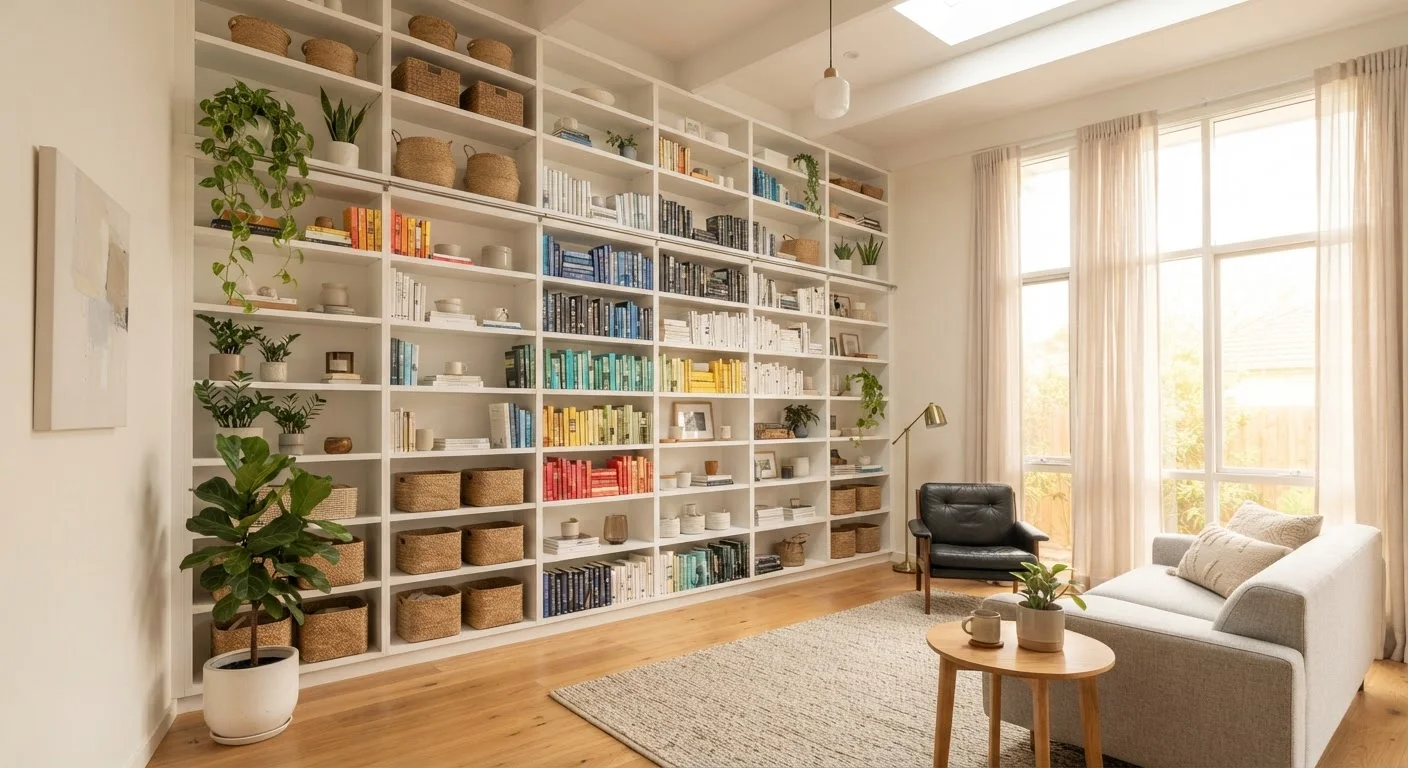
Why Vertical Space Gets Ignored
When most people feel crowded in their home, the instinct is to look for more floor space - a bigger closet, extra furniture, or a storage unit rental. But the ceiling is usually farther away than it seems, and the wall area between your tallest furniture and the ceiling is often completely empty.
This happens for a few reasons. Furniture is designed and marketed at human eye level, so that's where attention lands. Standard bookcases and cabinets typically stop at 6 to 7 feet, leaving 1 to 2 feet of usable wall height idle in most rooms. Doorways, the backs of cabinet doors, and the space above appliances are similarly invisible in everyday life.
The result is that many households have meaningful storage capacity they've never used - no renovation required. If you're starting from scratch with a compact home, our practical guide to small-space organization covers the foundational mindset before you add any new systems.
Renters: Check Before You Mount
Lease agreements vary widely in what wall modifications are permitted. Before drilling anything, review your lease or ask your landlord in writing. Many vertical storage needs - tall shelving units, over-door organizers, tension-rod systems - work well without any wall penetration at all.
What Counts as Vertical Space
Vertical storage opportunities exist in four main forms:
- Wall surface above furniture: The wall area above desks, sofas, dressers, and beds. This is the most common missed opportunity - easily accessible and often well-lit.
- Full-height wall runs: Stretches of bare wall that could accommodate floor-to-ceiling shelving or a modular system extending from baseboard to ceiling.
- Door surfaces: Both the back of closet doors and the backs of pantry, bathroom, and bedroom doors can hold hooks, shallow pockets, or over-door racks for flat or lightweight items.
- Above-cabinet space: Kitchen cabinets that don't reach the ceiling leave a gap often used only for dust. Closed baskets or bins here can store infrequently used kitchen items without visual clutter.
Garages are a particularly underutilized vertical environment - walls, ceiling joists, and the space above parked vehicles all hold potential. For a thorough breakdown, see our guide to reclaiming garage space.
Practical Ways to Start Using Vertical Space
The right approach depends on your home, your budget, and whether you own or rent. Here are the most accessible starting points:
Wall-Mounted Shelving
Individual floating shelves or bracket-mounted shelf boards are among the most flexible options. They can be installed at any height, in any width, and adjusted over time. The critical step is anchoring them correctly - shelves holding books, pantry goods, or tools must be fastened into wall studs, not just drywall. For closets specifically, modular shelving versus pre-built closet systems each have distinct trade-offs worth understanding before you invest.
Freestanding Tall Units
Ladder shelves, tall bookcases, and etagere-style shelving require no drilling and move with you. The trade-off is floor footprint - a tall unit still needs a base. For renters or anyone cautious about wall anchoring, these are the most practical starting point.
Over-Door and Hook Systems
Over-door organizers slide over the door frame and need no hardware. Hook rails mounted on walls or inside cabinets handle bags, tools, cleaning supplies, and more. These are low cost and reversible.
Label Everything at Height
Bins and boxes stored above eye level are easy to forget. Use large, clear labels on the front face of every container stored at shoulder height or above. If you use opaque bins, add a label on the front edge as well as the top - you'll see the top label when pulling items down from a shelf.
Ceiling-Level Storage
In garages or utility rooms with exposed joists, ceiling-mounted platforms or pulley systems can hold large, lightweight items like kayaks, bikes, or seasonal bins. This work typically requires proper load calculations and, in some cases, a permit - consult a licensed contractor before adding ceiling-mounted storage in finished spaces or where structural loads are uncertain.
Matching Storage Height to Access Frequency
A simple rule makes vertical storage livable rather than frustrating: store items in proportion to how often you reach for them.
- Daily use belongs at or near eye level and within comfortable reach - no stretching or step stools.
- Weekly use can go slightly above or below eye level, still accessible without tools.
- Monthly use - seasonal linens, occasional-use kitchen appliances, craft supplies - works well on higher shelves with a step stool nearby.
- Annual or archival items (holiday decorations, tax records, keepsakes) are good candidates for the highest shelves or above-cabinet bins.
This logic pairs naturally with seasonal rotation. Moving items in and out of high storage based on the time of year keeps daily life functional. Our article on seasonal rotation strategies covers this approach in more depth.
If your household has multiple occupants with different organizational habits, vertical zoning can also help assign storage areas clearly. That dynamic is explored in organizing shared spaces with different standards.
8-10 ft
Typical US interior ceiling height
Standard US residential construction uses 8- to 9-foot ceilings in older homes and 9- to 10-foot ceilings in newer builds, meaning most rooms have 2-4 feet of wall above standard furniture height.
~30%
Estimated unused wall height in average rooms
Home organization practitioners commonly observe that the upper third of most walls goes entirely unused for storage in the average American home.
$20-$80
Approximate cost of basic wall-shelf installation
A pair of bracket-mounted shelves with hardware typically costs between $20 and $80 in materials, depending on shelf depth, length, and bracket style - making this one of the more affordable storage improvements available.
Keeping It Manageable and Safe
Vertical storage works best when it's maintained - a wall of overstuffed shelves becomes harder to use than no shelves at all. A few practices help:
- Use uniform containers at height so bins stack cleanly and are easy to label.
- Anchor all tall freestanding furniture to the wall - this is a standard safety recommendation regardless of children in the home.
- Reassess high storage at least once a year; items migrate upward and get forgotten.
- Never stack heavy items on shelves that aren't rated for the load.
If you're thinking about storage more broadly across different room sizes and home types, storage strategies that scale offers approaches matched to your actual footprint. And for homeowners weighing whether paring down belongings is a better answer than adding storage, the honest trade-offs of minimalist organization offers a grounded perspective on both paths.