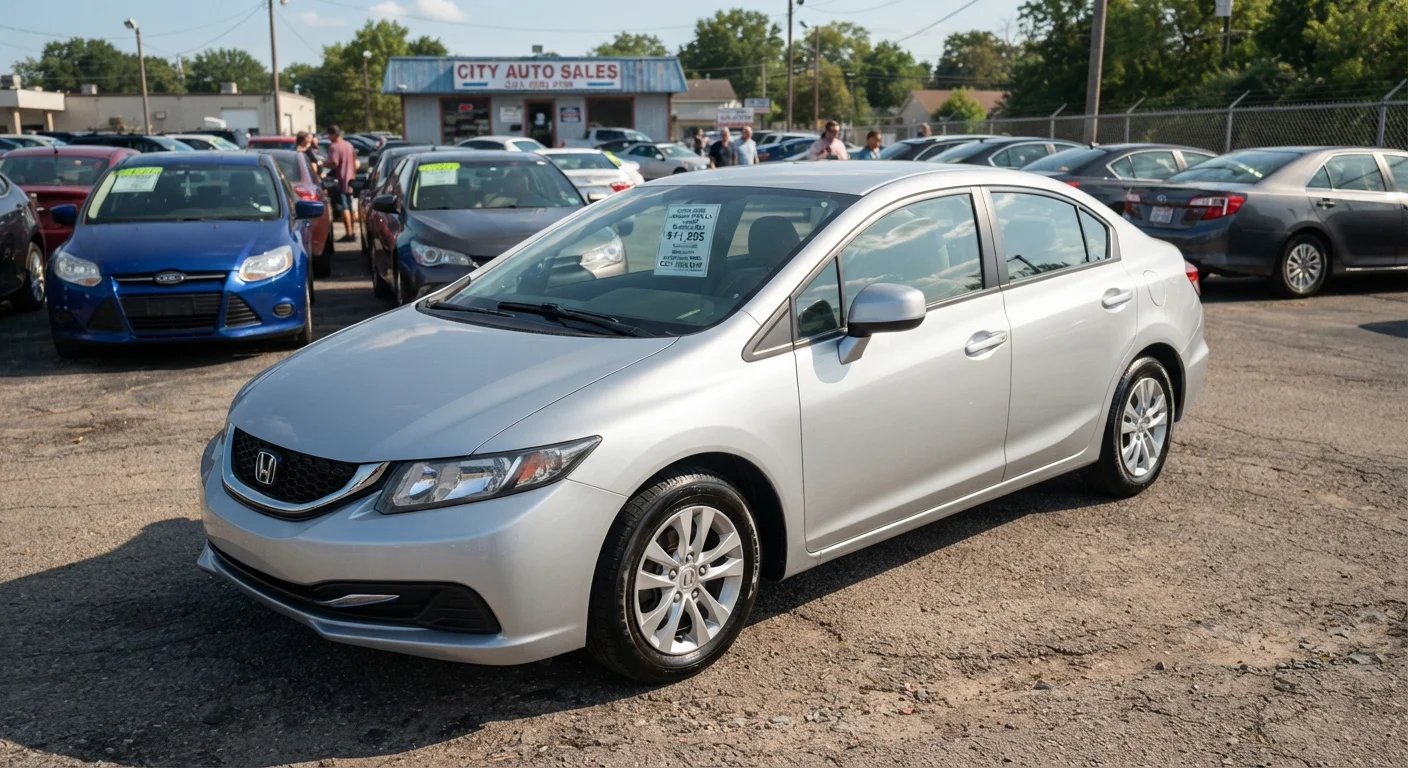
The Core Financial Case: Paying Less for More Car
The most straightforward reason buyers turn to the used market is purchasing power. A two- or three-year-old vehicle that originally carried a $45,000 sticker price may sell for $30,000–$35,000, depending on mileage, condition, and market demand. That gap isn't incidental — it reflects the steepest portion of a vehicle's depreciation curve, which new-car buyers absorb and used-car buyers avoid.
How depreciation works explains that new vehicles can shed a significant portion of their value in the first few years — a financial loss that falls entirely on the original owner. When you buy used, you step into the vehicle after that drop, meaning your own resale loss will likely be smaller in percentage terms.
This matters for monthly budgeting too. A lower purchase price, even at a slightly higher interest rate, often translates to a more manageable payment. For buyers working within a fixed monthly ceiling, used inventory can unlock a higher trim level or a vehicle class that would otherwise be out of reach new.
Lower purchase price for equivalent vehicle
Used vehicles in the same segment typically sell for considerably less than their new counterparts, freeing up budget for higher trim levels or reduced loan size.
Depreciation curve already absorbed by prior owner
The sharpest value drop in a vehicle's life occurs in its first two to three years. Buying used means that loss has already been realized by someone else.
Wider selection of models, trims, and configurations
The used market encompasses every model year simultaneously, giving buyers access to discontinued trims, specific feature combinations, and a broader price range than new inventory allows.
Lower registration and sales tax costs in many states
Because most state registration fees and sales tax are calculated on purchase price, a lower-priced used vehicle typically results in lower upfront transaction costs.
Generally lower comprehensive insurance premiums
Insurers base collision and comprehensive coverage partly on vehicle replacement value, so a lower-valued used vehicle often carries a smaller premium for those coverage types.
Access to proven, long-term reliability data
Older model years have years of owner feedback and repair records available, making it easier to evaluate a specific vehicle's real-world reliability before purchase.
Selection Advantages the New Market Can't Match
New car inventory is limited to what manufacturers are currently producing and dealers have in stock. The used market, by contrast, spans every model year, every trim configuration, and every price tier simultaneously. A buyer seeking a specific combination — say, a mid-size SUV with a third row, a V6, and under 40,000 miles — has far more candidates to evaluate used than new.
That breadth extends to discontinued models that may have strong reliability records, vehicles with dealer-installed or aftermarket features already included in the price, and trims that were phased out in newer generations. For buyers with specific requirements, the used market often surfaces options that the new-car market simply cannot offer.
~20%
Average new vehicle value lost in year one
Industry data from sources including Edmunds and CarGurus consistently indicate new vehicles lose roughly 15–25% of their value within the first twelve months of ownership.
1–3%
Typical APR premium on used vs. new auto loans
Federal Reserve consumer credit data shows used vehicle loan rates have historically run one to three percentage points higher than new vehicle rates from the same lenders.
3x+
More model-year options available used vs. new
At any given time, a buyer shopping used has access to multiple model years of a given nameplate, while new inventory is limited to the current model year in production.
For a structured approach to comparing these options side by side, the complete new vs. used decision framework walks through all the relevant financial and practical factors.
The Risks That Deserve Equal Attention
The used car advantages above are real — but so are the risks. The central challenge with any used vehicle is incomplete information. You're evaluating a machine that has an ownership history you may only partially know, and mechanical wear that isn't always visible during a standard test drive.
Incomplete or uncertain vehicle history
Even with a history report, unreported accidents, deferred maintenance, and undisclosed mechanical wear can be difficult to detect before purchase.
Higher interest rates on used auto loans
Lenders treat used vehicles as higher-risk collateral and typically charge higher APRs than on new-car loans, increasing total financing cost over the loan term.
Limited or no remaining manufacturer warranty
Many used vehicles are sold with expired factory coverage, leaving the buyer fully responsible for repair costs unless they purchase an aftermarket service contract.
Older safety technology and driver-assist features
Vehicles from several model years ago may lack modern active safety systems — such as automatic emergency braking or blind-spot monitoring — now standard on new models.
Potentially higher near-term maintenance costs
Wear items like tires, brakes, and belts may be due for replacement soon after purchase, adding costs that should be factored into the effective purchase price.
Used-market pricing can spike during supply disruptions
During periods of constrained new-vehicle supply, used-car prices can rise sharply, narrowing or eliminating the typical price advantage over new vehicles.
Financing is another factor worth modeling carefully. Lenders typically charge higher interest rates on used vehicles than on new ones, reflecting the greater collateral uncertainty. Over a five-year loan, a two- or three-percentage-point rate difference can add thousands of dollars to total interest paid — partially offsetting the purchase price advantage. See how auto loan rates work for more on structuring a loan that minimizes your total outlay.
Insurance costs also deserve a closer look. While used vehicles are generally cheaper to insure due to lower replacement value, the actual premium depends on the specific vehicle, your driving record, and coverage selections. What drives the insurance gap between new and used breaks down those variables in detail.
Not every used-car scenario delivers genuine savings. Situations where buying used rarely makes financial sense covers the specific circumstances — high mileage, poor reliability records, inflated used-market pricing — where the calculus can shift against the buyer.
Certified Pre-Owned Is a Middle Ground
If uncertainty about vehicle condition is your primary hesitation, certified pre-owned (CPO) programs offer a compromise: manufacturer-backed inspections, extended limited warranties, and in some cases roadside assistance. CPO vehicles cost more than standard used inventory, so the financial advantage narrows. Whether that tradeoff makes sense depends on the specific vehicle, the program's terms, and your own risk tolerance. The CPO vs. standard used comparison covers what these programs actually include — and where they fall short.
How to Reduce the Risk Without Eliminating the Savings
The gap between a risky used-car purchase and a smart one usually comes down to process. Three steps consistently separate informed buyers from those who inherit problems:
- Pull the vehicle history report. Services like Carfax or AutoCheck provide accident records, title status, odometer readings, and service history. These reports don't catch everything, but they flag the most significant red flags.
- Get an independent pre-purchase inspection. A mechanic who has no financial stake in the sale can assess the vehicle's mechanical and structural condition in ways a test drive cannot. This typically costs $100–$200 and can surface issues that justify renegotiating the price — or walking away entirely.
- Understand your warranty position. Some used vehicles still carry a portion of the original manufacturer warranty. Others qualify for certified pre-owned programs, which add inspection standards and extended coverage at a cost. Know what protection you have before you sign.
For buyers concerned about reliability stereotypes, common used-car reliability myths addresses the assumptions that lead buyers to overpay for new vehicles they may not need. And for a full picture of how ownership costs compare beyond the sticker price, the real total cost of owning new vs. used is worth reviewing before finalizing any decision.